

BY Serge LOUNGOU
Teodoro Obiang Nguema Mbasogo of Equatorial Guinea is 82 and has been in power for 45 years. Denis Sassou Nguesso of Congo, 79, has held on to power for 40 years. Cameroon’s Paul Biya is 91 and has been president for 42 years.
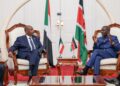
Their extended tenures are largely due to a lack of constitutional limits on presidential age and terms in their countries. These three cases of political endurance aren’t unprecedented in Africa: Félix Houphouët-Boigny led Côte d’Ivoire for 33 years, Gnassingbé Eyadema remained at the helm in Togo for 40 years and Omar Bongo Ondimba reigned over Gabon for 42 years.
As such leaders approach an end-of-reign phase, intense succession rivalries tend to play out. These rivalries are fuelled by deep-seated conflicts within presidential families, and can lead to prolonged social and political instability.
I have researched the geopolitical issues in central Africa and explored political transition prospects in Equatorial Guinea, Congo and Cameroon. In a recent article, I analysed the risks of destabilisation posed by succession conflicts in these three countries – and their potential impact on neighbouring regions.
The potential for political transition in Equatorial Guinea, Congo and Cameroon is notable given the “twilight” phase of their long-serving leaders. This transition was also seen in the last years of power of the long-serving Ivorian, Togolese and Gabonese presidents.
The signs of a twilight phase include:
- Frequent and increasingly extended health-related absences of the heads of state
- Growing discord and dissonance within decision-making circles of the ruling camps
- Intensified power struggles within the president’s political and family networks
- RIsing ambitions within the presidential camp to attain the highest office
- A noticeable detachment from the public’s basic concerns.
How things might pan out
Equatorial Guinea’s and Congo’s regimes favour dynastic power transitions. In contrast, hereditary succession is unlikely to play out in Cameroon, but party power struggles could complicate the political transition.
Presidential clans come with complexity. They have intricate alliances and networks centred on the leader. As the leader’s authority wanes due to age or illness, unity within these clans fractures. This is driven by:
- Power struggles among the leader’s children from different mothers
- Disputes over economic monopolies and resources
- Growing conspiracies within the inner circle
- The disgrace and repression of perceived “traitors” and their allies.
These factors could contribute to unstable succession prospects in Equatorial Guinea and the Congo.
Teodoro Obiang Nguema Mbasogo succeeded his uncle Francisco Macias Nguema Biyogo, the first president of Equatorial Guinea, following a coup d’état in 1979. With the exception of Pascal Lissouba (1992-1997), who was a native of the south of the country, presidential power in the Congo has been in the hands of the northerners since a 1968 coup d’état. The significant political influence wielded by Mbasogo’s many children fuels the potential of an upcoming hereditary succession.
The push for family succession aims to protect the presidential clan’s interests in the state and military apparatus after the leader’s death. This is driven by the memory of disinheritance faced by past ruling families (such as Central African Republic’s Jean Bedel Bokassa, Democratic Republic of Congo’s Mobutu Sese Seko, Angola’s José Eduardo Dos Santos and Gabon’s Omar Bongo). There are also often fears of political and judicial repercussions.
In Cameroon, the president has excluded his family from political roles. Instead, Biya has maintained tight control and eliminated internal rivalries. Despite this, his political record offers no assurance of a smooth transition.
The impending departure of the current leaders in all three countries – Equatorial Guinea, the Congo and Cameroon – could jeopardise their stability. This could spill over into the region.
Rivalry in Equatorial Guinea
Mbasogo’s successor will likely be a member of his clan. The question is who. Will it be Teodorin Nguema Obiang, the eldest son, better known for his spending sprees than his statesmanship? His rise to strategic positions (vice-president of the republic) and the overt support of his mother, the first lady, seem to signal his potential ascent to head of state.
There’s also Gabriel Mbaga Obiang Lima, the youngest son, with a mother from São Tomé and Príncipe. He has held several ministerial dockets, and currently oversees mines and oil. Lima’s perceived “seriousness” has made him a favourite among ifluential Chinese and western investors in the country.
Conflict over inheritance in Congo
In Congo, succession is complicated by family conflicts. President Nguesso’s son, Denis Christel Sassou Nguesso, is rumoured to be seeking the presidency. His mother is from the neighbouring Democratic Republic of the Congo. But Denis faces opposition from his cousins: Jean-Dominique Okemba, head of the intelligence service, and Edgard Nguesso, a senior military officer and director of presidential assets.
Congo’s turbulent political history heightens concerns about the upcoming transition. A north-south ethno-political divide has fostered deep-seated resentment among local communities, particularly between their elites. Political dissent is now prevalent, especially in the north, which has traditionally been the regime’s stronghold.
After he regained power through military means in 1997, the president refocused on his ethnic group, the Mbochis. This shift has alienated other ethnic groups from Nguesso’s home region. They include the Kouyou, Makoua and Téké who have increasingly voiced their grievances. These northern elites are feeling marginalised and are, therefore, likely to oppose any perceived attempts at dynastic succession.
In the south, the civil war (1997-2001) deepened the long-standing mistrust of the “northern regime” among the Kongo-Lari ethnic group. The prospect of dynastic succession is likely to stir up old grievances.
The reactivation of dissent in the southern region after Nguesso’s contentious re-election in 2016 highlights the lingering threat of civil war in the country. Although the suppression of political and military forces from contested regions reduces the likelihood of opposition, the dynastic handover plan could still provoke significant unrest.
There are still residual armed factions in the south. This supports the possibility of a resurgence of resistance in areas opposed to the regime.
Cameroon’s inter-community tensions
With Biya excluding his family from political roles, the possibility of dynastic succession is unlikely. However, with Cameroon due to hold presidential elections in 2025, two major challenges to a smooth transition stand out:
- the lack of an official successor within the ruling party
- uncertainty about the process of selecting a party candidate for the presidential election.
This could lead to numerous claimants for the position, potentially igniting internal conflicts within the party. These power struggles could deepen existing identity-based divisions.
The rivalry between the Bulu-Béti (south) and Bamiléké (west) communities epitomises the inter-community tensions threatening the country’s stability. This rivalry is driven by a quest for dominance among political and intellectual elites.
Traditionally focused on economic activities, the Bamiléké are now increasingly showing national political ambitions. This has raised concerns among the Bulu-Béti elite.
The contested 2018 presidential election results and the ethnic slurs that followed highlight ongoing tensions in the country. These dynamics are likely to shape the political landscape leading up to the 2025 elections.
Serge Loungou is a lecturer at Université Omar Bongo (UOB)