
A US lawmaker has proposed a deal to exchange American agricultural and mining technology for Sudanese natural resources..
Republican Congressman Jim Baird has proposed the Sudan Investing in Minerals, Partnership, Agriculture, Commerce and Trade (IMPACT) Bill, which places the country’s gold, uranium and oil at the centre of a deal.


The partnership is further tied to civilian protection, as Washington expands its pursuit of strategic minerals across Africa.
The proposal comes as Sudan enters a fourth year of war between the Sudanese Armed Forces and the paramilitary Rapid Support Forces.
The United Nations has warned that the exploitation and trafficking of natural resources are helping sustain the conflict.
The Bill introduced on October 13 proposes to establish a framework for the US to provide agricultural and mining equipment, technology and expertise in exchange for access to resources mined or produced in Sudan.
The legislation has been referred to the House Committee on Foreign Affairs.
The bill lists 11 commodities, including gold, uranium, crude oil, copper, nickel, iron, silver and gum arabic, a key agricultural export.
However, the proposed partnership cannot be established until US Secretary of State Marco Rubio determines that a legitimate, civilian-led governing authority in Sudan is established. It also adds that authority must have demonstrated measurable improvements in civilian protection, political stability and responsible management of the resources covered by the arrangement.
GOLD AT THE CENTRE OF SUDAN’S WAR ECONOMY
The proposal comes against a backdrop of mounting evidence that Sudan’s mineral wealth has become intertwined with the financing of the war.
A United Nations Security Council Panel of Experts report published in January 2024 found that gold continued to generate revenue for the warring parties despite a decline in production following the outbreak of fighting in April 2023.
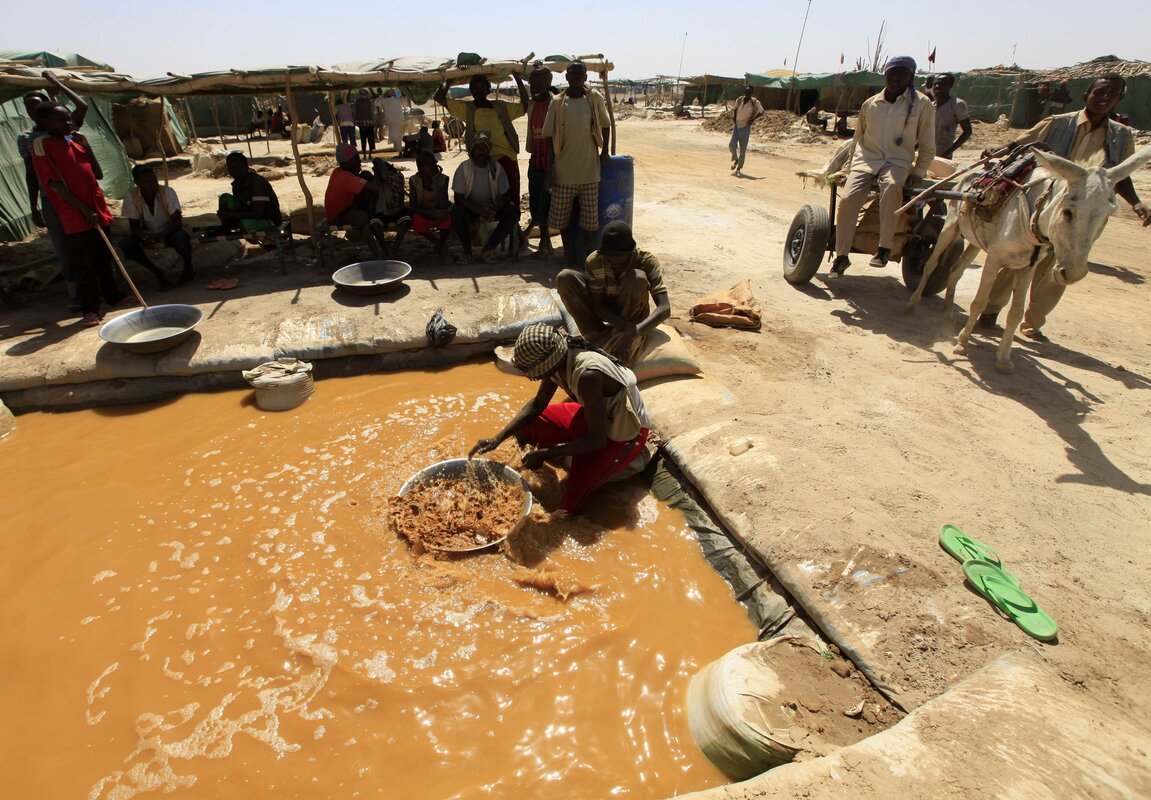
The report documented the expansion of gold-smuggling networks amid weak oversight of the industry, noting that more than half of Sudan’s gold was reportedly being smuggled out of the country rather than traded through formal channels.
Artisanal mining, which accounted for about 30 per cent of production according to the report, operated in areas controlled by different armed actors, including the RSF and local militias.
A March 2025 analysis by Chatham House further traced the links between gold, regional trading networks and Sudan’s conflict, noting that competition over natural resources predated the war and was among the factors driving tensions between the military and the RSF.
The United Arab Emirates has been a major destination for Sudanese gold, with shipments also moving through neighbouring countries. Such cross-border trade has made it difficult to establish the origin of gold and determine who ultimately benefits from its sale.
The implications extend beyond gold. In a report released in July 2026, the UN Human Rights Office warned that Sudan’s wider war economy was becoming increasingly self-perpetuating as the warring parties exploited territory, trade routes and commodities to finance military operations.
The report examined gum arabic, which is used in soft drinks, cosmetics and pharmaceuticals, as a case study of how commercial supply chains can become entangled in conflict. It documented looting, extortion and the disruption of livelihoods, warning that commodities from conflict-affected areas could enter international markets through neighbouring countries and be traded with their origins obscured.
The findings raise questions about how a future US-Sudan minerals partnership would guarantee traceability, prevent illicit trade and ensure commercial benefits reach civilians rather than armed groups.
WASHINGTON LINKS MINERALS TO REGIONAL SECURITY
The Sudan proposal echoes Washington’s efforts to connect mineral supply chains with peace and economic cooperation elsewhere in Africa.
In December 2025, the Democratic Republic of Congo and Rwanda signed the US-brokered Washington Accords for Peace and Prosperity, which include a regional economic integration framework intended to expand trade and investment and strengthen transparency in critical-mineral supply chains.
The agreement came amid longstanding allegations that illicit mineral trading has helped finance armed groups in eastern Congo, where fighting has persisted despite repeated diplomatic initiatives.
In June 2026, the US Treasury imposed sanctions on a Rwandan gold refinery and a network it accused of facilitating the trafficking of gold from areas controlled by the Rwanda-backed M23 armed group in eastern Congo.
The Treasury said the illicit trade had enabled armed actors to generate revenue for weapons, equipment and fighters, undermining peace efforts and contributing to abuses against civilians.
KENYA’S MRIMA HILL IN THE WIDER STRATEGY
Kenya is also emerging as a potential partner in Washington’s drive to diversify access to strategic minerals.
In September, US officials said Washington would help Kenya develop its critical-minerals processing industry, with attention on the Mrima Hill deposit on the Coast, believed to contain substantial rare-earth minerals and niobium reserves.
Kenya is considering investors for the project, with US companies among those shortlisted to compete for development rights. President William Ruto has advocated local processing and value addition to create jobs and expand domestic industrial capacity.
Reuters reported in September that Ruto had previously said Kenya and the US were close to concluding a critical-minerals deal, although neither side provided an update on the agreement at the time.
The US interest reflects wider competition with China, which dominates important parts of the global rare-earth processing chain. Washington has identified dependence on foreign supplies of processed critical minerals as a national security vulnerability, with applications ranging from electronics and vehicles to defence equipment and energy infrastructure.
A January 2026 proclamation by President Donald Trump called for negotiations to address US dependence on imported processed critical minerals and their derivative products.
The Sudan IMPACT bill, the Washington Accords and US engagement with Kenya point to a growing emphasis on commercial partnerships, mineral security and supply-chain resilience in American policy towards Africa.
But the proposed Sudan arrangement presents a particularly difficult test. Unlike Kenya’s prospective mining investment or the DRC-Rwanda regional framework, it is explicitly conditioned on improvements in civilian protection and political stability in a country still at war.
Whether such a model can deliver economic opportunities without reinforcing the resource networks that sustain conflict will depend on how governance, transparency and accountability are built into any eventual agreement.