

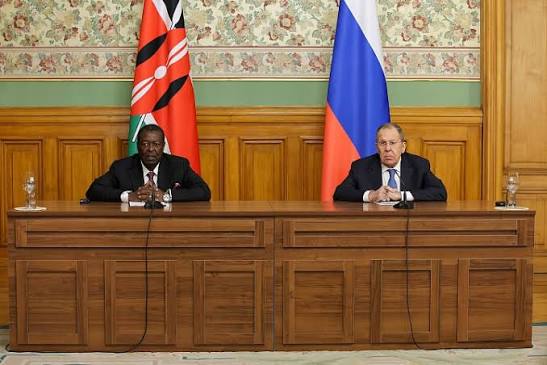
Prime Cabinet Secretary Musalia Mudavadi is heading back to Moscow for a summit on Russia-Africa relations, but the fate of Kenyans recruited to fight in the Russia-Ukraine war remains an unresolved diplomatic challenge.
A press release issued by the Office of the Prime Cabinet Secretary on Monday announcing Mudavadi’s departure lists trade, investment, agriculture, energy, manufacturing and technology among Kenya’s priorities at the October 28-30 summit.


According to the press release, Kenya will on the sidelines of the Russia-Africa Summit pursue trade and investment interests, including greater access for Kenyan tea, coffee and horticultural products to the Russian market.
It also confirms plans for bilateral talks with Russian Foreign Minister Sergey Lavrov to discuss relations between the two states and opportunities for deeper economic and political cooperation.
However, the statement makes no mention of negotiations or talks over Kenyans recruited into Russia’s military, including those reported killed, missing in action, hospitalised or captured by Ukrainian forces.
The omission comes barely seven months after Mudavadi’s previous visit to Moscow, where Kenya announced an agreement to stop further enlistment of its nationals through Russia’s Defence Ministry.
While that agreement was presented as a diplomatic breakthrough, the situation of Kenyans already caught up in the war remains unresolved, leaving families searching for answers about their relatives.
According to figures Mudavadi presented to Parliament on October 8, the government had documented 354 Kenyans connected to the conflict, including 84 classified as killed or missing in action.
A further 77 were reported to be on the front lines, 38 in military camps and 52 in unknown or unclassified locations. Another 34 had been hospitalised, while 62 had been repatriated.
Five Kenyans were confirmed to be prisoners of war in Ukraine.
The figures underline the scale of the challenge awaiting the government as it engages Russian authorities again.
MARCH AGREEMENT YET TO RESOLVE OUTSTANDING CASES
During his March 16 visit to Moscow, Mudavadi announced that Kenya and Russia had agreed that Kenyans would no longer be enlisted into military operations through Russia’s Defence Ministry.
The agreement followed talks with Lavrov, who maintained that Kenyan nationals had voluntarily signed military contracts.
Mudavadi also said the two countries would facilitate consular assistance for affected Kenyans and address their welfare.
However, stopping new recruitment did not secure the release of those already serving in the Russian military, establish the fate of missing recruits or guarantee the return of those who have died.
In October, Mudavadi told lawmakers that requests to terminate existing military contracts were being considered individually, with decisions resting with commanders of the relevant military units.
Russia’s Defence Ministry had also declined to cover the cost of returning the remains of deceased Kenyans, according to Mudavadi’s account to Parliament, leaving Nairobi to negotiate arrangements with Russian authorities and affected families.
These unresolved issues place the coming engagement under scrutiny, particularly over whether Kenya can obtain concrete commitments beyond the agreement to stop further enlistment.
FAMILIES STILL WAITING FOR ANSWERS
The official figures have also raised questions about the full extent of the recruitment crisis.
During the October parliamentary proceedings, petitioner Peter Kamau presented documents containing a list of approximately 841 Kenyan recruits, a figure substantially higher than the government’s recorded cases.
Mudavadi said the list had not previously been provided to his office and could not immediately be verified. Parliamentary committees directed that the documents be forwarded to the Foreign Affairs Ministry for verification against records held by Kenyan diplomatic missions.
The discrepancy highlights the difficulty of establishing the true number of Kenyans recruited and determining their current whereabouts.
Some are still waiting to establish whether their loved ones are alive, held in captivity or among those reported missing.
Kenya is pursuing the release of five prisoners of war held in Ukraine, including through possible prisoner exchanges. It is also engaging Ukrainian authorities over the welfare of Kenyans detained during the conflict.