

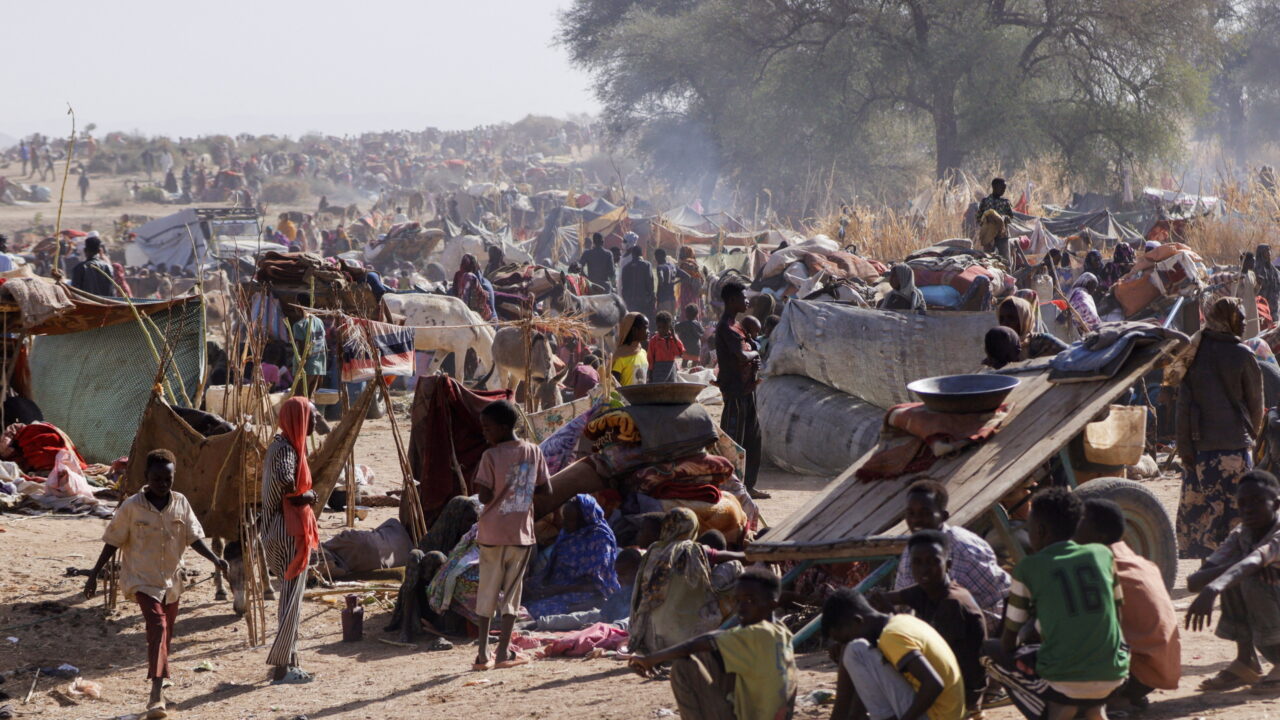
What began as a domestic power struggle between military commanders in Sudan has morphed into a conflict increasingly driven by external interference, with foreign fighters, private recruitment networks and cross-border financing entrenching the war.
Fresh sanctions announced by the US Department of the Treasury on April 17 expose how these external actors are prolonging a crisis with mounting consequences for Eastern Africa.

Treasury’s Office of Foreign Assets Control said the sanctions target a network accused of recruiting and deploying former Colombian soldiers to fight for the paramilitary Rapid Support Forces, one of the two main factions battling for control of Sudan.
Another statement by the US State Department said the Trump Administration was imposing the sanctions on five individuals and entities responsible for stoking the conflict, which has created the world’s worst humanitarian crisis.
“Since April 2023, over 150,000 people have been killed, more than 14 million displaced, and famine conditions persist in conflict-affected areas. This war further destabilizes an already fragile region, creating opportunities for terrorist groups that threaten US interests and regional security,” the State Department said.
It further called on external actors to cease financial and military support to the warring parties.
“Regional stability depends on ending this conflict. The international community must unite to support the restoration of civilian governance in a peaceful and unified Sudan”.
The sanctions come three years after war erupted between the RSF and the Sudanese Armed Forces (SAF), a conflict that has spiralled into one of the world’s worst humanitarian crises.
But beyond the humanitarian toll, Washington’s move has once again raised concerns over the complexities brought about by external actors injecting manpower, money and logistical support.
FOREIGN FIGHTERS AND OUTSOURCED WARFARE
At the centre of the sanctions is a Colombia-linked recruitment pipeline that has channelled hundreds of former soldiers into Sudan since 2024.
Treasury says that since 2024, hundreds of former Colombian soldiers have travelled to Sudan to support the RSF. They have engaged in combat and technical roles and participated in battles across the country, including el-Fasher. Their involvement has been facilitated by networks of individuals and companies, mostly based in Colombia, Treasury says. These fighters have also engaged in drone operations and sniper deployment, in support of RSF offensives.
“Retired Colombian military officer Alvaro Andres Quijano Becerra (Quijano), who was designated on December 9, 2025, plays a central role in recruiting and deploying former Colombian military personnel to Sudan.
“Quijano and his OFAC-designated wife, Claudia Viviana Oliveros Forero (Oliveros), founded International Services Agency (A4SI), a Colombia-based employment agency, which OFAC also designated, that has recruited drone operators, snipers, and translators”.
US investigators say the network operates through a web of recruitment agencies and intermediaries designed to obscure financial flows and contractual links, with entities spanning Colombia and Panama.
Those being sanctioned are Fénix Human Resources S.A.S. (Fénix), a Bogota, Colombia-based employment agency opened by Quijano and Jose Oscar Garcia Batte (Jose Garcia Batte) is a Colombian national, former Colombian Army Colonel, and the owner of Bogota, Colombia-based recruiting company, Global Qowa Al-Basheria S.A.S. (GQAB), also known as Mi Futuro Global.
GQAB’s manager and legal representative Omar Fernando Garcia Batte (Omar Garcia Batte), a Colombian national, has also been sanctioned.
The outcome of their involvement is a complex web of to transnational networks and private actors motivated by profit or political alignment helping sustain battlefield operations, and frustrating efforts to end the war.
Indeed, a 2025 UN Fact-Finding Mission report found that external support and the flow of weapons are intensifying the civil war in Sudan, violating an arms embargo and worsening the humanitarian crisis.
The report highlighted how foreign influence and weapon supplies allow both SAF and the RSF to prolong the conflict.
RSF, led by Mohammad Hamdan Dagalo — who was sanctioned on January 7, 2025 — is reportedly using foreign fighters and resources, particularly from UAE, for tactical reinforcement, strategic depth and international engagement for legitimacy, allowing it to maintain pressure even as it faces mounting international scrutiny.
The Department of State has already determined that RSF elements committed genocide, war crimes and ethnic cleansing particular in el-Fasher massacre. .
EXTERNAL INTERFERENCE COMPLICATES DIPLOMACY
The growing role of external fighters and private recruitment networks has the consequence of undermining the multiple mediation efforts that have been initiated. These include the Jeddah Process, IGAD Quartet, and Egypt’s Initiative. And they have failed despite being led by numerous international and regional actors including the US, Saudi Arabia, the African Union and IGAD.
It is against this background that Washington has called on all external actors stoking the fighting to cease financial and military support to RSF and SAF, acknowledging that foreign involvement is now a central driver of the conflict’s longevity.
Treasury Secretary Scott Bessent renewed calls for an immediate three-month humanitarian truce to allow aid delivery and create space for negotiations.
““It is unacceptable that the leaders of the Sudanese Armed Forces and the Rapid Support Forces have not committed to a humanitarian truce to address the devastating famine created by the civil war in Sudan. They must act to end this humanitarian crisis immediately,” Secretary Bessent said.
RISING STAKES FOR EAST AFRICA
Sudan’s instability is already spilling across borders, with neighbouring countries including South Sudan, Ethiopia and Chad grappling with refugee flows, arms trafficking and economic disruption.
Kenya’s efforts to mediate have been rejected by SAF over concerns that Nairobi is harbouring RSF commanders and being used to facilitate arms imports and export of gold on behalf of the rebels.
The conflict is thus evolving from a political dispute into a multi-layered security crisis, where enforcement of any ceasefire becomes far more difficult.There are also broader concerns that prolonged instability could create openings for extremist groups to expand across the region, further compounding security risks.
SANCTIONS AS PRESSURE
While the debate on the effectiveness of sanctions has been raging, the latest US designations are widely seen as yet another attempt to disrupt the networks facilitating foreign fighter recruitment by freezing assets and restricting financial transactions.
By targeting individuals and entities involved in these operations, Washington is signalling that external interference will carry increasing costs.
However, sanctions alone are unlikely to deliver much change many of these conflicts in Africa are sustained by informal economies, and transnational actors tend to be resilient, particularly where multiple external interests are at play.
Therefore, as the conflict enters its fourth year, the growing role of external interference suggests a war becoming harder to end. The involvement of foreign fighters and recruitment networks not only intensifies the violence but also fragments accountability, complicating peace efforts.