
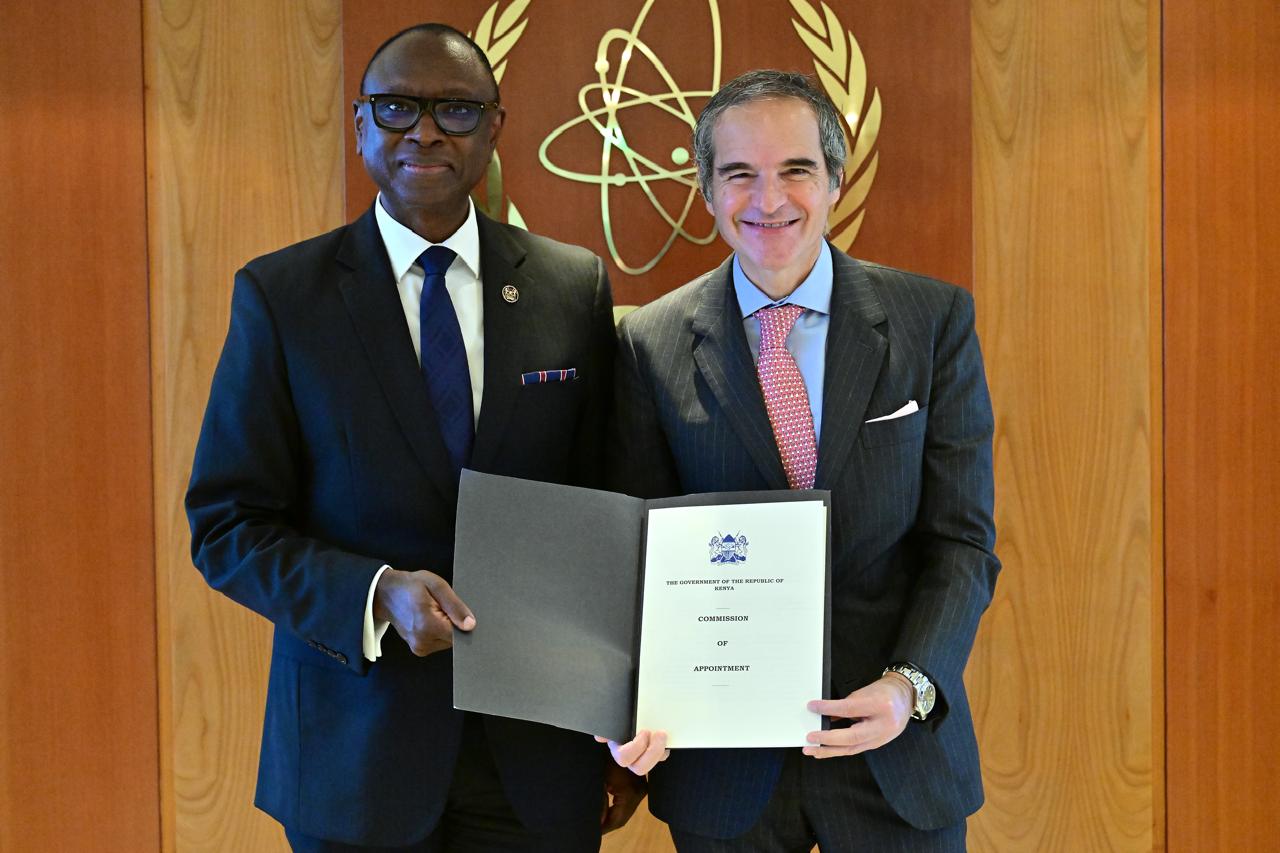
Kenya is deepening its strategic partnership with the International Atomic Energy Agency as it prepares to pursue its first nuclear power plant by 2034.
The expanding relationship comes as IAEA Director-General Rafael Mariano Grossi seeks Nairobi’s support for his candidature for United Nations Secretary-General, adding a diplomatic dimension to Nairobi’s growing engagement with the UN nuclear watchdog.

Grossi has reached out for Nairobi’s support for his UN bid, saying he would champion development issues should he become Secretary-General.
At the same time, Kenya is looking to the IAEA for deeper technical cooperation as it moves from planning towards implementation of an ambitious nuclear energy programme.
Kenya has committed to commissioning its first nuclear power plant by 2034 and is seeking IAEA support for a Phase II Integrated Nuclear Infrastructure Review (INIR) mission in the final quarter of 2026. Nairobi is also seeking assistance to build the human-resource capacity needed to address a shortage of nuclear engineers and scientists.
A high-powered delegation from Kenya is expected to attend the 70th IAEA General Conference from September 14 to 18 in Vienna, Austria.
The IAEA has already played a significant role in helping Kenya establish the institutional foundations for the programme. The country appointed the Nuclear Power and Energy Agency as the programme implementing organisation in 2019, established the Kenya Nuclear Regulatory Authority the same year and designated KenGen as owner-operator of the first nuclear power plant in 2025.
In May, Kenya and the IAEA signed an MoU covering cooperation in energy planning, modelling and monitoring, nuclear infrastructure development and specialised training. The agreement also provides for capacity building in the analysis, planning, implementation, operation and supervision of nuclear technologies, including small modular reactor technologies.
The IAEA ties have already produced tangible benefits in healthcare. Through the Agency’s Rays of Hope initiative, Kenya received two linear accelerators for cancer treatment centres in Nakuru and Mombasa. The machines were commissioned in May 2026, and Kenya is now seeking five additional LINAC machines to expand radiotherapy coverage. Nairobi also wants Kenya designated as an anchor state and regional centre for education, training and innovation in nuclear applications for cancer diagnosis and treatment.
Grossi’s participation in the commissioning of the machines during the Africa-France Partnerships for Innovation and Growth Summit in Nairobi showed the increasingly broad nature of the relationship. Kenya used his presence to showcase the practical benefits of its cooperation with the Agency.
Agriculture is another emerging pillar in the cooperation.
Kenya wants to deepen cooperation under the IAEA-FAO Atoms for Food initiative, including support for mutation breeding, food irradiation to extend shelf life and assisted reproductive technologies to improve livestock production.
The government is also seeking IAEA support for Kenya to become a pilot country for recycling under the circular economy, while strengthening research into microplastics. It wants the National Isotope Hydrology Laboratory developed into a regional designated centre for cross-border cooperation and knowledge sharing.
Nairobi is thus increasingly moving to position nuclear science as a development tool spanning energy, healthcare, agriculture, water, climate resilience and industrial applications.
Kenya says its cooperation with the IAEA has already supported 18 interregional, 153 regional and 36 national projects, while hundreds of Kenyan specialists have benefited from technical competency programmes, fellowships and scientific visits linked to the nuclear power programme.