
President William Ruto’s ambitions to strengthen Kenya’s position on the global stage could be undermined by growing youth discontent, democratic backsliding and potential election-related violence ahead of next year’s polls, a study on Kenya-Germany relations has warned.
The Kenya’s Global Player Ambitions: A Strategic Opportunity for Germany study published by Konrad-Adenauer- Stiftung argues that Kenya’s international standing will depend partly on its ability to maintain political stability and protect democratic institutions as it seeks a greater role in global affairs.


“Democratic backsliding, political unrest, or even violence in light of the growing frustration of the young generation as Kenya moves to the next general election in August 2027 would put Kenya’s credible and principled international engagement at risk,” the authors warn.
Written by Kenya’s former ambassador to Germany Tom Amolo and head of the Konrad-Adenauer-Stiftung’s Kenya office Mathias Kamp, the paper was published in the foundation’s International Reports journal on September 10, 2026.
The authors note that Kenya has emerged as an important diplomatic and economic partner for Germany at a time of growing geopolitical uncertainty. They, however, caution that the country’s domestic political challenges cannot be ignored in assessing the sustainability of that relationship.
They cite President Ruto’s contested domestic political standing and mounting frustration among the youth as issues that will become increasingly significant as the country approaches 2027 polls.
“Ruto’s domestic political standing has been tested, his past has been contested, and the frustration of Kenya’s young generation is real and growing such that it will matter greatly ahead of the August 2027 general election,” the paper says.
The duo argue that Germany’s engagement with Kenya should extend beyond the priorities of the current administration to consider the resilience of the country’s institutions.
“A serious partnership must account not merely for the preferences of Kenya’s current leadership, but also for the nation’s institutional durability,” they write.
The argument suggests that Kenya’s strategic importance to Germany should be assessed not only through its diplomatic relationships and economic opportunities, but also through the strength of the institutions underpinning its international engagement.
The study, however, maintains that Kenya’s foreign-policy positions have a degree of continuity beyond the current President.
It argues that Kenya’s stance on international affairs reflects an established tradition in its foreign policy rather than presidential preferences alone.
“What is significant, however, is that Kenya’s principled posture on multilateral issues reflects not only presidential preference, but also a durable strand in Kenyan foreign policy thinking – one that successive governments have broadly maintained,” the authors say.
Kenya has sought to position itself as a leading voice for developing countries, particularly on reform of the international financial system, climate finance and the representation of African countries in global institutions.
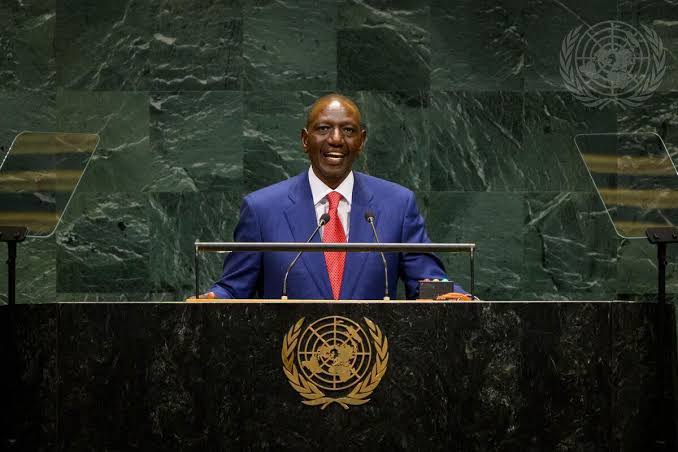
President Ruto has been on the frontline in that push in various global platforms, including UNGA and G7.
However, the President has recently faced criticism over his speech at the 81st United Nations General Assembly, with political and foreign policy analysts accusing him of painting a picture that is at odds with the reality on the ground in Kenya.
But in his rebuttal, Ruto said international appearances are exactly how a leader builds a nation’s global reputation.
Speaking at State House, Nairobi, he also dismissed criticism over his frequent travel and high-level speeches.
“Wengine wananiambia, ati sijui nimeenda kuongea United Nations, sijui nimeenda kuongea African Union: [But] That is how you profile a nation. That is how you raise the profile of a country,” he said.
He added that because of these global platforms, Kenya now “commands greater respect internationally” and is recognized worldwide as a serious nation.
The KAS study identifies these ambitions, alongside Kenya’s regional diplomatic role and economic position, as reasons Germany should deepen its partnership with Nairobi.
However, the authors warn that domestic instability could complicate Kenya’s efforts to present itself as a reliable international partner.
The paper also draws attention to the risk of democratic backsliding in Germany, warning that both countries must address threats to democratic governance at home while strengthening cooperation internationally.
In Germany’s case, the authors cite growing xenophobia and the possibility of governments led by right-wing populists at state or federal level as potential challenges.
They argue that constructive international engagement should also help protect democratic institutions from domestic pressures, economic decline and declining public trust.
The study places these concerns within a wider period of geopolitical uncertainty marked by changing US commitments, tensions among Western allies, reductions in development funding and growing competition among major powers.
It argues that Germany needs to reconsider its approach to Africa and prioritise strategic partnerships with countries capable of contributing to regional stability and international cooperation.
Kenya is identified as a particularly important partner because of its economic influence in East Africa, diplomatic engagement and role in addressing regional security challenges.
The authors propose cooperation in climate finance, renewable energy, skilled labour mobility, private-sector investment and security in the Horn of Africa.
They also argue that Kenya and Germany could work together to advance reform of the UN Security Council and the international financial architecture.