
Kenya and Armenia have moved to operationalise a bilateral agreement on diaspora affairs, establishing a joint committee to coordinate cooperation/.
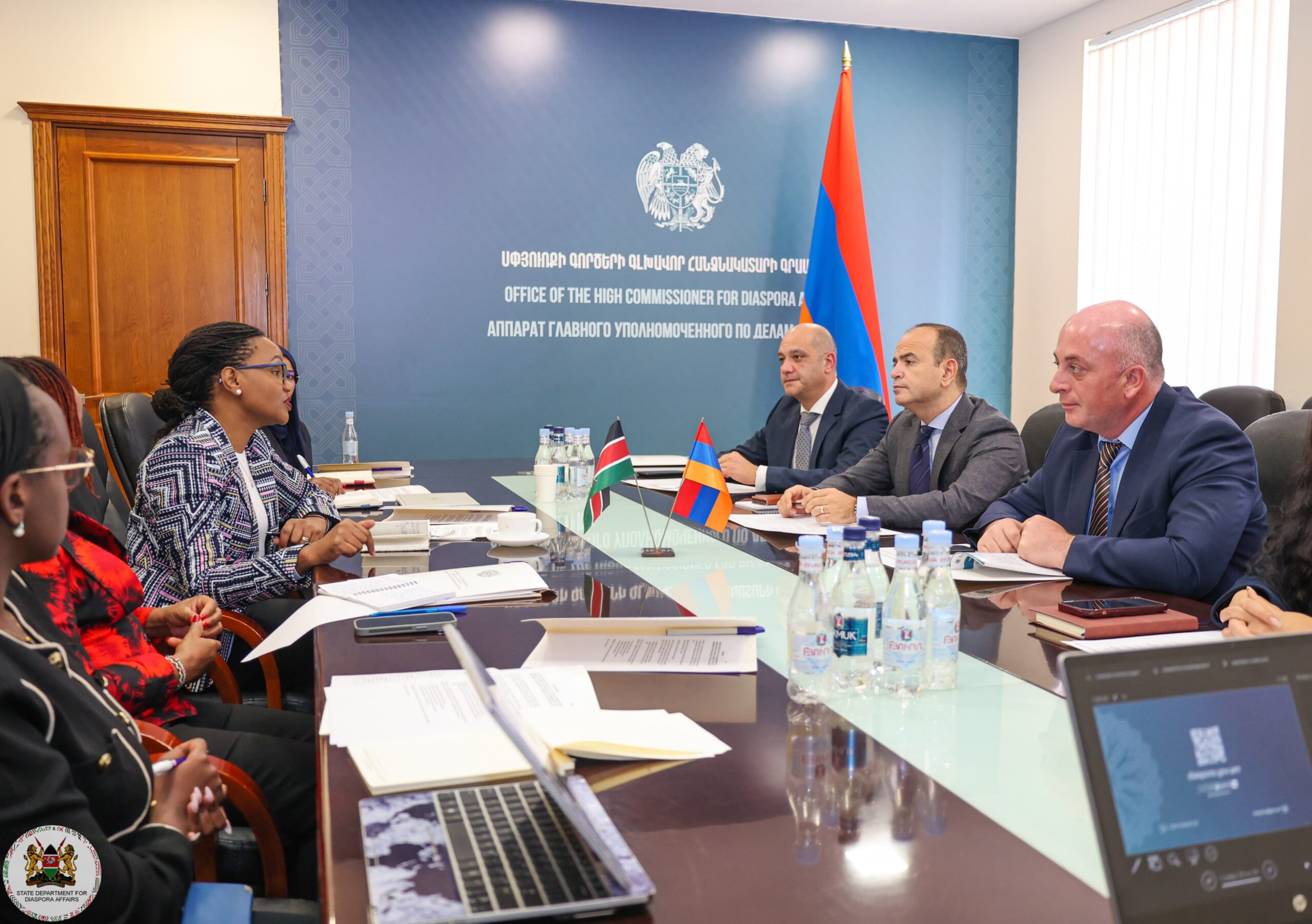
Even though very little is publicly known about the size and profile of the two countries’ communities in each other’s territories, Diaspora Affairs PS Roseline Njogu on Wednesday held talks with Armenia’s High Commissioner for Diaspora Affairs, Zareh Sinanyan, in Yerevan ahead of the Global Armenian Summit 2026.


The meeting was followed by the inaugural session of the Joint Implementation Committee established under an MoU on Cooperation in Diaspora Affairs signed between the two states on June 18, 2026.
Co-chaired by Njogu and Sinanyan, the committee discussed mechanisms for implementing the agreement and identified opportunities for collaboration in diaspora engagement, institutional knowledge exchange, youth initiatives and cultural cooperation.
The two sides also exchanged experiences and explored practical initiatives to strengthen connections between their respective diaspora communities.
However, the engagement raises questions about the actual size of the Kenyan and Armenian populations living in each other’s countries. Neither government has publicly provided a comprehensive breakdown of the communities the agreement is intended to serve.
The available public information does not establish how many Kenyans live in Armenia or how many Armenians reside in Kenya, making it difficult to assess the immediate reach of the partnership.
In Kenya, one of the most prominent historical references to Armenian nationals remains the controversial Artur brothers — Artur Margaryan and Artur Sargsyan — whose activities in the country in 2006 attracted considerable public attention and became the subject of a major security and political controversy.
Their presence, which involved allegations of criminal conduct and questions about their access to powerful individuals, became one of the most notorious cases involving Armenian nationals in Kenya.
The absence of reliable bilateral population figures is significant given the agreement’s emphasis on strengthening diaspora engagement and institutional cooperation.
Diaspora engagement is a major component of Armenia’s national development and foreign relations. The country has an estimated 7.2 million people of Armenian descent living across the world, considerably more than its resident population.
Armenia has historically relied on its global diaspora for investment, skills transfer, cultural preservation, international business networks and support for national development.
Kenya, meanwhile, has increasingly sought to mobilise its citizens abroad as a source of foreign exchange, investment, professional expertise and technology transfer.
The Central Bank of Kenya has identified diaspora remittances as an important source of foreign exchange, while the government has developed policies to encourage Kenyans abroad to participate in national development.
The June agreement provides an opportunity for Nairobi to learn from Armenia’s experience in organising and engaging a globally dispersed population.
The timing of the committee’s first meeting is also significant, coming ahead of the Global Armenian Summit 2026, which brings together representatives of Armenia’s diaspora and other stakeholders to discuss the country’s relationship with its global communities.
Njogu’s participation offers Kenya an opportunity to engage Armenian institutions and diaspora networks while exploring areas where the two countries can share expertise.
The partnership also builds on wider efforts to strengthen bilateral relations. Kenya and Armenia established diplomatic relations in 1993, with recent engagements identifying opportunities for cooperation in mining, energy, ICT, tourism, education, healthcare, manufacturing and innovation.
Llssons for Kenya could include adopting elements of Armenia’s diaspora investment and skills-mobilisation model.