
Western diplomats are increasingly deepening contacts with Kenya’s opposition as the country moves towards what is expected to be a hotly contested 2027 General Election.
Various diplomats, mostly from the West, have intensified engagements with key opposition principals, who have declared their presidential ambitions. These include Wiper leader Kalonzo Musyoka, Senator Edwin Sifuna of Linda Mwananchi, former Interior Cabinet Secretary and Jubilee presidential aspirant Fred Matiang’i and his party leader retired President Uhuru Kenyatta.

While the meetings do not amount to an endorsement of any particular politician, they offer an early indication that foreign missions are mapping the country’s increasingly fluid political landscape before the opposition settles on a presidential candidate.
Kalonzo’s latest engagement provides the clearest illustration.
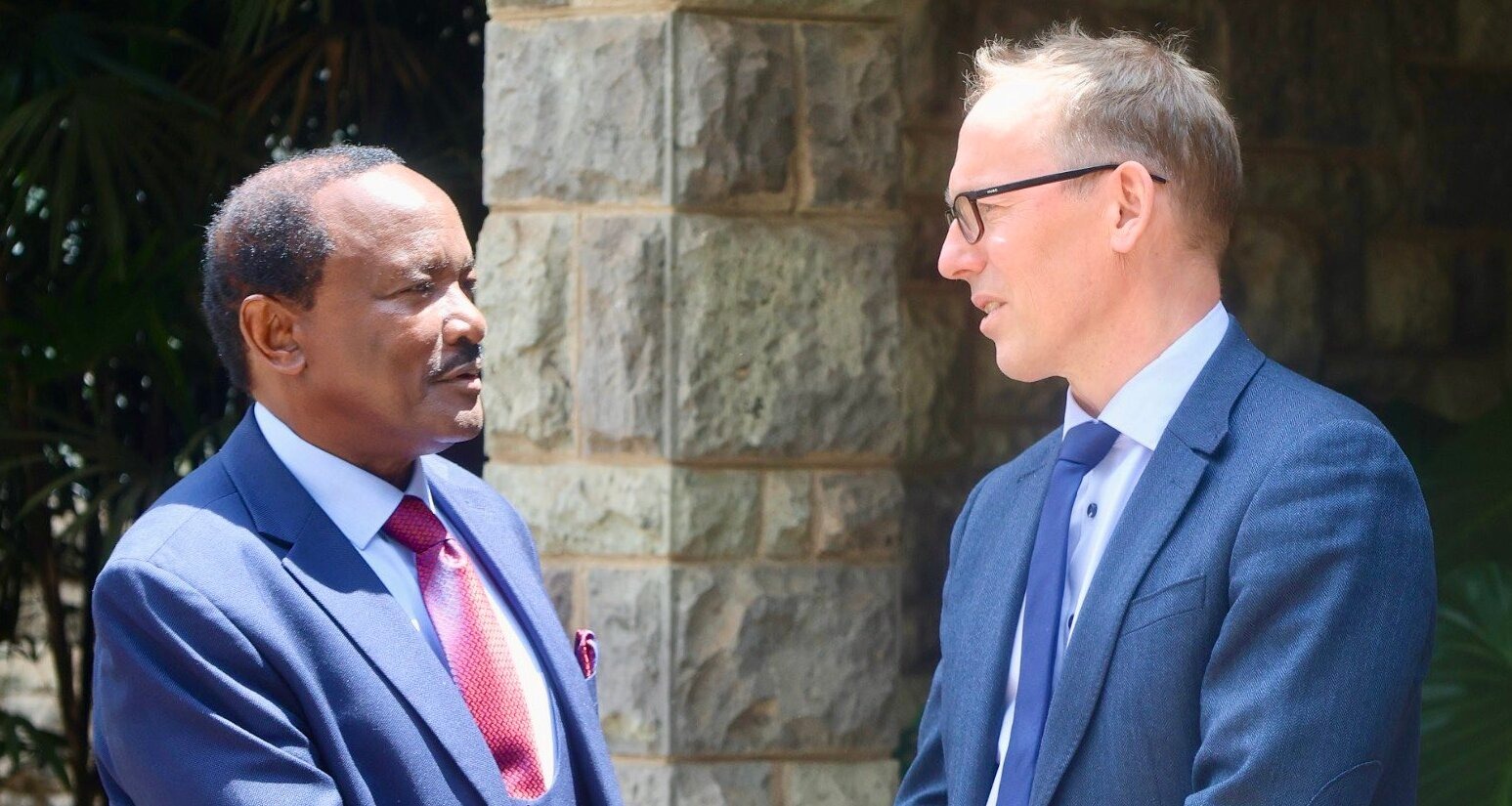
On Wednesday, the Wiper leader met British High Commissioner Matt Baugh at his official residence in Nairobi, where he said they discussed the electoral preparedness and the wider democratic environment.
“We exchanged views on matters of national and international concerns, including the preparedness of the Independent Electoral and Boundaries Commission (IEBC) ahead of 2027 General Elections and the rising tides of political intolerance in our country,” Kalonzo said.
Kalonzo told the envoy that a credible and fully prepared IEBC would be indispensable to the legitimacy of the 2027 election, while dissent should not be criminalised or treated as enmity.
He also reaffirmed his commitment to non-violence and free, fair and credible elections.
“I expressed my gratitude to High Commissioner Baugh for his sustained engagement with Kenya’s democratic process and reaffirmed that Kenya’s international partners like her wananchi, expects a peaceful and credible path towards the forthcoming General Election,” he said.
The meeting followed a similar engagement in August, when Kalonzo hosted the French and German ambassadors, Arnaud Suquet and Sebastian Groth, at his residence.
At the time, Kalonzo said discussions centred on political violence, the rule of law and the independence of the IEBC.
Kalonzo is not alone in attracting diplomatic attention.
On the same day, High CommissionerBaugh hosted Siaya Governor James Orengo who is affiliated to Linda Mwananchi.
Governor Orengo has also declared his presidential ambitions.
“This afternoon, I had cordial and instructive discussions with the British High Commissioner to Kenya, H.E. Matt Baugh OBE,” Orengo said on X.
Sifuna, who has emerged as one of the most prominent figures in the opposition, has also held meetings with several Western representatives.
In August, the Linda Mwananchi movement leader met High Commissioner Baugh, hosted Australian Acting High Commissioner Andrew Barnes and his team, and received Ambassador Suquet during the diplomat’s farewell visit.
Sifuna has also engaged Ambassador Groth publicly acknowledging a meeting with the senator in March and discussion of Kenyan politics.
His engagement with the United States also dates back to March 2025, when then-US Chargé d’Affaires Marc Dillard said he had discussed the US-Kenya partnership and the creative economy with Sifuna.
The breadth of those contacts is significant because Sifuna is among the politicians whose national ambitions have increasingly become part of the debate over who should carry the opposition’s presidential ticket.
Matiang’i has similarly been maintaining diplomatic contacts.
On August 28, the former Interior CS met High Commissioner Baugh, discussing Kenya’s democratic journey, the country’s future and the importance of strong relations between Kenya and Britain.
A month earlier, he met US Chargé d’Affaires Susan Burns, saying their discussions covered Kenya’s development and the aspirations of its people.
Former President Uhuru Kenyatta, whom President William Ruto has repeatedly placed aat the centre of organising and financing the opposition, hosted Burns at his Ichaweri home in July.
The engagements in total present an emerging diplomatic mapping of the opposition.
Diplomatic analysts note that the growing engagements with opposition figures point to a diplomatic effort to understand the political forces that could shape Kenya’s next government.
University don Macharia Munene opines that it is the job of foreign countries and missions to monitor political progress.
“Kenyan elections are never Kenyan alone, every time they (foreign interests) are always interested and sometimes they show their hands openly, sometimes they don’t but they are always there,” Prof Munene, who teaches international relations at USIU-Africa, says.
He adds that it is normal for foreign powers, especially Britain and the United States, to be interested in Kenya’s political developments.
“They see Kenya as their geopolitical backyard in East Africa and they always have an interest in the outcome of elections,” he adds.
Kalonzo represents one of the established presidential contenders and is a key figure in the United Opposition. Matiang’I, another United Opposition principal, brings experience from the Uhuru Cabinet, where he occupied the “Super Minister” role.
Sifuna, on the other hand, represents a younger generation of opposition politics whose influence has expanded rapidly. Uhuru remains an important political actor and potential power broker.
Against this backdrop, it signals that the diplomats are maintaining relationships with several people who could have a role in determining the political direction ahead, in and after 2027.
Kenya remains a major regional security, economic and diplomatic hub due to its geographical location, and a change of administration would have implications for relations with Western governments on their national interests and priorities.
These include security cooperation, trade, investment, regional conflicts and democratic governance.
Understanding the personalities, alliances and political calculations, therefore, forms part of preparing for possible changes in government — or how the President deals with the opposition if he retains his job.
Opposition politicians also have an interest in talking to diplomats.
The united opposition and Linda Mwananchi have in the recent past drawn the attention of the International Community to the political violence and IEBC preparedness.
These meetings provide an opportunity to communicate these concerns directly to representatives of states with considerable diplomatic influence.
The diplomatic meetings therefore offer opposition figures a channel through which they can put their assessment of Kenya’s political environment before foreign missions.