
The killing of a 65-year-old Kenyan woman in Moyale has exposed the dangers of a conflict unfolding across the border, where a longstanding territorial dispute has forced thousands of Ethiopians to flee into Kenya.
Amina Guchi was killed on Monday after being struck by a suspected stray bullet while at Marsabit County government offices, as fighting continued in neighbouring Ethiopia. Kenyan authorities have also reported injuries from stray bullets and explosive devices landing on Kenyan territory.


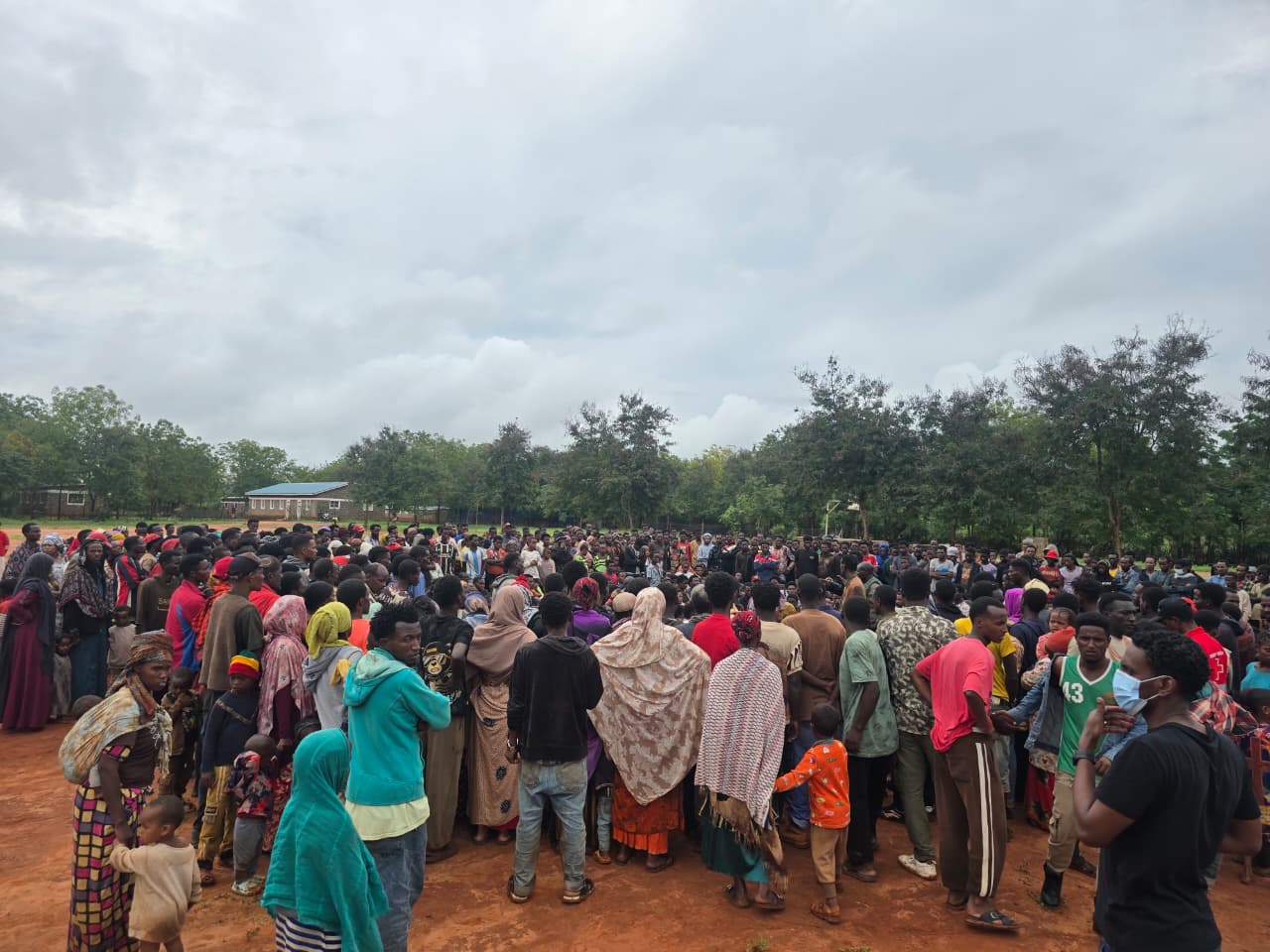
At least 50,000 people have fled the violence in Ethiopia into Kenya, according to county authorities, further straining humanitarian resources in Moyale. The United Nations High Commissioner for Refugees, International Organization for Migration, UNICEF and World Food Programme are appealing for $8.9 million to provide life-saving assistance to those displaced.
Many of those fleeing are women and children, with some seeking refuge among relatives and host communities.
Asal Humanitarian Network convener Ahmed Ibrahim says the influx is overwhelming a township of approximately 65,000 residents.
“About seven out of 10 persons are being hosted by the community. The area has 67 camps. We also understand that out of the arriving refugees, 52 per cent are children, and 50 per cent of those in camps are women,” Ibrahim told Citizen TV.
But the confrontation is not simply an ethnic disagreement. It is rooted in decades of unresolved disputes over land, administrative boundaries, political authority and access to resources.
Ethiopia operates an ethnic-based federal system introduced under its 1994 Constitution, which came into force in 1995. It gives regional administrations considerable authority over local governance, security, resources and political representation.
However, the arrangement has fuelled competing territorial claims, particularly along the boundary separating Oromia, home to the Oromo community, and the Somali Regional State, predominantly inhabited by ethnic Somalis.
East, Horn and Southern Africa Senior Advocate for Refugees International Abdullahi Halake Boru says the ethnic federalism arrangement is under “tremendous strain”.
“We have discussed this about the Oromia, Amhara, Tigray and Somali regions. And unless there are changes, it becomes a very difficult issue,” Boru said.
Africa Policy Institute chief executive Peter Kagwanja warns that the latest confrontation is only “the tip of the iceberg”, arguing that Ethiopia is experiencing its third civil war.
“The uniqueness of this conflict that is now between two communities is a reflection of the larger problem in Ethiopia,” Kagwanja said, calling for a political system that is accountable to citizens beyond electoral victories.
In its September 2009 report, Ethiopia: Ethnic Federalism and Its Discontents, the International Crisis Group challenged the tendency to explain such confrontations purely through ethnic differences.
“These are routinely described as ‘ethnic conflicts’, but they are more often the result of rivalry over state resources than of irreconcilable ethnic differences,” the organisation observed.
It added that “many conflicts have become more protracted as struggles over land, political power and administrative control become intertwined”.
Attempts to resolve the competing territorial claims date back decades. In 2004, Ethiopia held a referendum in disputed areas along the Oromia-Somali boundary to determine which regional administration residents wanted to join.
However, the exercise failed to settle the dispute. In its February 2019 report, Managing Ethiopia’s Unsettled Transition, Crisis Group noted that 80 per cent of voters in the disputed territory had chosen Oromia administration.
“The results have never been respected,” it stated, identifying Moyale among the areas where tensions persisted.
HOW A FLAG REIGNITED THE FIGHTING
The latest escalation began on October 18, when the Somali regional administration opened an office and raised its regional flag in a disputed part of Ethiopian Moyale.
The move was opposed by members of the Oromo community, who viewed it as an attempt to extend Somali regional authority into territory claimed by Oromia.
A confrontation involving Somali regional police and Oromo militias followed. A 13-year-old Oromo girl was killed during the initial clashes, before violence spread to other localities.
The Borana, predominantly Oromo pastoralists, and the Garre, a Somali clan, have longstanding connections across the Kenya-Ethiopia border. Their historical tensions involve competition over grazing land, water and territorial administration.
WHY KENYA IS AFFECTED
Moyale straddles the international boundary, with families, communities and commercial activities spread across both countries. The Borana also maintain strong social and family connections across the border, making Kenya a natural refuge for those fleeing violence.
The proximity of settlements to the fighting means gunfire and explosive devices can cross into Kenyan territory, threatening civilians with no involvement in the conflict.
Beyond the immediate security threat, the refugee influx is placing additional pressure on Marsabit County, where communities already face shortages of water, food and other essential services. Cross-border trade has also been disrupted.