Kenya and the DRC have moved to repair diplomatic relations strained by accusations of interference in each other's internal affairs.
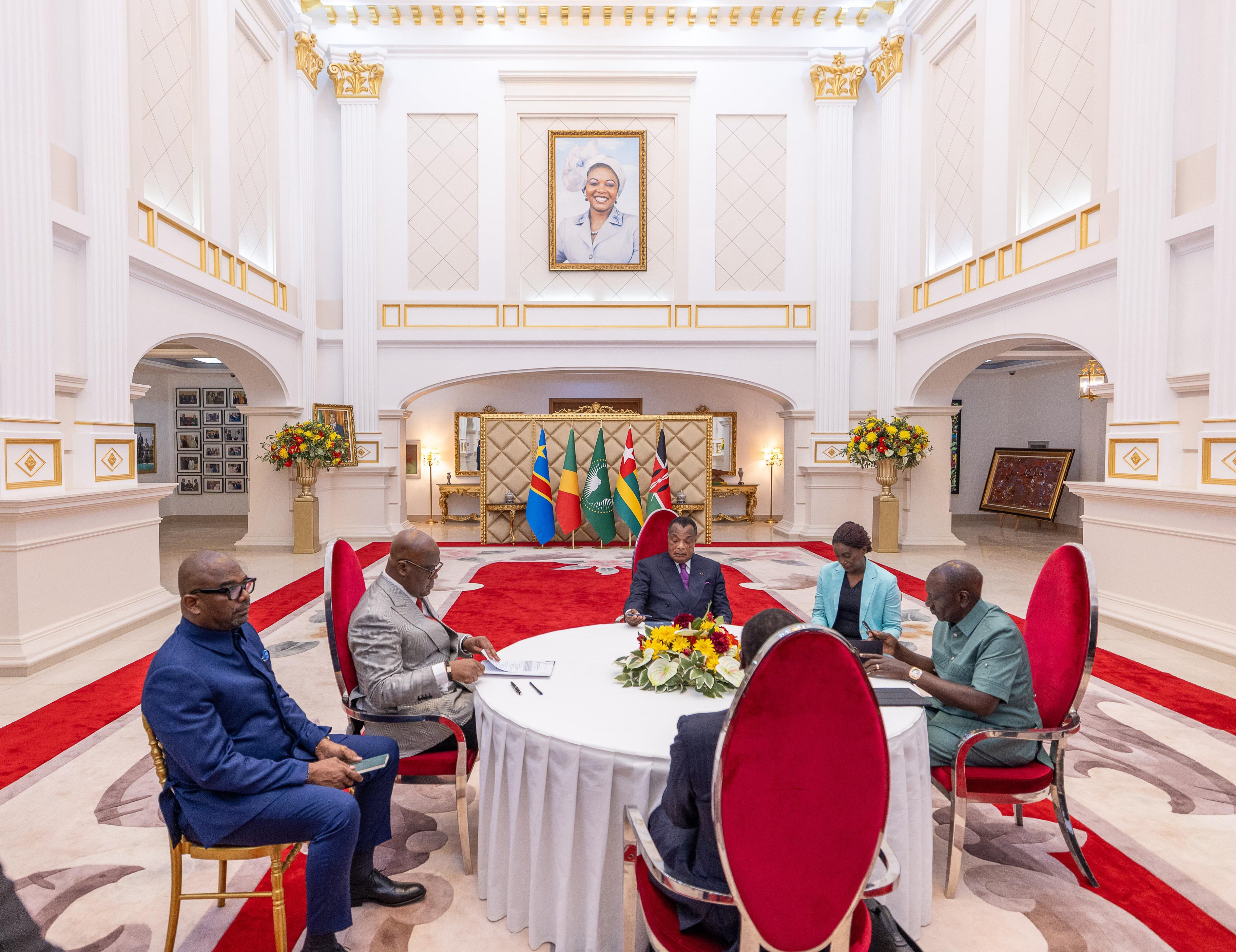
Presidents William Ruto and Félix Tshisekedi on Sunday committed to respect sovereignty and refrain from actions that could undermine relations between the neighbouring countries following mediation talks in Congo Brazzaville.
The two leaders, who met in Oyo, agreed to prioritise diplomatic channels, consultation and peaceful settlement of disputes, addressing some of the grievances that have defined their frosty relations over the past three years.
"Held talks with President Félix Tshisekedi of the Democratic Republic of the Congo at the high level Quadripartite Political Summit in Oyo, Republic of the Congo, where we agreed to open a new chapter in our relations built on mutual trust, respect and cooperation," President Ruto said in a dispatch after the meeting.
He added that they also committed to working towards fully restoring diplomatic relations, including restoring representation at ambassadorial level.
They will also resume the Joint Grand Commission for Cooperation — the formal bilateral framework used to manage, review, and expand diplomatic, economic, and security ties — and strengthening regular diplomatic consultations.
In a joint communiqué issued after the quadripartite summit, the presidents reaffirmed their commitment to the principles of "sovereignty, territorial integrity, non-interference in the internal affairs of States, good-neighbourliness and the peaceful settlement of disputes."
The diplomatic rapprochement has, however, drawn scrutiny over whether Kenya will change its approach to Congolese armed and political groups operating from its territory.
Former US Special Envoy for the Sahel and Great Lakes Region Dr J. Peter Pham questioned the substance of the agreement, arguing that commitments to sovereignty and non-interference would remain hollow unless Nairobi addressed the presence of M23 and other armed groups from eastern DRC.
"The reaffirmations of sovereignty, territorial integrity and non-interference are well and fine, but appeals to 'solidarity and brotherhood' will ring hollow if the Kenyans continue to allow M23 and other armed groups from Eastern DRC to use Nairobi as a de facto rear base," Pham wrote on X.
He described the dispute as one-sided, arguing that there were no equivalent Kenyan rebel groups operating from Kinshasa.
His remarks drew a response from Foreign Affairs Principal Secretary Korir Sing'Oei, who criticised what he described as attempts by commentators based outside the region to manufacture tensions between the two countries.
Sing'Oei maintained that Kenya and the DRC shared deep economic, security and social connections, with communities and businesses maintaining close links across the two countries.
The relationship between Nairobi and Kinshasa had deteriorated after Kenya hosted the launch of the Congo River Alliance, a political-military coalition that brought together Congolese opposition figures and armed groups, including the M23 rebel movement.
The announcement was made in Nairobi in December 2023 by Corneille Nangaa, the former head of the DRC's electoral commission, who said the alliance sought to bring together nine armed groups and political organisations to challenge President Tshisekedi's government.
Kinshasa protested the meeting, accusing Kenya of providing a platform for forces seeking to destabilise the country. It recalled its ambassador to Nairobi, while subsequently refusing to accredit Kenyan diplomats appointed to serve in Kinshasa.
The dispute exposed fundamentally different interpretations of Kenya's role as a regional diplomatic centre and Kinshasa's concerns over the activities of political and armed groups opposed to its government.
President Ruto, however, dismissed demands by the Congolese government that Kenya arrest those behind the Nairobi declaration, arguing that the country could not criminalise political statements.
Speaking in December 2023, Ruto said Kenya could not arrest individuals simply for making statements, insisting that the country was a democracy.
"If they decide that they want to recall their ambassador because a statement was issued in Nairobi, that is their right. But I cannot arrest anybody merely because they issued a statement. That is undemocratic, and that is not how Kenya is," he said.
The President maintained that Kenya only arrests people suspected of criminal activities and would not detain individuals simply for expressing political positions.
His remarks underscored the differences between the two governments over the extent to which Kenya should restrict the activities of Congolese opposition figures operating from its territory.
The disagreement resurfaced with Kenya's subsequent diplomatic appointments to Kinshasa, with the DRC refusing to accept the credentials of two Kenyan ambassadorial appointees, further complicating efforts to restore normal diplomatic engagement.
Relations were also strained by Kenya's hosting of former DRC President Joseph Kabila, whose political activities have become increasingly contentious in Kinshasa amid accusations linking him to the rebellion in eastern Congo.
Kabila's appearance at a meeting of Congolese opposition figures in Nairobi attracted attention after he was sentenced to death in absentia by a Congolese military court on charges, including treason and war crimes, allegations he has disputed.
The developments reinforced Kinshasa's concerns about the use of Kenyan territory by individuals and groups it considers a threat to its political and territorial integrity.
The tensions were also reflected in attacks on Kenya's diplomatic mission in Kinshasa in January 2025, when protesters angered by the M23 offensive in eastern Congo targeted several foreign embassies.
The Kenyan embassy was looted during demonstrations that also targeted diplomatic missions belonging to Uganda, Rwanda, France, Belgium, the Netherlands and the US.
Kenya condemned the attacks, describing them as a serious violation of international law and the Vienna Convention on Diplomatic Relations.
In a statement, the government said two Kenyan embassy staff members had been forced to flee and seek refuge elsewhere as demonstrators attacked the mission.
The incident brought the diplomatic fallout into sharp focus, raising concerns over the safety of Kenyan diplomatic personnel and the protection of diplomatic premises in the DRC.
Against this background, Sunday's agreement offers an opportunity to address the underlying grievances and restore confidence between the two governments.
Ruto and Tshisekedi committed to giving priority to diplomatic channels and existing regional and continental mechanisms in addressing common concerns and resolving potential disputes.
They also agreed to prioritise continued consultations as a means of preventing disagreements from escalating, particularly through the return of ambassadors.
The two leaders further pledged to strengthen cooperation within the International Conference on the Great Lakes Region and the East African Community, of which both countries are members.
The institutions have a critical role in regional peace and security, particularly as conflict in eastern DRC continues to threaten stability across the Great Lakes region.
The summit was convened by Congo President Denis Sassou Nguesso and attended by Togo's President of the Council, Faure Essozimna Gnassingbé, who is the AU-appointed mediator for the security crisis in eastern DRC.
The involvement of the two leaders provided an opportunity for African mediation in a dispute that had increasingly complicated relations between two countries expected to cooperate on regional security and economic integration.
Restoring relations with Kinshasa is important for Kenya because of the DRC's growing significance as a market for Kenyan goods and services.
The Port of Mombasa and the Northern Corridor provide important trade links for the DRC, while Kenyan financial institutions and businesses have established a growing presence in the Congolese market.
The two presidents consequently pledged to place their bilateral relations on a renewed footing of trust, dialogue, cooperation and African solidarity, particularly through enhanced economic cooperation.