

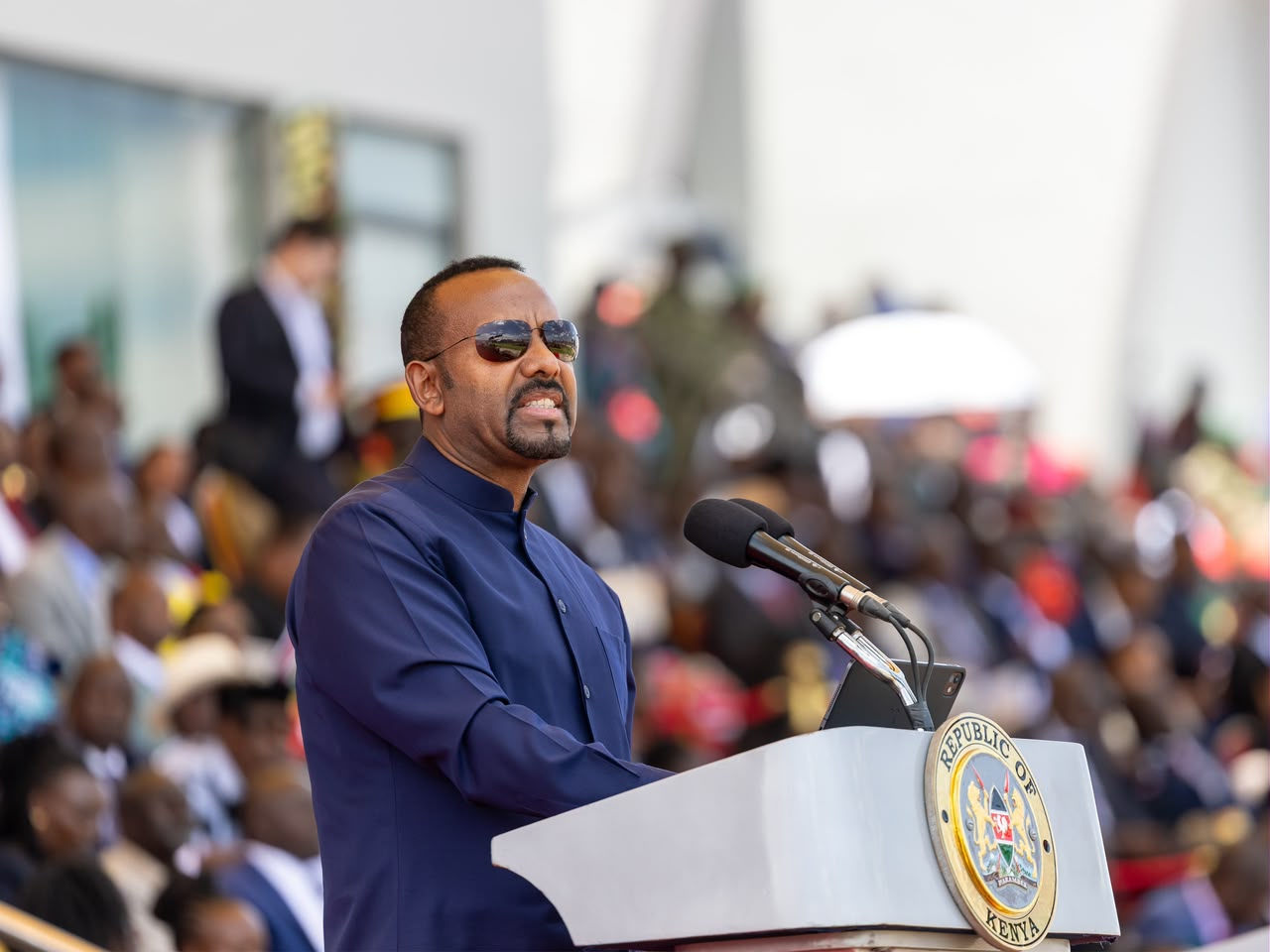
Ethiopia Prime Minister Abiy Ahmed has called for Kenya and Ethiopia to ease cross-border trade, urging the two countries to make it easier for farmers and producers to access markets and ensure more families benefit from their economic partnership.
Speaking during Mashujaa Day celebrations in Eldoret on Tuesday, Abiy said stronger commercial links and increased movement of people between the two countries would help translate their longstanding friendship into shared prosperity.


Abiy said farmers and producers must face fewer barriers when accessing markets across the shared border, calling for stronger trade links, increased travel and deeper people-to-people exchanges.
“Our farmers and producers must be able to trade more easily across our borders. Let more of our people visit each other’s countries, discover our cultures and learn together. More families must benefit from our friendship,” he said at Kipchoge Keino Stadium, where he attended as the guest of honour..
His call comes as official Kenyan data show a significant trade imbalance between the two neighbours, with Kenya exporting considerably more goods to Ethiopia than it imports.
Figures published by Kenya’s Ministry of Foreign and Diaspora Affairs show Kenyan exports to Ethiopia doubled from Sh7.1 billion in 2019 to Sh15.8 billion in 2023. Imports from Ethiopia stood at Sh6.7 billion in 2023, driven largely by electrical energy and dried leguminous vegetables.
In April 2025, Kenya and Ethiopia held bilateral talks on implementing a Simplified Trade Regime aimed at accelerating commerce among communities living along their common border.
According to the Kenya Export Promotion and Branding Agency, the discussions covered common lists of tradable products, designated border trade zones, the value of goods eligible under the arrangement and the frequency of cross-border travel by traders.
The proposed framework envisaged border zones extending 50km into Ethiopia and 100km into Kenya, with a goods-value threshold of $1,000 and trading permitted up to four times a month. The two countries also agreed to develop a memorandum of understanding to advance implementation of the African Continental Free Trade Area framework.
The arrangements could create opportunities for small-scale traders and producers, although their impact will depend on implementation and how effectively border procedures are simplified.
Abiy said the wider partnership should move beyond geographical proximity and historical solidarity to focus on shared economic interests.
“Geography made us neighbours. History made us brothers. Our choices must make us partners in shared prosperity,” he said.
He described the relationship as one in which the two countries could compete while cooperating on common development priorities.
“We race as rivals, but build as partners. In Ethiopia, we call this spirit Madama, meaning synergy,” he said.
Abiy also pointed to Kenyan businesses operating in Ethiopia as evidence of the potential for commercial partnerships to connect markets and expand access to services.
“Our partnership grows through our businesses. Today, Safaricom connects millions of Ethiopians, and M-Pesa helps people send money and make payments,” he said.
Safaricom Ethiopia, established by a consortium led by Safaricom, launched commercial mobile services in October 2022. By March 2025, the company reported 8.8 million active mobile customers and more than 2.3 million M-Pesa users, illustrating the growing role of Kenyan-linked investment in Ethiopia’s digital economy.
Energy cooperation is another pillar of the relationship.
The two countries are connected through a power interconnector that enables Ethiopia to export electricity to Kenya, linking regional energy resources with demand from homes and industries.
The two governments have also pursued cooperation in infrastructure, tourism and other sectors. During Abiy’s February 2024 state visit to Kenya, the countries signed seven memoranda of understanding covering areas including tourism and wildlife, the blue economy, petroleum and energy development, cultural cooperation and public service capacity building.
Beyond business, Abiy urged Kenyans and Ethiopians to travel more frequently between their countries and strengthen cultural exchanges.
He also reaffirmed Ethiopia’s solidarity with Kenya, drawing parallels between the two countries’ histories of defending their sovereignty and dignity.
“Ethiopia stands with Kenya as we work to make freedom meaningful for all our people,” he said.
Abiy recalled the 1952 arrest of Jomo Kenyatta and other Kenyan leaders during the struggle for independence, alongside Ethiopia’s defence of its sovereignty in 1896.