
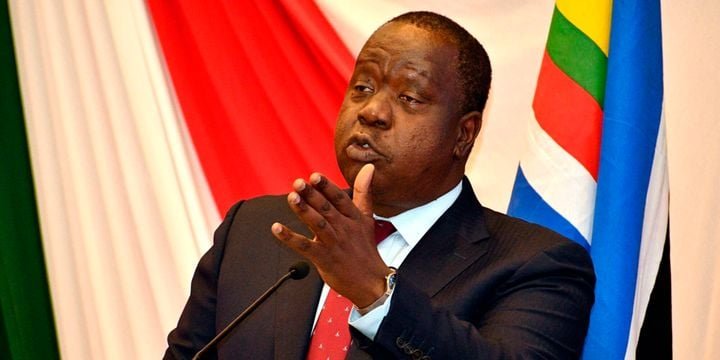
Jubilee Party leader Fred Matiang’i has pledged to end the arrest and surrender of foreign opposition figures seeking refuge in Kenya, signalling a foreign policy shift that would seek to restore the country’s reputation as a defender of international law and regional stability.
Matiang’i said no citizen of a neighbouring country would be arrested in Kenya and handed over to their government for political reasons, if he became president.


In what was seen as an apparent criticism of the handling of foreign dissidents under President William Ruto’s administration, Matiang’I said he would seek to restore order and competence in governance, and Kenya’s image abroad.
The former Interior Cabinet Secretary also criticised what he termed as government engaging in criminal activities, violating international agreements and supporting rebel groups in neighbouring countries.
The remarks come amid controversy over Ruto’s administration’s alleged relations with Sudan’s paramilitary Rapid Support Forces (RSF).
Speaking to NTV on his foreign policy agenda, Matiang’i said Kenya must rebuild its international standing through respect for multilateralism, international obligations and the sovereignty of other countries.
“Our approach will be based on respect for international obligations, respect for multilateralism and ensuring that Kenya’s image is protected and improved at every available opportunity,” he said.
“Our image suffers when the government engages in criminal activities. Our image suffers when the government makes mistakes and blunders, such as violation of agreements we have signed with the UN on rendition and so on”.
While he did not mention the RSF by name, his remarks on supporting rebel groups come against the backdrop of growing scrutiny of Nairobi’s engagement with the Sudanese paramilitary force.
In February 2025, Kenya hosted RSF-linked political forces in Nairobi, where they announced plans to establish a parallel government in Sudan, triggering a diplomatic fallout with Khartoum.
Sudan’s military-led government accused Kenya of siding with the paramilitary group, which has been accused of widespread atrocities during the country’s civil war. Nairobi, however, defended its role as providing a platform for political engagement and dialogue.
The controversy has since widened following questions over alleged issuance of Kenyan passports to individuals linked to the RSF, with opposition leaders warning the dealings could damage Kenya’s relations with other states and undermine its credibility as a regional mediator.
Matiang’i’s criticism also touches on the controversy surrounding the abduction and transfer of foreign dissidents from Kenyan territory to their home countries.
His pledge comes against the backdrop of the November 2024 abduction of Ugandan opposition leader Kizza Besigye in Nairobi and his subsequent appearance before a military court in Kampala.
Human rights organisations criticised the absence of formal extradition proceedings, describing the incident as part of a worrying pattern of transnational repression. The Kenyan government denied involvement in Besigye’s abduction and said investigations had been initiated.
Matiang’i said Kenya must not allow its territory to be used to pursue political opponents of neighbouring governments.
He recalled an incident during his tenure as Interior CS when a neighbouring government sought the arrest of opposition figures who had fled into Kenya.
The former minister said President Uhuru Kenyatta refused to allow their arrest and handover, despite pressure from the neighbouring country’s authorities.
“My counterpart from that country called me several times, and I told him that we would not arrest them. We don’t have the opposition in your country. If they have committed a crime in your country, you will have to wait for them to return and arrest them there,” he said.
He said Kenya must uphold the international protection principles associated with its hosting of large refugee populations and major United Nations institutions.
Nairobi hosts one of the largest United Nations offices in the Global South, while Kenya remains a major refugee-hosting country.
Matiang’i also linked foreign policy to Kenya’s economic interests, arguing the country’s diplomatic ties must protect its businesses and investors operating across the region.
He notedseveral Kenyan banks and other companies were expanding into neighbouring markets, making regional stability and good diplomatic relations important to their operations.
“Most of our trading partners are within this particular region,” he said, pledging to prioritise relations with East African countries, strengthen engagement across Africa and improve Kenya’s global standing.
Matiang’I’s stance places regional diplomacy, respect for international obligations and protection of foreign dissidents at the centre of his foreign policy agenda, while raising questions about the diplomatic choices made under the Ruto administration.