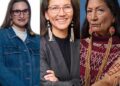


The election of three Indigenous women to senior political offices in the US marks a breakthrough for communities historically excluded from power.
Deb Haaland, Peggy Flanagan and Claire Valdez made history in the November 3 midterm elections, taking Indigenous representation into some of the country’s most influential political institutions.
Haaland, a member of the Laguna Pueblo tribe and former US Secretary of the Interior, was elected Governor of New Mexico, becoming the first Native American woman to lead a US state.
Flanagan, a member of the White Earth Nation of Ojibwe people and Minnesota’s outgoing Lieutenant Governor, won a seat in the US Senate, becoming the first Native American woman elected to the chamber.
In New York, Claire Valdez, a member of the Ysleta del Sur Pueblo Nation, won a seat in the House of Representatives, becoming the first Native American woman to represent the state in Congress.
The International Work Group for Indigenous Affairs (IWGIA) congratulated the winners, noting they were breaking barriers.
“One of the highlights happened In New Mexico, where Deb Haaland, former Secretary of the Interior and member of the Laguna Pueblo tribe, became the first Indigenous Governor,” IWGIA said.
In breaking barriers, the wins mark a shift in the representation of communities that have endured centuries of dispossession, discrimination and exclusion from the institutions governing the US.
The breakthrough also comes against a backdrop of growing Indigenous participation in American electoral politics.
According to Indigenous news organisation ICT and Advance Native Political Leadership, 363 Indigenous candidates ran for public office during the 2026 election cycle, representing a 44 per cent increase from 2024.
Of these, 225 candidates appeared on general election ballots across 30 states, representing nearly 100 Indigenous nations and communities.
FROM EXCLUSION TO POLITICAL INFLUENCE
The significance of the victories becomes clearer against the history of Indigenous political exclusion in America.
Native American communities had established systems of governance long before the creation of the US. However, the expansion of the American state came with the dispossession of Indigenous territories, forced displacement and policies that undermined tribal sovereignty.
Although the Indian Citizenship Act of 1924 granted US citizenship to Native Americans born within the country’s territorial boundaries, several states continued restricting their voting rights.
New Mexico, for instance, only removed constitutional restrictions preventing Native Americans from voting in 1948.
The barriers were, therefore, not simply about access to electoral politics but also the recognition of Indigenous peoples as equal participants in the country’s democratic institutions.
Flanagan’s election to the Senate is significant given the chamber’s role in approving legislation, federal spending and appointments. It is also the institution that has historically dealt with treaties and relations between the federal government and Native American nations.
Haaland’s governorship places an Indigenous woman at the head of a state government with responsibilities touching on land management, natural resources, economic development and relations with tribal communities.
Having Indigenous leaders in these positions creates opportunities for communities to participate more directly in decisions affecting their interests.
However, representation does not automatically translate into policy change. The three women will operate within political institutions shaped by party interests, competing economic priorities and constitutional divisions of authority.
Their influence will ultimately depend on the policies they pursue, the coalitions they build and their engagement with Indigenous communities.
A MESSAGE BEYOND AMERICA
The significance of these victories extends beyond the US.Across the world, Indigenous communities continue to confront disputes over ancestral land, resource ownership, cultural preservation and political recognition.
From the Māori in New Zealand and Aboriginal and Torres Strait Islander peoples in Australia to the Sami communities of Scandinavia and Indigenous populations across Latin America, political representation remains central to demands for recognition and self-determination.
The UN Declaration on the Rights of Indigenous Peoples, adopted in 2007, recognises Indigenous peoples’ right to participate in decision-making on matters affecting their rights and to maintain their own political institutions.
Yet translating these principles into meaningful political influence remains a challenge in many countries.
The American elections offer an illustration of how Indigenous candidates can move beyond community-level leadership and enter institutions that shape national policy.
They also demonstrate the importance of building political participation across generations, particularly for Indigenous women who have faced overlapping barriers linked to gender and identity.
Witnessing women from their communities occupy positions of authority challenges longstanding assumptions about who belongs in political leadership.
The significance of Haaland, Flanagan and Valdez’s electoral breakthrough in the US may allso offer an important lesson for Kenya as the country heads towards the 2027 General Election.
Communities such as the Ogiek, Endorois, Sengwer, Turkana, Yiaku and Ilchamus continue to face challenges influencing decisions on land, natural resources, conservation and development, despite constitutional guarantees.
The 2027 elections present an opportunity for Indigenous communities to push political parties and candidates to address their longstanding demands, including greater representation in Parliament and county assemblies, protection of ancestral lands and participation in decisions affecting their livelihoods.