

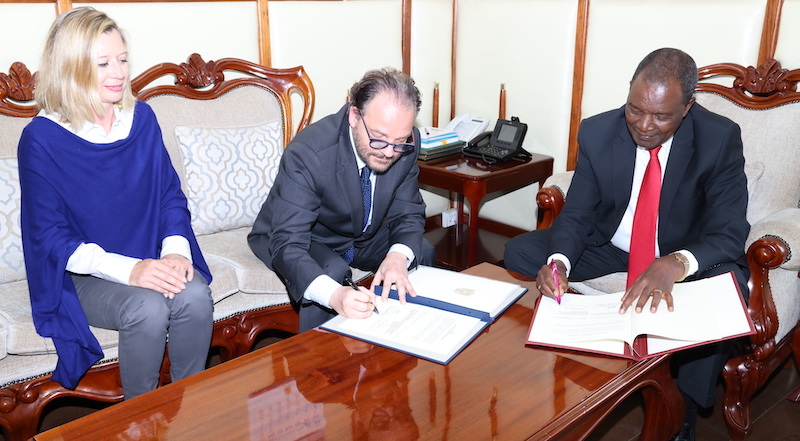
NAIROBI – Kenya and Austria have signed a 40 million Euros loan deal after four years of negotiations.
The agreement described as a momentous occasion for the bilateral relations between the two nations was signed by Austrian Ambassador Christian Fellner and CS Treasury Prof. Njuguna Ndung’u.


“This landmark agreement aims to bolster financial cooperation between the two nations and facilitate the provision of concessional loans under the Austrian Soft Loan Scheme to support projects of mutual interest in vital sectors, such as water, energy, health, and education,” Austria embassy said in a statement.
Edith Predorf, the Commercial Counsellor at the Austrian Embassy Nairobi, said the framework agreement signals a new era of collaboration and development between Kenya and Austria, fostering even stronger ties and creating opportunities for growth in various sectors.
“It is anticipated that this agreement will not only enhance financial cooperation but also stimulate trade relations,” Predorf said.
One of the key outcomes of the agreement is the encouragement it provides for Austrian companies to invest in Kenya, particularly in the aforementioned strategic sectors.
“This investment is poised to bring about substantial economic benefits and contribute to the sustainable development of Kenya.
“Through this collaborative effort, both Kenya and Austria are demonstrating their commitment to addressing pressing challenges in key public sectors. The financial support provided by Austria will undoubtedly bolster Kenya’s capacity to undertake transformative projects and achieve sustainable growth,” she added.
This comes at a time the Kenyan government is reducing its cost of debt, opting for cheaper loans.
Total external debt jumped from $10.2 billion in 2013 (16.5% of GDP) to $34.8 billion in 2020 (35.4% of GDP), according to the Central Bank of Kenya. This included a tenfold jump in commercial borrowing (to US$10.4 billion) and a near fourfold rise in bilateral loans (to $10.6 billion), led by China.
The World Bank estimates that Kenya’s external debt stock is about $4 billion larger than calculated by the CBK, although IMF figures align with Kenya’s official tally.
According to the Economist Intelligence, Debt owed to multilateral sources jumped from $13.7 billion in 2020, to $17.9 billion in 2022, whereas bilateral debt fell to $9.8 billion in 2022, and commercial debt dipped to $10.1 billion, despite a new $1 billion Eurobond in mid-2021 (paying a 6.3% coupon, the lowest rate to date).
The fall in bilateral debt reflects a drop in obligations to China, from a peak of $7 billion in 2021 to $6.6 billion at end-2022, as amortisation outpaced new borrowing. The overall debt stock moved upwards in 2021 and 2022, largely because of new multilateral borrowing, but remained stable at 34.5% of GDP.
Debt dynamics shifted in 2020-22, as Kenya turned to concessional multilateral borrowing from the IMF, the World Bank and the African Development Bank, to help deal with the impact of the Covid‑19 pandemic.
European bank signs $200m loan to support African companies affected by trade shocks