
New EU Ambassador to Kenya Andreas Peschke has put investment, trade, security and multilateral cooperation at the centre of his tenure, signalling a push by Brussels to deepen its relationship with Nairobi beyond traditional development assistance.
Peschke, who took up his posting in Nairobi a week ago, says attracting more European investment into Kenya will be his major focus.

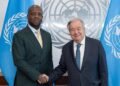
The envoy also told journalists that expanding trade under the EU-Kenya Economic Partnership Agreement and strengthening cooperation on regional and global challenges would also be top of his agenda during his tour of duty in Nairobi.
The investment push, he said, will be backed by an expansion of the EU presence in Nairobi, with about 20 additional officials expected to join the delegation to strengthen its capacity to identify, develop and support investment opportunities.
The move effectively positions Nairobi as an important hub for the EU’s Global Gateway strategy, through which Brussels is seeking to mobilise public and private capital for infrastructure and other strategic investments.
Peschke said the approach is intended to use public financing as a lever to attract significantly larger amounts of private capital into viable projects.
Renewable energy, digital infrastructure and connectivity are among sectors where the EU sees opportunities for greater European investment in Kenya.
The ambassador said the EU’s engagement was increasingly focused on creating investment that could support economic growth and jobs while bringing European companies into projects where Kenya requires capital and technology.
The shift towards investment comes as the EU and Kenya implement their Economic Partnership Agreement, which entered into force in July 2024 and gives Kenyan exports duty-free and quota-free access to the European market.
The EU is already one of Kenya’s largest trading partners and its biggest export market, particularly for flowers, vegetables, fruits and other agricultural products.
EU-Kenya merchandise trade stood at about €3.36 billion in 2024, with Kenya exporting €1.40 billion worth of goods to the EU and importing €1.96 billion from the bloc, according to Eurostat data published by the European Commission.
Peschke said one of the priorities of his posting would be ensuring the agreement translates into increased trade and greater opportunities for Kenyan businesses.
Security will form another pillar of Peschke’s tenure, reflecting Kenya’s strategic role in the Horn of Africa and the wider East African region.
Kenya and the EU already cooperate on counterterrorism, maritime security, organised crime and regional peace and stability, with instability in Somalia, Sudan and other parts of the Horn remaining a concern for both sides.
The EU also sees Kenya as an important partner in the Western Indian Ocean, where maritime security, trade routes and geopolitical competition have become increasingly important.
Peschke’s fourth priority of multilateralism could give the relationship a broader geopolitical dimension.
Kenya has increasingly positioned itself as an influential diplomatic actor on African and global issues, including climate change, peace and security and reform of international institutions.
During the interview, Peschke backed the case for reform of the United Nations system and greater African representation in global decision-making, including the UN Security Council.
African countries have long demanded permanent representation on the Council, arguing that the continent remains underrepresented. This is despite accounting for more than a quarter of UN member states, and a significant share of issues on the Security Council agenda.
The ambassador’s agenda comes as Europe seeks to strengthen partnerships in Africa amid growing geopolitical competition involving China, the US, Russia and emerging powers.
China has established itself as a major infrastructure financier across Africa through the Belt and Road Initiative, while the EU is positioning Global Gateway as an alternative model built around sustainable infrastructure, investment and partnerships with the private sector.
Peschke, however, avoided framing the EU’s engagement with Kenya as competition with China. He argued that Nairobi should be able to work with different international partners according to its interests.
The ambassador has also indicated that Europe’s renewed economic focus will not mean abandoning traditional EU concerns around democracy, governance and human rights.
He described Kenya and the EU as “partners in democracy”, noting that shrinking democratic spaces, populism and disinformation were challenges confronting both sides.
The EU is also closely following preparations for Kenya’s August 2027 General Election and has indicated it would favourably consider deploying an election observation mission if formally invited.
Peschke’s priorities point to a relationship centred on economic and strategic interests, using trade and investment to deepen ties while maintaining cooperation on security, multilateral diplomacy and democratic governance.