
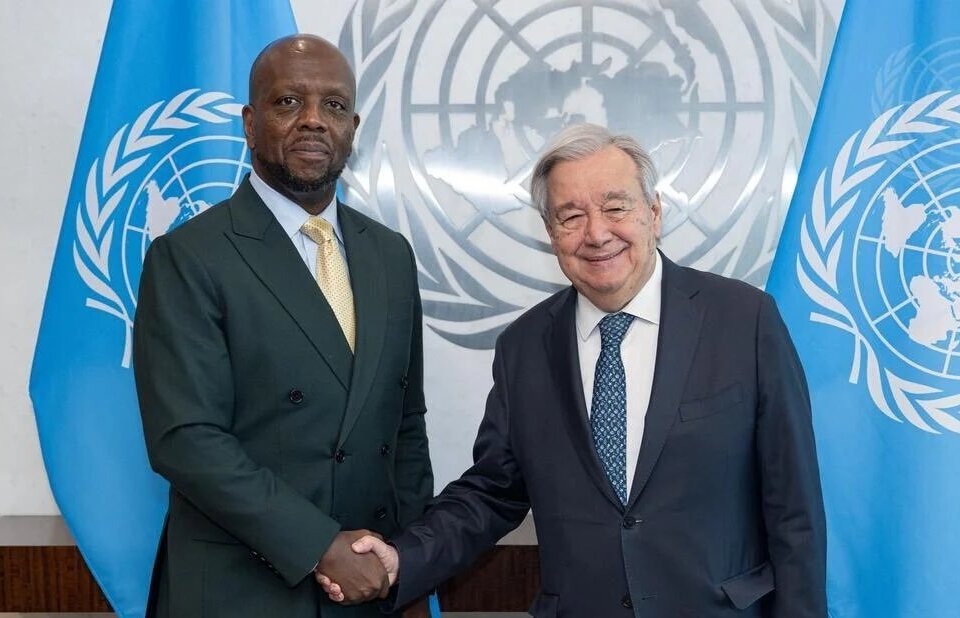
Kenyan diplomat Ambassador Martin Kimani has been appointed the United Nations’ new Assistant Secretary-General for Africa.
The appointment by UN Secretary-General António Guterres on Monday, September 14, places Amb Kimani — one of Kenya’s most prominent voices on global diplomacy — at the centre of the UN’s political and peacebuilding operations on the continent.

Guterres named Kimani Assistant Secretary-General for Africa in the Departments of Political and Peacebuilding Affairs and Peace Operations.
He succeeds Ghana’s Martha Ama Akyaa Pobee and takes up a position with significant responsibility for the UN’s engagement with African political crises, conflicts, peace processes and preventive diplomacy.
The appointment also marks a return to the UN for Kimani, who served as Kenya’s Permanent Representative in New York in 2020-24.
It is a role that brings him back to an institution where he established a reputation as an outspoken advocate of multilateralism and a more representative global order.
Kimani particularly became internationally known in February 2022 for a Security Council speech on Russia’s recognition of the separatist regions of Donetsk and Luhansk in Ukraine, delivered two days before Russia launched its full-scale invasion.
Drawing on Africa’s experience with colonial borders, Kimani argued that African states had made the difficult choice of respecting inherited borders because repeatedly redrawing them risked endless conflict.
“We believe that all states formed from empires that have collapsed or retreated have many peoples in them yearning for integration with peoples in neighboring states. This is normal and understandable. After all, who does not want to be joined to their brethren and to make common purpose with them? However, Kenya rejects such a yearning from being pursued by force,” he said.
He added that the world must complete its recovery from “the embers of dead empires in a way that does not plunge us back into new forms of domination and oppression”.
“We rejected irredentism and expansionism on any basis, including racial, ethnic, religious, or cultural factors. We reject it again today.
“Kenya registers its strong concern and opposition to the recognition of Donetsk and Luhansk as independent states. We further strongly condemn the trend in the last few decades of powerful states, including members of this Security Council, breaching international law with little regard,” he added.
His remarks became one of the most widely circulated diplomatic speeches of the Ukraine crisis.
While the speech was widely seen as the defence of Kyiv’s sovereignty, it also reflected a broader view of the international system that Kimani had articulated repeatedly at the UN. He argued that great powers cannot selectively invoke international law while disregarding it when their strategic interests are at stake.
In another Security Council intervention in January 2022, he warned that Africa had a direct interest in preventing Ukraine from becoming a theatre for a new Cold War.
He also made an unusually direct call for reform of the Security Council, arguing that if the Council was to remain relevant, its structure and culture had to change.
“We can no longer deny others the power of permanent membership and veto power,” he said, in a reference to the privileges enjoyed by the five permanent members.
During his time at the UN, he repeatedly supported greater African representation in the Security Council, including the position advanced by the AU under the Ezulwini Consensus for permanent African seats with the same rights and privileges as other permanent members.
In 2023, Kimani told a UN Security Council debate the Council was suffering from a serious trust deficit and called for urgent reform of its membership. He also argued that the practice of assigning “penholder” responsibility for African files should be changed so that African members could have a greater role in shaping decisions on conflicts on their own continent.
His public interventions and social-media commentary have similarly focused on the changing balance of global power and the need to make multilateral institutions more representative.
Kimani has described the emerging international system as multipolar and has argued that Africa should not simply become an arena in which competing powers pursue their geopolitical interests.
In a June 2026 address on UAE-Africa relations, for instance, he argued that partnerships in a multipolar world should leave African states “stronger and more sovereign” rather than reproduce a scramble for African resources. He linked economic development directly to peace, arguing that investment and political settlements must advance together in conflict-affected regions such as the Horn of Africa and the Red Sea.
His thinking has also extended to the limits of the current multilateral system.
In commentary on the Gaza crisis, Kimani argued the failure to implement Security Council decisions risked turning the Council into a weaker version of the General Assembly, undermining its authority and legitimacy.
His views on African diplomacy and geopolitics is thus likely to be significant in his new UN assignment.
Kimani will be dealing with a continent facing a crowded conflict and political agenda, from Sudan and South Sudan to the Sahel, the Horn of Africa and the Great Lakes. The UN is also grappling with growing questions about the effectiveness of traditional peacekeeping, the role of regional organisations and the increasing influence of competing external powers.
His experience spans African conflict prevention, counterterrorism, diplomacy, multilateral negotiations and international policy.
Before becoming Kenya’s UN ambassador, Kimani served as Director of the National Counter Terrorism Centre and President’s Special Envoy for Countering Violent Extremism. He also previously represented Kenya at UNEP and UN-Habitat and headed IGAD’s Conflict Early Warning and Response Mechanism.
He has also worked outside government, including as president and CEO of The Africa Center, Executive Director of New York University’s Center on International Cooperation and Deputy Director of the Atlantic Council’s Africa Center.