

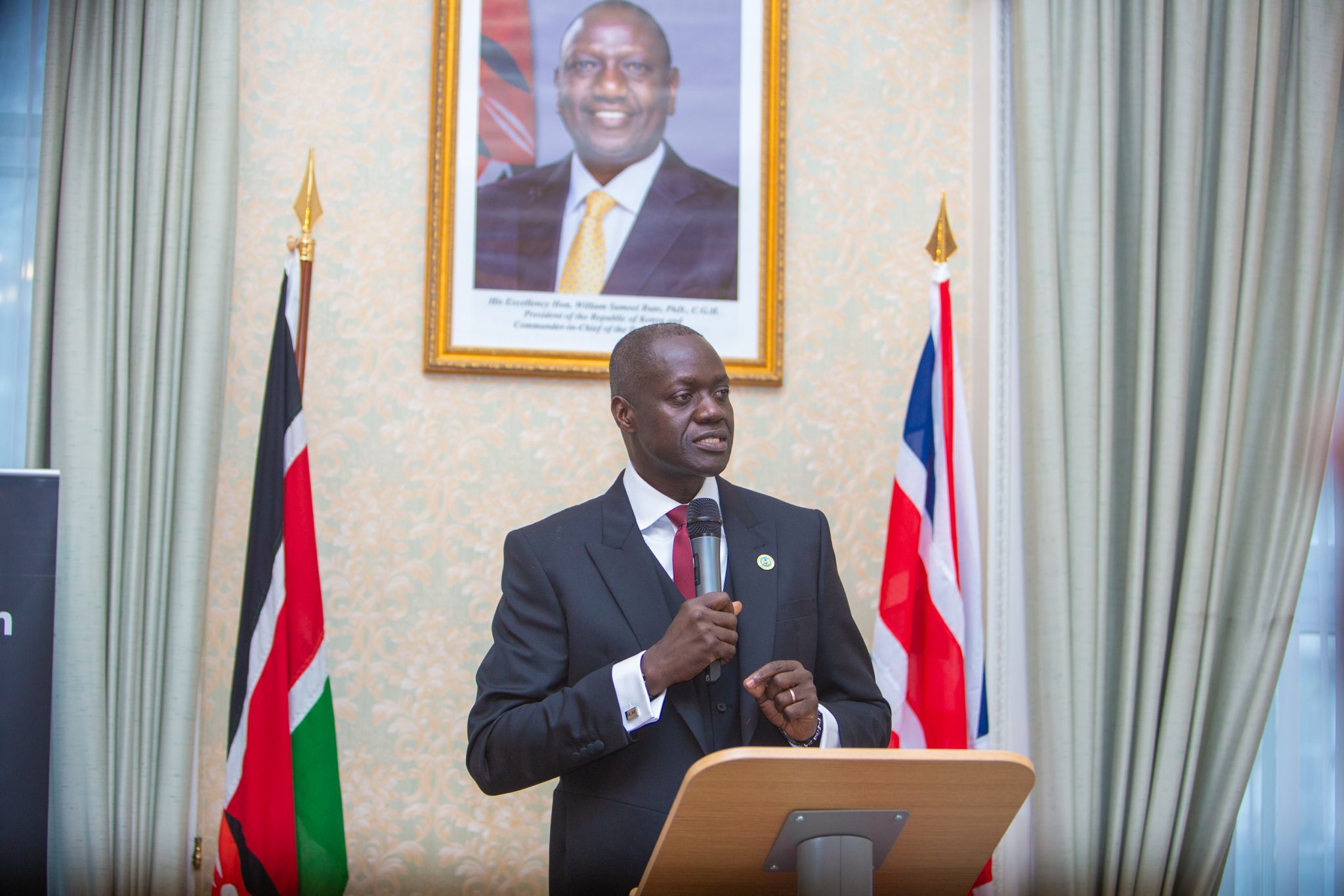
High Commissioner to the UK Maurice Makoloo has rejected claims Kenya has a “massive doping problem”, defending the country’s successful bid to host the 2029 World Athletics Championships.
Responding to The Times journalist Matt Lawton, who questioned the decision to award the 2029 championships to Kenya and argued Africa should instead host the event in 2031, Makoloo said the allegation was “unjustified and incorrect”.


“With respect, it is unjustified and incorrect to allege that Kenya has a ‘massive doping problem’,” Makoloo said, arguing that Kenya had “rightfully won the bid” and had waited too long for the opportunity to host the global athletics showcase.
He cited Kenya’s record at major events in the UK as evidence of the country’s contribution to British sporting events.
Kenya won 12 medals at the 2026 Commonwealth Games in Glasgow and 22 medals at the 2022 Commonwealth Games in Birmingham. Makoloo described the performances as “all clean”.
He also highlighted Kenya’s dominance at the London Marathon, noting that Kenyan men have won 19 of its 45 editions, including the 2026 race, while Kenyan women have won 14 editions.
Makoloo further invoked one of Kenya’s most celebrated sporting achievements in Britain—the world-record 800m run by David Rudisha at the 2012 London Olympics.
“The record set by Kenyan David Rudisha in 800m still holds. Clean and unbroken,” he said.
“Kenya will deliver clean championships in 2029! Because that’s who we are. Capable!”
Kenya will become the first African country to host the World Athletics Championships after winning the bid for the 2029 edition on Tuesday.
The event is set to be staged at the 48,000-capacity Kasarani Stadium. Londond and Rome missed out, with Munich awarded hosting rights in 2031.
Nairobi previously hosted the World U18 Championships in 2017 and World U20 Championships in 2021, giving it experience with major international athletics events.
The decision followed a bid that was partly about geographical representation in athletics. Kenya is one of the world’s great athletics nations but Africa had never hosted the senior World Athletics Championships. London had put forward a strong competing bid, reportedly backed by a £45 million package, while World Athletics ultimately cited factors including government guarantees, financial commitments and the opportunity to expand the sport’s global footprint.
While Lawton’s claim of “massive doping problem” is obviously a matter of characterisation, the doping issue is real.
Kenya has had a significant number of athletes sanctioned for anti-doping violations. The Athletics Integrity Unit’s current global list contains Kenyan athletes serving bans for offences ranging from prohibited substances and methods to whereabouts failures and tampering. Recent 2026 cases include athletes sanctioned over EPO, anabolic steroids, prohibited methods and other substances.
In 2025, the World Anti-Doping Agency placed Kenya’s anti-doping agency, ADAK, on a compliance watchlist following an audit that identified 35 corrective actions, several of them classified as high priority.
Kenya subsequently implemented corrective measures, and WADA removed ADAK from the watchlist in April 2026, saying it had aligned with the World Anti-Doping Code and relevant international standards.