

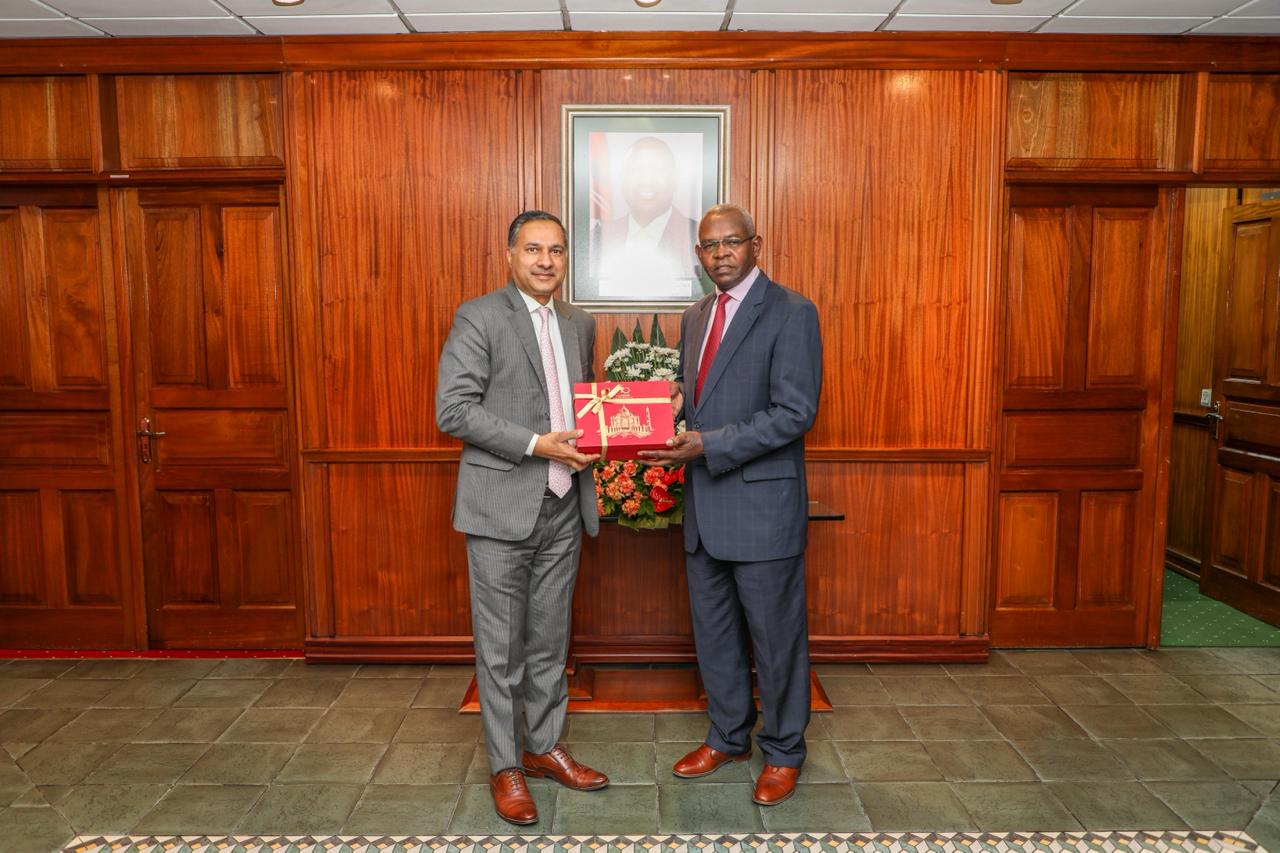
India’s push to deepen cooperation with Kenya on digital payments has gained fresh momentum, with the Indian High Commissioner in Nairobi meeting Central Bank of Kenya Governor Kamau Thugge.
Indian High Commissioner Adarsh Swaika met Thugge on September 25 for discussions on cooperation in banking and digital payments, as Nairobi moves to overhaul the country’s payment infrastructure.


According to the High Commission, they discussed India’s experience with real-time payment systems and opportunities for greater engagement in the financial sector.
The meeting comes days after the CBK and National Treasury unveiled a draft National Payment System Policy and National Payment System Bill, 2026, proposing a modern and interoperable payment ecosystem that could reshape how Kenyans move money between banks, mobile-money platforms and fintechs.
The draft policy specifically points to India’s Unified Payments Interface and Brazil’s PIX as examples of open and interoperable payment infrastructure that Kenya can draw lessons from.
It proposes the development of a national instant payment system capable of facilitating near real-time settlement of retail payments, with the proposed instant payment switch forming part of the modernisation of Kenya’s National Payment System.
The latest India-Kenya talks give fresh push to discussions that began more than a year ago over whether elements of India’s UPI model could be introduced in Kenya.
In June 2025, media reports indicated that officials of the National Payments Corporation of India, which operates UPI, were engaging the CBK as Kenya explored the possibility of adopting the Indian digital payments model.
At the time, Indian officials said discussions involved studying Kenya’s financial ecosystem and gathering information on interoperability before determining how the system could be adapted to local conditions.
The latest discussions, however, appear to be taking place against a broader Kenyan push to establish infrastructure that allows different payment providers to interact seamlessly.
Rather than simply importing UPI, the CBK policy envisages an open system that brings together government, banks and fintech platforms. The policy says such infrastructure, comparable to UPI and PIX, could improve efficiency, financial inclusion and transparency.
It also calls for regulation of instant payment systems and proposes that Kenya’s instant payment switch be developed, implemented and regulated as part of the national payment system.
The development could have significant implications for Kenya’s mobile-money market, where Safaricom’s M-Pesa has played a dominant role in driving digital financial services.
M-Pesa’s success has made Kenya one of the world’s most closely watched mobile-money markets, but the next phase of digital payments is increasingly likely to centre on interoperability. This is where customers are able to transact across different banks, wallets and payment platforms without being restricted by the system through which they hold their money. Indian experience could become particularly relevant in this space.
UPI allows customers to make instant payments between participating banks and financial institutions through a common interoperable infrastructure. It has expanded beyond person-to-person transfers to merchant payments and other digital transactions.
India has increasingly promoted UPI as part of its digital public infrastructure model, including through international partnerships.
It is against the background that Kenya is seeking to create a payment infrastructure capable of connecting multiple players.
The CBK draft policy seeks to promote competition and innovation while making the payment system more efficient, affordable, accessible and inclusive. The proposed National Payment System Bill would replace the existing National Payment System Act and establish a new legal framework for payment systems, including provisions on competition, innovation, consumer protection and financial stability.
The talks also came at a time Nairobi is seeking deeper economic engagement with New Delhi, with banking and financial services forming part of the broader relationship.
The Indian High Commission said Swaika and Thugge also positively assessed the longstanding presence of Indian banks in Kenya and their contribution to the economy, including investments in government securities and support for local businesses.
The CBK and Treasury have invited public comments on the draft National Payment System Policy and Bill, opening the next phase of consultations on the proposed reforms.
The eventual outcome could determine whether Kenya’s next generation of digital payments remains centred on individual platforms or moves towards a more integrated national infrastructure where banks, mobile-money operators and fintech companies can transact seamlessly.