

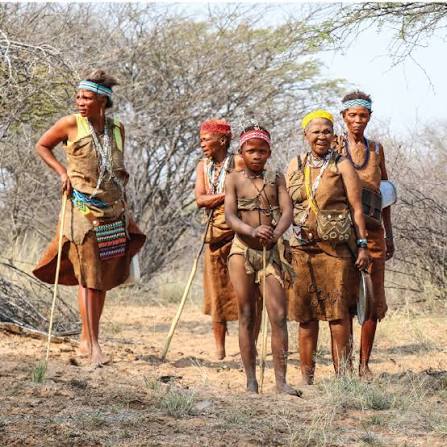
Botswana’s new approach to the Central Kalahari Game Reserve offers Kenya a fresh lens on how conservation, indigenous rights and community economic interests can coexist.
Botswana’s attempt to reconcile conservation with the rights and livelihoods of indigenous communities could offer important lessons for Kenya, where questions over ancestral land, conservation and community participation remain unresolved.


President Duma Boko approved the Central Kalahari Game Reserve (CKGR) Integrated Roadmap on September 15, 2026. The document sets out a multi-year framework that seeks to combine restitution of rights for San communities — members of any of the indigenous hunter-gatherer cultures of southern Africa — with conservation, community governance and economic development.
The roadmap proposes a shift away from a conservation model in which communities are primarily treated as beneficiaries or subjects of government policy, towards one in which they become rights-holders, governance partners and economic participants.
That approach resonates with Kenya’s own experience, particularly the long-running case of the Ogiek community in the Mau Forest in the Rift Valley.
The African Court on Human and Peoples’ Rights has found Kenya in violation of several rights of the Ogiek, including rights relating to land, property, natural resources, culture and development.
In December 2025, the Court found that Kenya had failed to comply with several of its earlier orders, including requirements relating to compensation and the identification, delimitation, demarcation and collective titling of Ogiek ancestral land.
The Botswana roadmap provides a different way of looking at such conflicts, whereby conservation does not necessarily have to come at the expense of indigenous rights.
The CKGR document acknowledges the historical tensions surrounding the reserve and proposes a process aimed at securing the “right to return” of San communities, while maintaining the reserve’s conservation status. It describes restitution, conservation and economic sustainability as interconnected rather than competing objectives.
The proposed framework includes negotiations over settlement, land tenure and usufruct rights, natural-resource use, community institutions and responsibilities for conservation.
This raises a fundamental question for Kenya on whether historical grievances around conservation can be addressed without undermining environmental protection.
The Ogiek case is particularly relevant because the African Court has stressed that recognition of indigenous status must translate into the practical enjoyment of rights.
In its latest compliance decision, the Court said Kenya had not yet completed key processes relating to ancestral land and had not begun required consultations over concessions and leases affecting Ogiek land.
Botswana’s experience suggests that restitution can instead become part of a broader conservation strategy.
But perhaps the most significant feature of the CKGR roadmap is its emphasis on co-management. The plan proposes a legally recognised community representative body and an inter-ministerial task group before moving towards management planning and the establishment of governance structures.
In this arrangement, the government and recognised community institutions are expected to operate a co-management framework for the reserve.
This is an important distinction for Kenya. It already has extensive experience with community participation in conservation. The Kenya Wildlife Service describes the conservation system as combining state-managed protected areas with community-led conservancies, while its current strategy includes expanding conservancies, securing wildlife corridors and strengthening their leadership and management.
Community conservancies, particularly in northern Kenya, have become an important part of wildlife management, with KWS describing them as a model that can enable communities to protect wildlife while benefiting from tourism and sustainable land use.
The Botswana roadmap, however, pushes the conversation further by placing rights, governance and restitution alongside conservation.
Kenya is thus invited to examine whether existing arrangements give communities sufficient authority over decisions affecting their land and resources. It is a question of real inclusion.
The second major lesson is economic.
Botswana’s roadmap envisages conservation as an economic platform capable of generating employment and revenue through tourism, carbon credits, biodiversity credits and other partnerships. It proposes that conservation revenues should flow through community institutions and support productive activities.
This is particularly relevant to Kenya, where communities living alongside wildlife often bear significant costs from conservation, including restrictions on land use and human-wildlife conflict.
Kenya already recognises the economic dimension of conservation. KWS describes its wildlife economy as the sustainable use of wildlife resources to generate economic benefits while maintaining ecological integrity. Its current programmes include community conservancies and wildlife enterprises.
The critical questions for Kenya are: How much influence and economic value do communities receive from conservation, and are those benefits sufficient to make conservation a durable local interest?
Botswana also proposes documenting traditional ecological knowledge and incorporating it into conservation planning alongside scientific research. Its roadmap envisages communities participating in the generation of knowledge that informs management decisions.
That has relevance beyond the Ogiek case. Kenya’s forests, rangelands and wildlife corridors are inhabited and used by communities with generations of knowledge about wildlife, water, vegetation and changing ecological conditions. Bringing that knowledge into formal conservation planning could strengthen community ownership while complementing scientific approaches.
Kenya already has many of the building blocks. Kenya’s Wildlife Conservation and Management Act provides for community participation, conservancies and benefit-sharing arrangements, while KWS management frameworks incorporate community partnership alongside ecological management, tourism and security.
The gap is therefore less about discovering the idea of community conservation than about deepening it.
Botswana’s CKGR roadmap offers a useful case study because it attempts to bring together indigenous rights, conservation, community governance and economic development, four elements often treated separately.
While its implementation is still ahead, the roadmap itself acknowledges unresolved legal, policy, infrastructure and institutional challenges, and lays out a phased process extending through community consultations, agreements, management planning and eventual operationalisation.
This makes the Botswana experience worth watching for Kenya, not much as a model to copy wholesale, but as a test of whether conservation can move beyond the old divide between protecting nature and protecting community rights.
So can indigenous communities become not merely participants in conservation, but rights-holders, co-managers and economic beneficiaries with a direct stake in protecting the landscapes they call home? That’s a question that should be answered by then draft Bill on Ethnic Minorities and Marginalized Communities, 2026, that is currently under review