

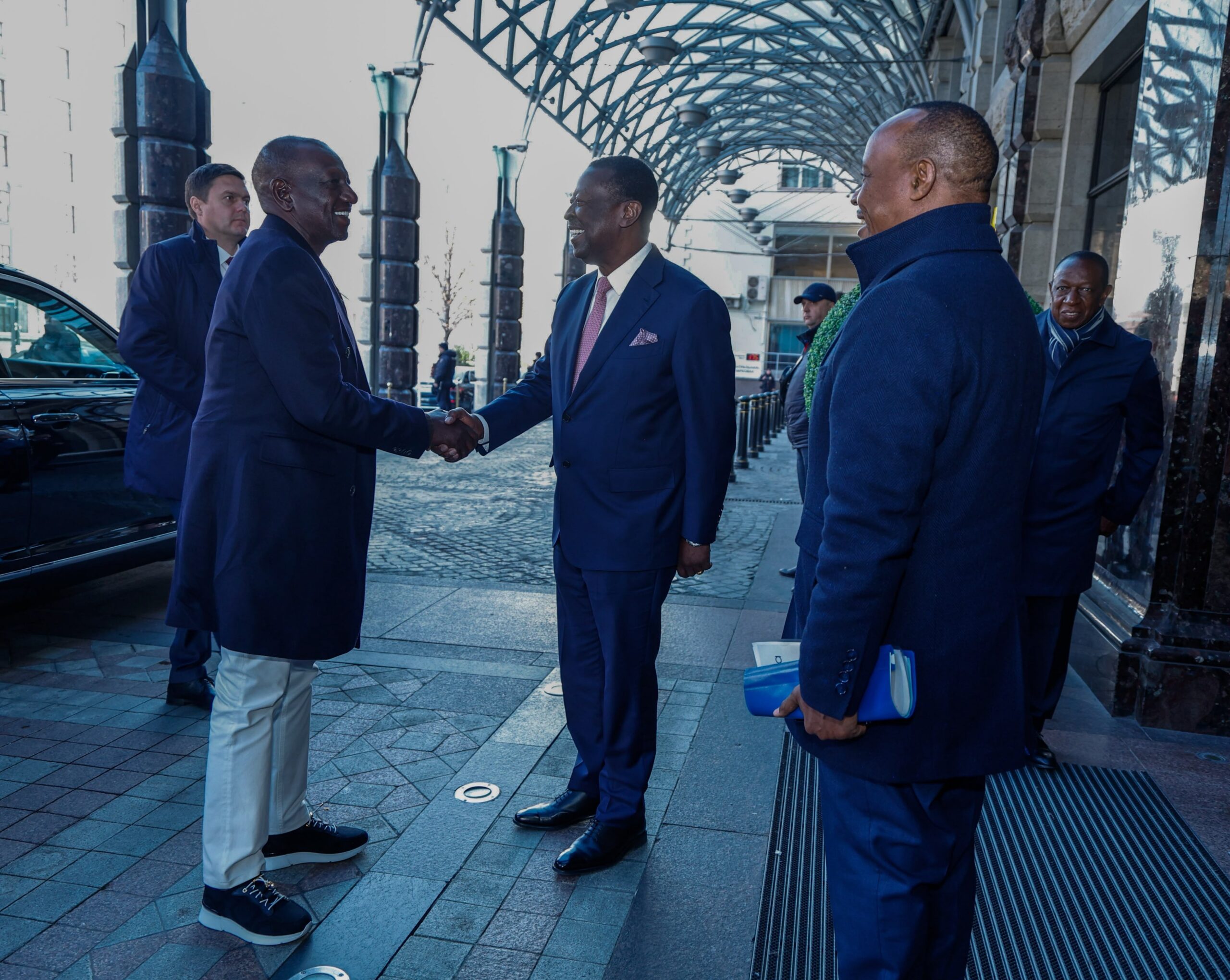
President William Ruto’s first visit to Moscow since taking office has put trade and investment at the centre of Kenya’s engagement with Russia, but left out the plight Kenyans recruited to fight in the war against Ukraine.
The President is attending the third Russia–Africa Economic and Humanitarian Forum on October 28–30, with State House outlining plans to expand exports, attract investment and secure partnerships in agriculture, energy, manufacturing and technology.


But the published presidential agenda makes no explicit reference to talks over Kenyans who travelled to Russia after allegedly being promised civilian jobs, only to find themselves in military service, with dozens reported killed or missing in action.
The issue was also absent from Prime Cabinet Secretary and Foreign Affairs CS Musalia Mudavadi’s public remarks outlining Kenya’s priorities ahead of the summit.
This is despite the government having acknowledged the scale of the crisis and the difficulties families face in tracing their relatives.
The omission raises questions about whether Ruto will use his first presidential engagement in Moscow to seek concrete commitments on missing Kenyans, the return of remains and the release of those seeking to leave military service.
According to figures Mudavadi presented to Parliament on October 8, the government had recorded 354 Kenyans connected to the Russia-Ukraine conflict.
Of these, 84 were classified as killed or missing in action, while 77 were reportedly on the front lines and 38 in military camps. Another 52 were listed as being in unknown or unclassified locations, 34 were hospitalised, 62 had been repatriated and five were prisoners of war in Ukraine.
The figures have been challenged by families and petitioners, who presented Parliament with a list containing approximately 841 names, arguing that the government’s records could significantly understate the number of Kenyans affected.
Earlier in February, National Assembly Majority Leader Kimani Ichung’wah presented a National Intelligence Service report to Parliament indicating more than 1,000 Kenyans had been recruited to fight for Russia in the war against Ukraine.
The report said recruiters had targeted former military and police officers, as well as civilians seeking employment abroad, with promises of lucrative salaries, bonuses and eventual Russian citizenship.
The intelligence briefing noted that some recruits left Kenya on tourist visas, transiting through Istanbul in Türkiye and Abu Dhabi in the UAE, while others travelled through neighbouring countries to evade scrutiny.
The report also detailed allegations that recruitment networks colluded with rogue officials to facilitate the movement of recruits. The Russian Embassy in Nairobi denied allegations of involvement in illegally recruiting Kenyans, saying foreign nationals could voluntarily enlist in the Russian armed forces.
The government has said it is working through diplomatic channels to establish the whereabouts of missing nationals, pursue the release of prisoners and facilitate the return of those seeking to leave the conflict.
However, the fate of those already recruited remains unresolved.
Mudavadi travelled to Moscow in March for talks with Russian Foreign Minister Sergey Lavrov, after which Kenya announced an agreement intended to stop further enlistment of its nationals through Russia’s Defence Ministry.
Kenya subsequently said it had been placed on a Russian military recruitment “stop list”, with the government reporting that no additional Kenyans had been enlisted through the Defence Ministry following implementation of the measure.
The agreement, however, did not automatically resolve the situation of those already serving in the Russian military.
Families continue to seek information about relatives whose whereabouts are unknown, while others are waiting for confirmation of reported deaths and the return of remains.
The government has also acknowledged the difficulties of tracing nationals in active combat zones, particularly where communication has broken down and access to battlefield information is limited.
During his appearance before parliamentary committees, Mudavadi said Kenya was dependent on diplomatic engagement because it lacked the capacity to conduct rescue operations inside Russian or Ukrainian territory.
The published programme, however, does not identify the recruitment crisis as a presidential agenda item or indicate the two leaders will discuss the matter.
In a statement ahead of the summit, the Kenyan Embassy in Moscow said the government was continuing to engage Russian authorities over the recruitment of Kenyans into foreign armed formations, loss of life and the welfare of affected families.
The embassy also indicated that issues discussed during Mudavadi’s earlier visit remained active on the bilateral agenda, although it did not specify whether individual cases would be raised during the summit.