
Kenya is projected to grow more slowly than Uganda, Ethiopia, Rwanda and Tanzania in 2027, according to the International Monetary Fund’s latest economic forecasts
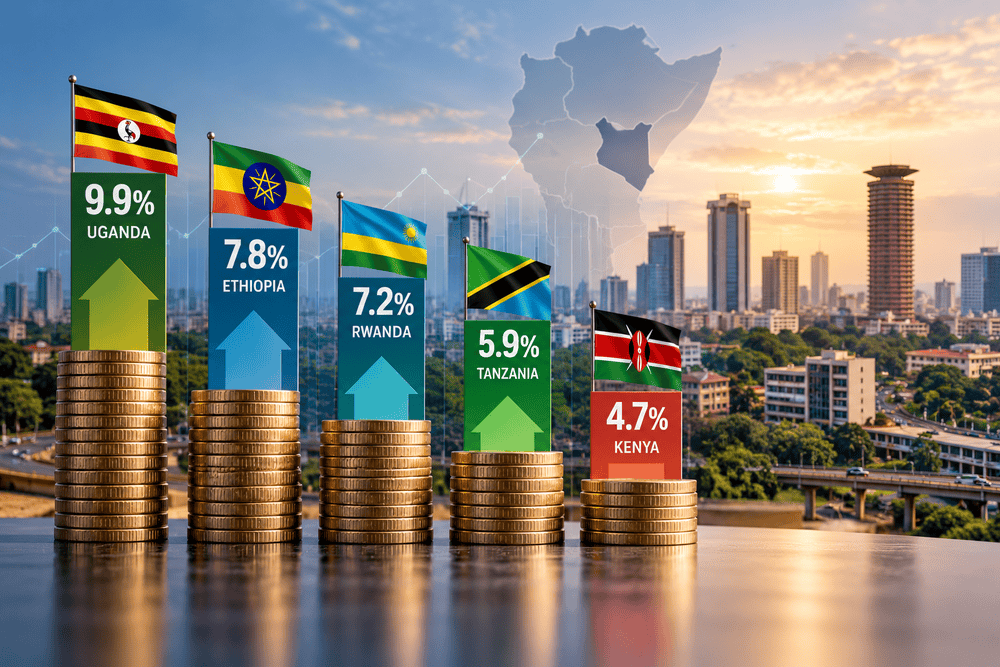
The IMF’s October 2026 World Economic Outlook database projects Kenya’s real gross domestic product to expand by 4.7 per cent in 2027, compared with 9.9 per cent for Uganda, 7.8 per cent for Ethiopia, 7.2 per cent for Rwanda and 5.9 per cent for Tanzania.


The projections place Kenya behind four countries in its wider East African neighbourhood, although its forecast remains above the projected Sub-Saharan African average of 4.5 per cent.
The gap is particularly pronounced against Uganda, whose projected growth rate is more than twice Kenya’s, while Ethiopia and Rwanda are also expected to record substantially faster economic expansion.
Zambia, at 4.9 per cent, is among the other African economies forecast to grow faster than Kenya in 2027.
Kenya’s economy is projected to grow by 4.5 per cent in 2026, down slightly from 4.6 per cent in 2025, before recovering to 4.7 per cent in 2027.
The 2027 projection represents an improvement of just 0.2 percentage points from the previous year, suggesting that economic expansion will remain relatively moderate even as the country enters the election cycle.
Uganda’s projected 9.9 per cent expansion in 2027 represents the largest gap with Kenya among the four East African economies. Ethiopia follows at 7.8 per cent, while Rwanda is forecast to grow by 7.2 per cent.
Tanzania’s projected 5.9 per cent growth is closer to Kenya’s, but still exceeds it by 1.2 percentage points.
The differences highlight the varied growth trajectories across the region. However, GDP growth rates alone do not establish which economy is performing better overall, as countries differ in population, income levels, economic structure and the distribution of growth.
The IMF’s October regional economic outlook, titled Resilient Growth, Clouded Outlook, projects Sub-Saharan Africa’s economy to grow by 4.5 per cent in both 2026 and 2027.
However, the Fund warns that the regional outlook faces significant downside risks, including renewed energy supply disruptions, rising financing costs, declining foreign aid and severe weather shocks.
It also identifies high interest payments, low foreign exchange reserves in several countries and limited fiscal room as vulnerabilities that could make governments less capable of responding to fresh economic shocks.
The IMF recommends protecting productive investment, supporting private-sector growth and targeting assistance towards vulnerable households, while containing persistent inflation.
Kenya’s forecast, however, remains above the projected regional average, offering some evidence of continued economic resilience.