
Western powers have condemned the pursuit of political power through violence by a new movement led by former DRC President Joseph Kabila.
Through a joint statement circulated on Saturday, the International Contact Group for the Great Lakes Region comprising the US, the EU and nine other Western countries warned that political grievances cannot be resolved through military means.

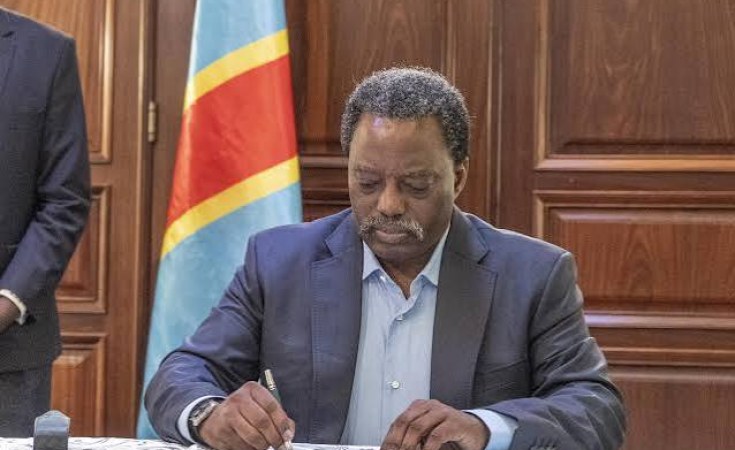
They singled out the newly established Front for the Refoundation of the Nation (FRN), which Kabila was appointed to lead in October.
The group said it categorically rejected the pursuit of political objectives through violence, as advocated by the movement, amid growing political and security tensions in the conflict-hit country.
“The ICG categorically rejects the pursuit of political objectives through the use of violence, as advocated by the recently created Front for the Refoundation of the Nation (FRN), “ it said.
The statement marks a significant diplomatic response to Kabila’s return to the centre of Congo’s political and security crisis, following the formation of the FRN, which brings together political and military figures previously associated with the Congo River Alliance and the M23 rebellion.
The Contact Group called on all Congolese actors to respect the country’s Constitution, rule of law and territorial integrity, insisting that lasting peace would require an inclusive political process involving all key stakeholders.
“It underscores the need for all parties to respect the rule of law and the Constitution of the DRC and reiterates its commitment to the sovereignty, independence, unity and territorial integrity of the DRC.
“It recalls the importance of a peaceful and inclusive inter-Congolese dialogue involving all key Congolese stakeholders as an essential prerequisite for lasting peace in the DRC,” the group said.
It said political differences and grievances could not be resolved through military means, adding that protecting fundamental rights was necessary to allow political parties and civil society organisations to operate freely.
Kabila’s appointment as head of the FRN on October 12 has introduced a new dimension to the conflict, with the former president taking a more direct leadership role in a coalition opposing President Felix Tshisekedi’s government.
The movement was unveiled in the eastern city of Goma as a successor to the Congo River Alliance (AFC), whose leadership had been closely associated with the M23 rebellion.
Its leadership structure includes former electoral commission chief Corneille Nangaa and M23 political leader Bertrand Bisimwa as vice-presidents. Military commander Sultani Makenga was named Chief of General Staff.
At its launch, the movement’s adviser Claude Ibalanky said its mission was to bring together resistance forces to end what it described as tyranny, including through the use of force.
Kabila, who ruled the DRC between 2001 and 2019, has accused Tshisekedi’s administration of corruption, poor governance and failure to address the security crisis in eastern Congo.
His involvement in the new coalition has heightened concerns about the possibility of further militarisation of the country’s political contest.
The former president has previously faced accusations from the Congolese government of supporting the AFC/M23 rebellion, allegations he has denied. He was also sentenced to death in absentia by a Congolese military court over charges including treason and complicity in the rebellion, which he has rejected as politically motivated.
The Contact Group’s statement comes as international mediators seek to advance two parallel diplomatic initiatives aimed at ending the conflict: the Washington Accords and the Doha Framework.
The group urged all parties to the agreements to remain committed to the peace process and fulfil their obligations without delay, while supporting mediation efforts led by the African Union and other regional partners.
“The International Contact Group for the Great Lakes region (ICG) encourages all parties to the Washington Accords and Doha Framework to remain committed and engage in good faith to find a lasting and peaceful resolution of the conflict and to fulfil their obligations without delay,” it said.
It also welcomed an October 19 statement by AU Commission chairman Mahamoud Ali Youssouf, calling on all parties to exercise restraint.
The renewed diplomatic intervention comes against the backdrop of continued fighting in eastern DRC, where clashes between government forces and M23 fighters have displaced civilians and complicated humanitarian operations.
The ICG specifically expressed concern over the increasing use of drones, warning that their deployment was having grave consequences for civilians and humanitarian workers.
It urged all parties to honour the ceasefire commitments made under the Doha process on July 19, 2025, and ensure that humanitarian organisations have safe and unrestricted access to populations affected by the conflict.
The statement also reiterated demands for Rwanda to cease support for M23 and withdraw its troops from Congolese territory, in line with United Nations Security Council Resolution 2773.
Kinshasa was equally urged to present an action plan and timeline for implementing the disarmament, demobilisation and reintegration of Democratic Forces for the Liberation of Rwanda (FDLR) fighters.
The group further called for the dismantling of parallel administrations established in areas outside government control.
The intervention places Kabila’s new political platform under renewed international scrutiny just weeks after its formation, as efforts to negotiate an end to the eastern Congo conflict face the additional challenge of an expanding political-military confrontation.