Kenya and China are exploring the expansion of Chinese language education into senior schools and Teacher Training Colleges.
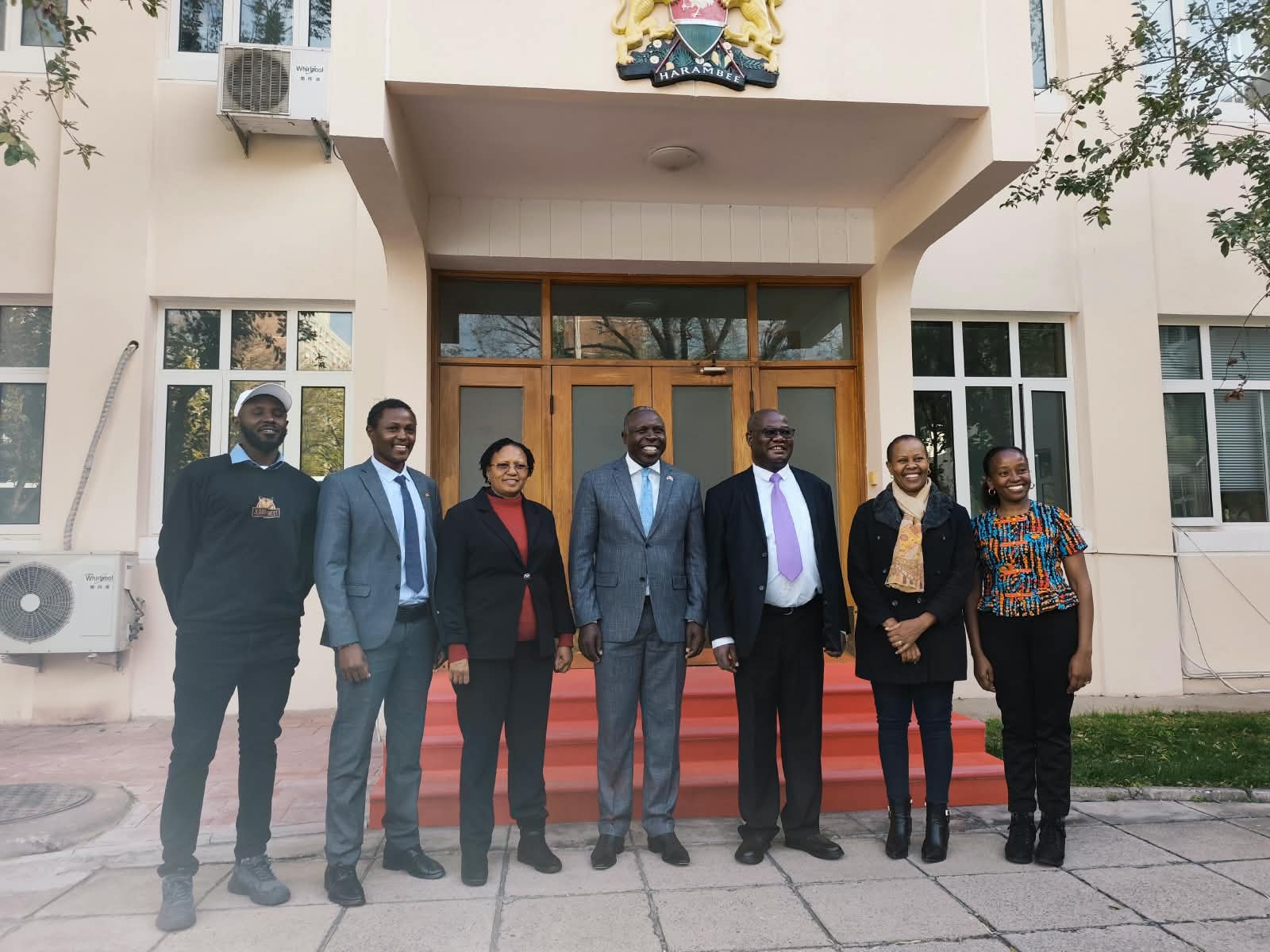
The proposal was discussed during a meeting between officials of the Kenyan Embassy in Beijing led by Ambassador Willy Bett and a University of Nairobi delegation led by Deputy Vice-Chancellor Prof. Josiah Omollo Aduda.
“Discussions focused on strengthening Kenya–China educational cooperation, particularly the piloting of Chinese language programmes in senior schools and Teacher Training Colleges in Kenya,” the Embassy said in a social media dispatch.
The proposed initiative comes amid growing interest in Mandarin, driven by expanding economic, educational and cultural ties between Nairobi and Beijing, as well as increasing demand for Kenyans with Chinese language skills.
The discussions also come against the backdrop of renewed institutional cooperation between Kenya and Chinese education bodies to expand language instruction and develop a pool of qualified teachers.
The University of Nairobi delegation visited China's Centre for Language Education and Cooperation, where it met Deputy Director General YU Tianqi and Zhong Yinghua, President of the World Chinese Language Teaching Society, among other officials.
According to UoN, discussions focused on “Kenya’s progress in expanding Chinese language education, strengthening the Confucius Institute and developing qualified Chinese language teachers to support growing demand in schools and universities.”
The visit followed the renewal of a four-party collaborative agreement involving the UoN, Tianjin Normal University, CLEC and the Teachers Service Commission.
UoN Vice Chancellor Eng. Prof. Ayub Gitau signed the agreement during the 2026 World Chinese Language Conference in Beijing on November 14.
The delegation also included Prof. Wang, Director of the Confucius Institute; Prof. Rosemary Imonje and Prof. Boniface Ngaruiya from the Faculty of Education; and Dr. Lilian Mwangi from the Teachers Service Commission, alongside other senior university officials.
TWO DECADES OF MANDARIN TEACHING
Kenya's engagement with Chinese language education dates back more than two decades, with the establishment of the Confucius Institute at UoN in December 2005.
The institute, established in partnership with China's Tianjin Normal University, was the first Confucius Institute in Africa. It was set up to promote Chinese language and culture through teaching, academic exchanges and scholarships.
Over the years, it has expanded its programmes beyond basic language instruction to include undergraduate studies, teacher education and Chinese proficiency examinations.
According to UoN, the institute had more than 500 students enrolled in different Chinese proficiency classes by July 2022, reflecting growing demand among Kenyans seeking to acquire Mandarin skills.
Its programmes include a Bachelor of Arts in Chinese, a Bachelor of Education (Arts) with Chinese and the Hanyu Shuiping Kaoshi (HSK), an internationally recognised Chinese language proficiency examination.
The institute has also worked with Kenyan schools to introduce Chinese language lessons and cultural programmes.
In July 2024, its then director, Prof. Wang Shangxue, said it had trained more than 20,000 students since its establishment and was seeking to expand Chinese language instruction across the country's education system.
Kenya has also established Confucius Institutes at Kenyatta University, Egerton University and Moi University, extending Mandarin instruction beyond UoN.
The proposed pilot in senior schools builds on earlier efforts to integrate Chinese into Kenya's national education system.
In 2020, Chinese was approved as one of the foreign languages that could be offered in the country's education system, alongside French, German and Arabic.
However, the expansion of the subject has faced challenges, particularly the availability of qualified teachers and appropriate learning materials.
In 2024, UoN led a delegation of Kenyan education officials, including representatives of the TSC and Kenya Institute of Curriculum Development, to China to explore ways of strengthening Chinese language instruction.
The discussions included teacher training, curriculum development, teaching materials and the introduction of pilot schools.
The Confucius Institute has since been involved in building local teaching capacity. Its collaboration with the TSC includes training Kenyan teachers to deliver Chinese language lessons, while its partnership with Tianjin Normal University has supported the development of specialised teacher education programmes.
In 2025, the institute also initiated a Chinese language teaching pilot at State House Girls High School, an initiative intended to support the integration of Mandarin into the Kenyan education system.
The latest discussions in Beijing point towards the expansion of these efforts, particularly through senior schools and teacher training colleges.
The involvement of teacher training institutions is significant because expanding Mandarin instruction across schools will require a steady supply of qualified teachers capable of delivering the subject under Kenya's Competency-Based Education system.
Beyond education, proficiency in Chinese is increasingly seen as a potential employment advantage as Kenyan businesses, tourism operators and companies working with Chinese investors seek workers able to communicate in Mandarin.