

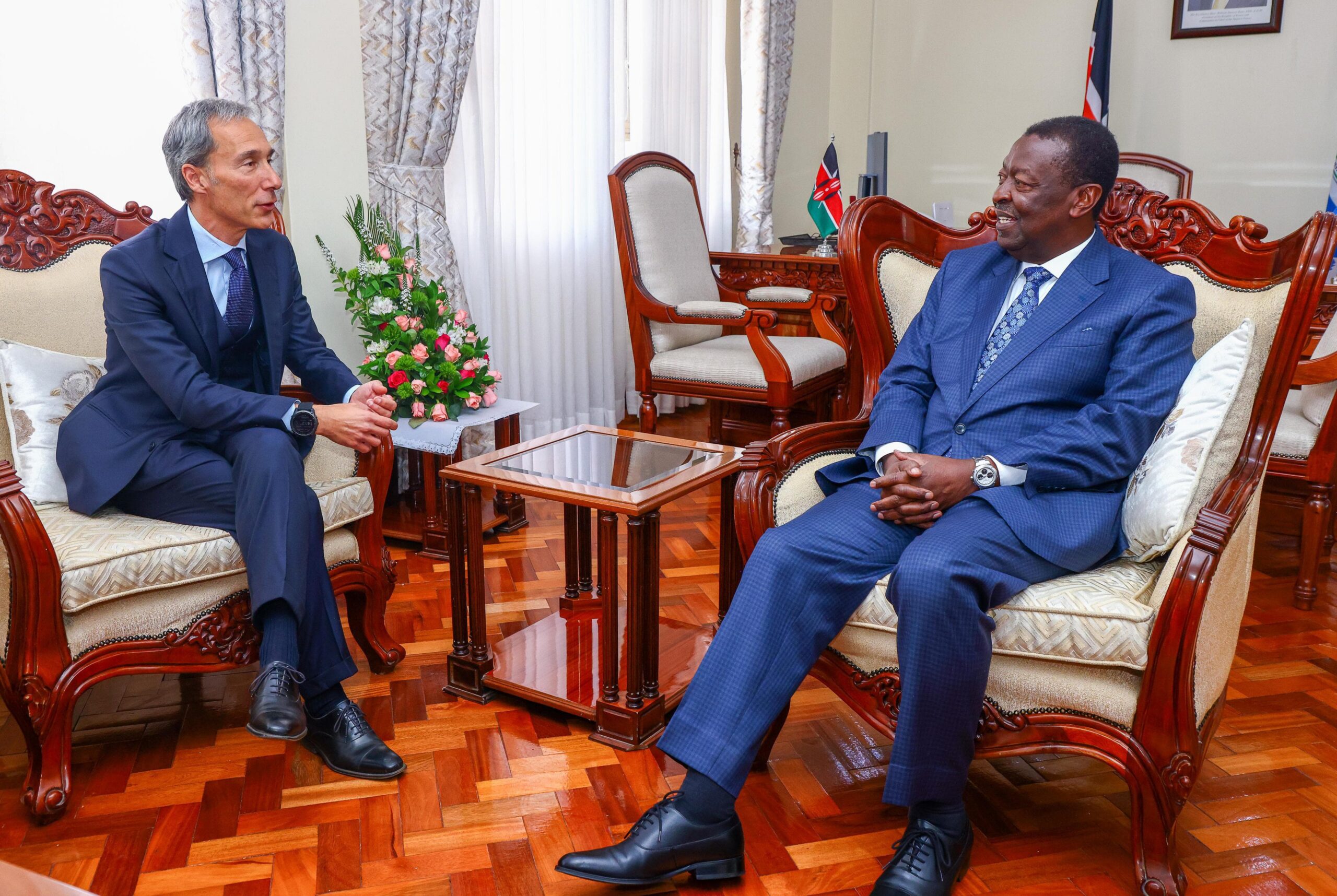
Kenya and the International Fund for Agricultural Development are seeking to strengthen climate-resilient agriculture, boost farm productivity and improve incomes for smallholder farmers as the government steps up efforts to transform the rural economy.
Prime Cabinet Secretary Musalia Mudavadi on Thursday said the priorities featured in discussions with IFAD’s new Country Director and Representative to Kenya, Matteo Marchisio, who formally assumed office after presenting his credentials to the government.


“When our farmers thrive, Kenya thrives. Food security begins with empowering the people who feed our nation,” Mudavadi said in a statement following the engagement.
He said the discussions focused on strengthening climate-resilient farming, boosting productivity and improving livelihoods for smallholder farmers and rural communities.
“For Kenyans, this means better harvests, stronger incomes and more opportunities for young people in agribusiness,” Mudavadi said, adding that the government’s goal was to make farming more productive, profitable and central to Kenya’s economic future.
The discussions come at a time as Kenya faces the challenge of raising agricultural output, while protecting rural livelihoods from climate shocks, reducing production costs and creating employment opportunities for a growing youth population.
IFAD, a specialised United Nations agency and international financial institution focused on rural development, has supported Kenya’s agricultural transformation through investments in smallholder farmers, rural enterprises and financial services.
The organisation says its support has also targeted agricultural value chains, market access, sustainable natural resource management and resilience to climate change.
Since Kenya joined IFAD in 1977, the organisation has financed more than 20 programmes and projects in the country, mobilising nearly $1.4 billion to support rural transformation, agricultural development and climate resilience.
According to IFAD, these investments have improved livelihoods, strengthened resilience and created opportunities for millions of rural Kenyans.
Marchisio said the organisation remained committed to supporting rural livelihoods, food security and climate resilience, emphasising shared ownership and cooperation with the government.
“Mutual commitment and shared ownership are at the heart of our partnership with Kenya, and we look forward to continuing our close partnership with the Government of Kenya and our partners to advance national development priorities and create greater opportunities for rural communities,” he said.
The partnership also comes as Kenya works to strengthen preparedness for climate-related emergencies, including the effects of El Niño and other extreme weather events that threaten farming communities and their productive assets.
IFAD said its financed projects were identifying measures to improve early warning systems and risk reduction, protect vulnerable rural households and productive assets, and support rapid recovery and longer-term resilience.
Such interventions seek to help rural communities withstand climate shocks while protecting the livelihoods that depend on agriculture.
Beyond climate adaptation, the partnership is aligned with Kenya’s ambition to strengthen agricultural value addition and agribusiness, mobilise public and private investment and reduce the costs associated with production.
These priorities are particularly significant for smallholder farmers, who need reliable access to markets, finance, appropriate technology and climate-resilient farming practices to increase productivity and improve earnings.
Expanding opportunities in agribusiness could also help create jobs for young people in rural areas, where livelihoods remain closely linked to agriculture and related economic activities.
Looking ahead, IFAD’s next country strategy for Kenya, scheduled for preparation in 2027, is expected to provide an opportunity to align future investments with government priorities and the country’s longer-term development ambitions.
The process will build on cooperation with national and county governments, the private sector, farmers’ organisations and development partners.
Marchisio also recognised Kenya’s role in IFAD’s governance and thanked the government for its pledge to the organisation’s Fourteenth Replenishment, describing the contribution as a reflection of Kenya’s commitment to multilateral cooperation and sustainable rural development despite a challe