

Thailand and Kenya are deepening agricultural cooperation, with the partnership shifting towards technology transfer, mechanisation and practical skills to improve smallholder farming.
This emerged on Wednesday during the opening of the Thailand-Kenya Agro-Technology Training 2026 at the Kenya School of Agriculture in Nyeri.


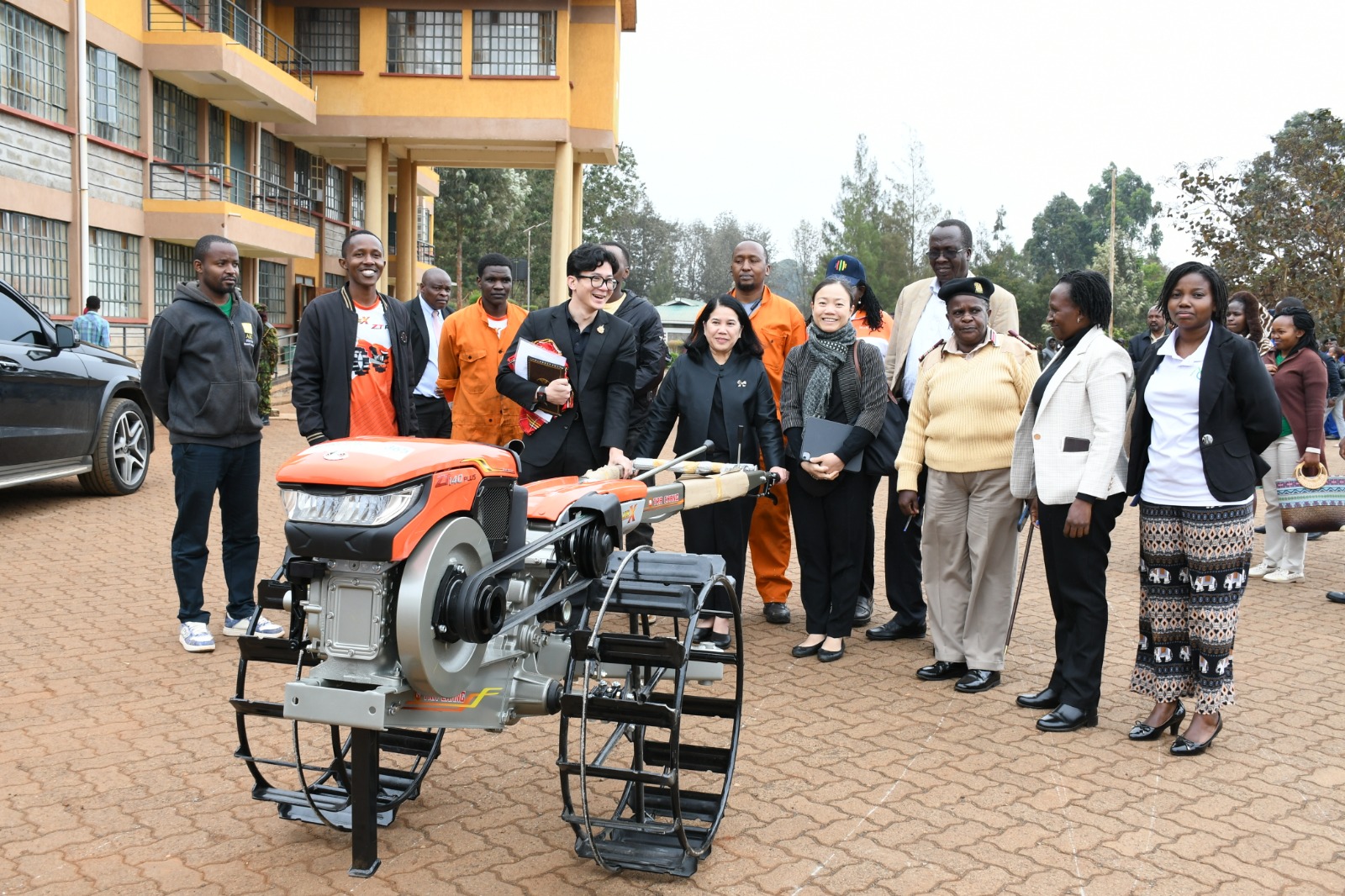
During the event, Green Africa Group — a green entrepreneurship and community-driven projects company — donated an AgroPro 365 powered by Kubota walking tractor to the institution.
The machine will be used as a training and demonstration tool for farmers, students and agricultural practitioners, with the partners seeking to move agricultural technologies from the classroom to farms.
Green Africa said appropriate mechanisation could help reduce physical labour, improve productivity and move farmers from subsistence production towards sustainable agribusiness.
“Technology alone is not enough. We must train, demonstrate and transfer knowledge,” Green Africa Group said in a speech delivered during the event.
The group said the donated tractor should become a long-term practical training facility rather than simply a piece of equipment.
“May it become a practical training and demonstration tool” for farmers, students and agricultural practitioners, it said.
Thai Ambassador to Kenya Jirusaya Birananda said the donation formed part of a broader partnership that seeks to strengthen local agricultural expertise.
“I hope that the training today will build further on local farming expertise,” Birananda said, adding that the power tiller was intended to be affordable and durable and suited to the needs of smallholder farmers in Nyeri and beyond.
The ambassador said the cooperation between Kenya and Thailand had traditionally centred on agriculture and agro-industry, areas where the two countries have exchanged knowledge and best practices.
The partnership is anchored by the Thailand-Kenya Agro-Technology Learning Centre at KSA, which was established in 2022 to commemorate 55 years of diplomatic relations.
Birananda said the cooperation was about more than agricultural machinery.
“It is about strengthening a partnership between our peoples,” she said, signalling a broader push to expand agricultural cooperation beyond individual training programmes.
KSA Director Rosemary Nyamu said the partnership with the Royal Thai Government, through the Thailand International Cooperation Agency and Khon Kaen University, had strengthened the institution’s capacity to demonstrate practical agricultural technologies.
The learning centre has enabled trainers and farmers to test technologies and learn about climate-smart agricultural practices, including smart soil and water management, climate-resilient crop production and agrobio-products.
Nyamu said the ultimate test of the partnership would be its impact beyond the training centre.
“The most enduring measure of this partnership will be the knowledge retained by our trainers, the skills gained by our students, and the improvements experienced by farmers,” she said.
KSA plans to extend lessons from the Nyeri centre through its network of campuses, trainers and agricultural stakeholders across the country.
The institution has identified agricultural machinery operation and maintenance, advanced agro-processing, water-efficient agriculture and climate-smart value addition as potential areas for further cooperation.
The partners also discussed possible Master’s degree scholarships for KSA staff, feasibility studies for a water-harvesting system and the establishment of a parabola dome at the Nyeri campus.
The agricultural partnership comes as Kenya prepares to mark 60 years of diplomatic relations with Bangkok in 2027.
Birananda said the Agro-Technology Learning Centre could remain a platform for turning the bilateral relationship into practical initiatives, particularly as Thailand seeks to deepen engagement with Africa.