

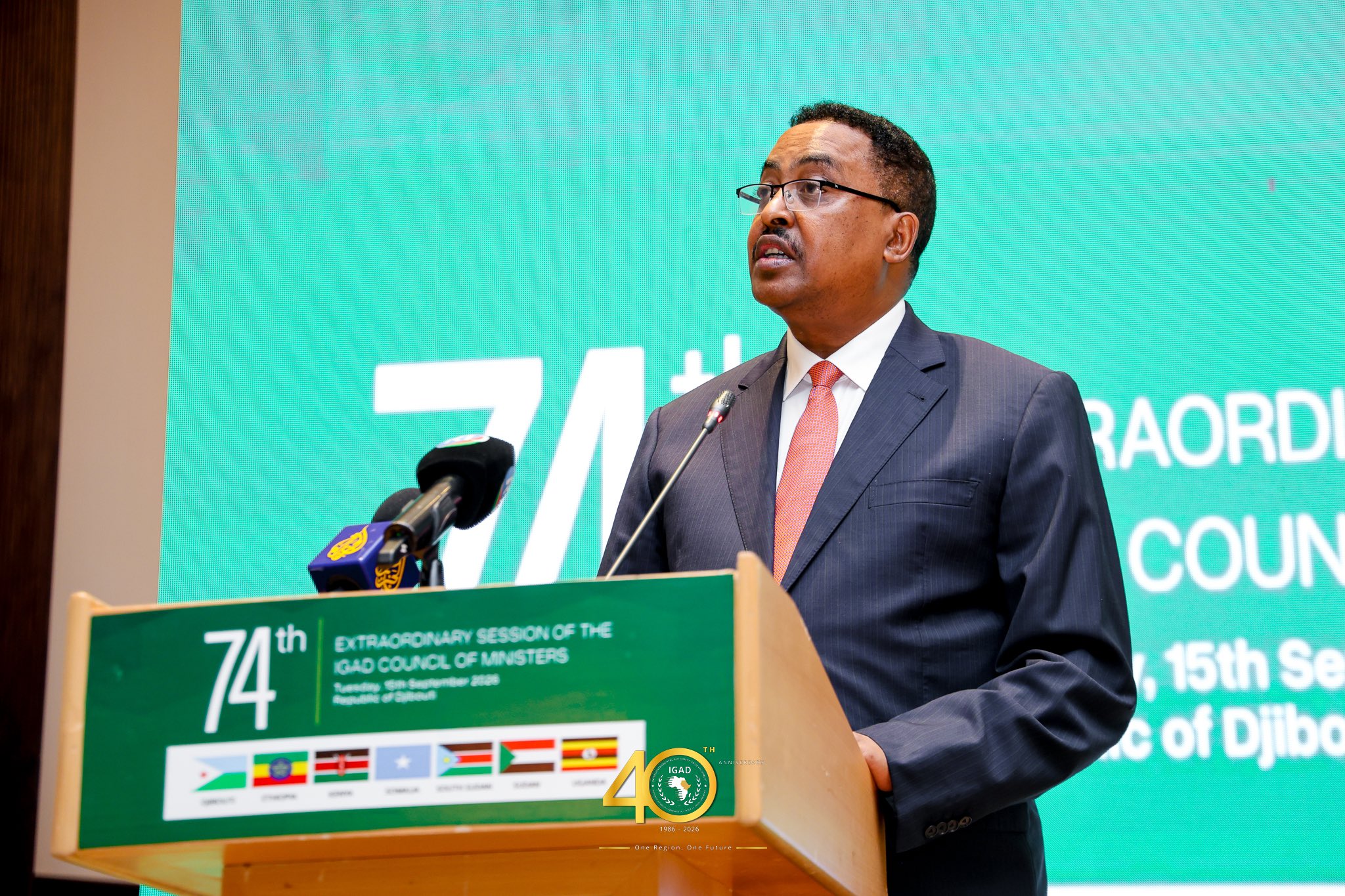
IGAD has ordered member states with outstanding arrears to clear their debts within one year through quarterly payments, alongside their pledges towards construction of the regional bloc’s new headquarters.
The directive was adopted by the IGAD Council of Ministers during its 74th Extraordinary Session in Djibouti on Tuesday as the organisation moved to strengthen its finances and prevent the accumulation of new arrears.
The Council directed the Secretariat to communicate to each member state the amount of its outstanding arrears and its pledge towards the headquarters, together with an agreed payment schedule.
It further directed the Committee of Ambassadors, supported by the Budget and Planning Committee, to review compliance with the payment arrangements every quarter and report to the next Ordinary Session of the Council.
The Council also tasked the committees with monitoring member-state contributions to prevent new arrears from accumulating.
Kenya was among three IGAD member states specifically commended for having no arrears of assessed contributions. The other two are Djibouti and Ethiopia.
The Council acknowledged payments received during the year from Ethiopia and Djibouti while requiring countries with outstanding obligations to clear them within the one-year period.
The financial measures come as IGAD acknowledges constraints facing the organisation and seeks to diversify its sources of funding beyond assessed contributions and support from development partners.
The Council encouraged the Secretariat to continue diversifying its funding sources, subject to authorisation by IGAD’s policy organs.
The organisation’s financial challenges are also linked to the construction of its new headquarters.
The Council confirmed that financing contracted by the Secretariat for construction of the headquarters was undertaken with the authorisation of IGAD’s policy organs and in line with previous decisions on the project.
It subsequently resolved that member states would collectively assume responsibility for servicing and discharging the resulting financial obligations.
The obligations will be apportioned among member states according to their respective assessed contributions.
The headquarters project has been in the works for several years.
In November 2022, the IGAD Council of Ministers committed member states’ support for the Secretariat to mobilise resources needed to complete the project from diverse sources, including bank loans.
In June 2023, the IGAD Assembly of Heads of State and Government resolved that each member state contribute $2 million towards construction of the headquarters complex.
The communiqué says the financing contracted by the Secretariat was undertaken pursuant to those earlier decisions and that member states will collectively take responsibility for the resulting obligations.
The Council acknowledged financial constraints facing IGAD had contributed to the need to mobilise resources from different sources, including loans, to complete the headquarters project.
The financial pressure comes as the regional bloc faces expanding demands across the Horn of Africa, including conflicts, humanitarian crises, food insecurity and security threats.
IGAD estimates that 49 million people in the region face acute food insecurity, while internal displacement has exceeded 19 million.
Sudan remains the region’s most severe humanitarian crisis, with almost 19.5 million people facing crisis levels of hunger and about nine million people displaced by the conflict.
The organisation is also engaged in peace efforts in Sudan and South Sudan, supports regional security efforts in Somalia and is seeking stronger cooperation to address security threats along the Red Sea and Gulf of Aden.
The Council’s decision introduces closer quarterly monitoring of member contributions, with countries in arrears expected to follow agreed payment schedules over the next year.
The communiqué, however, does not disclose the total outstanding arrears owed by individual member states or the total amount borrowed to finance the new headquarters.
It also does not provide the individual amount each member state will be required to contribute towards servicing the headquarters financing.