
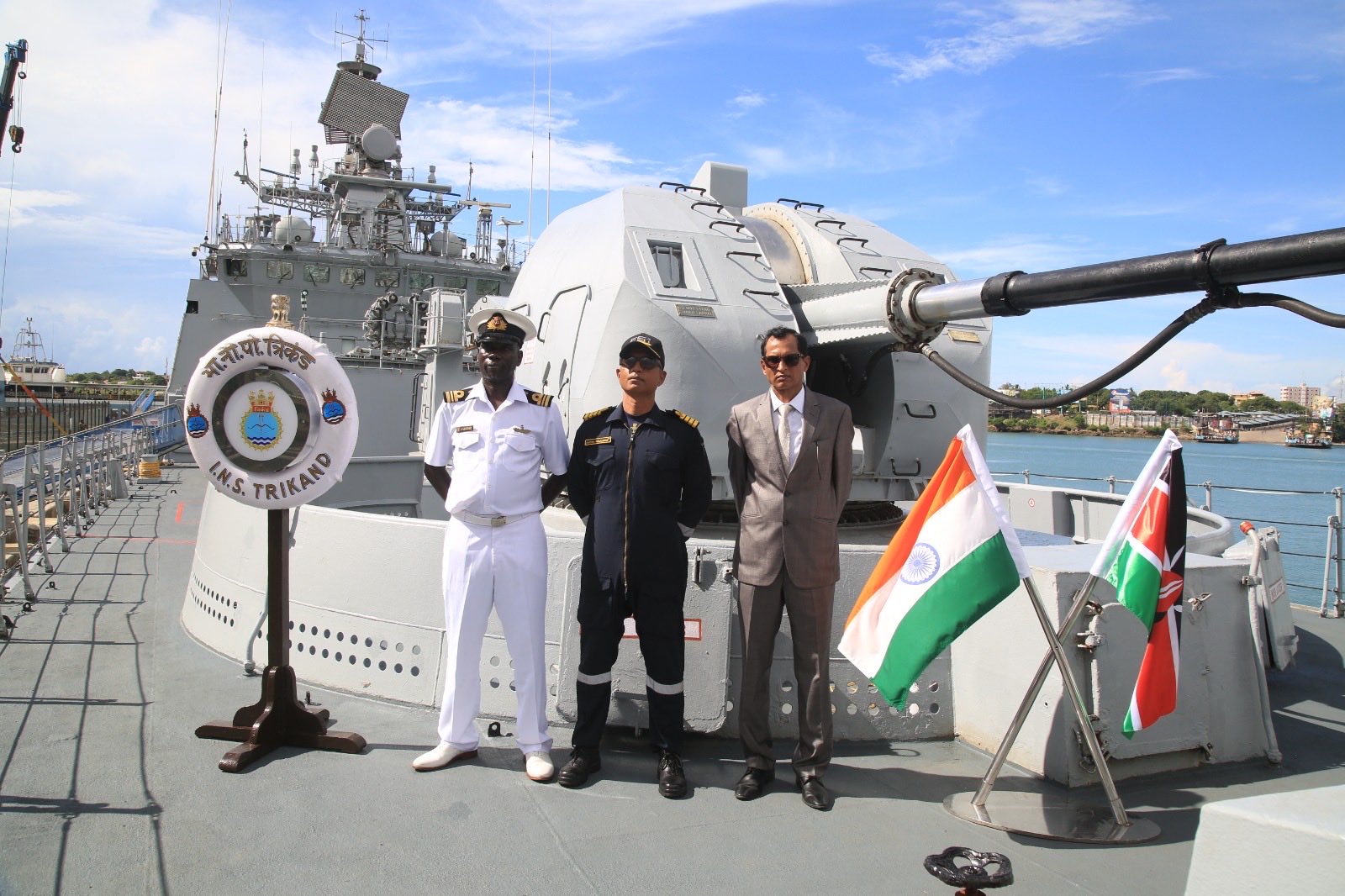
Indian Naval Ship Trikand on Tuesday docked at the Port of Mombasa, marking the start of a four-day port call that further deepens maritime cooperation between the two states.
In a statement, the Indian High Commission said the warship’s April 7–10 visit will include professional exchanges with Kenyan counterparts and a Passage Exercise with the Kenya Navy, underscoring “shared values of security, stability, and collaboration at sea.”


But beyond the formalities of a routine Operational Turnaround, the visit signals a deeper strategic push by India to entrench its presence in a region of growing geopolitical importance.
New Deli has in the recent past intensified maritime cooperation, as the Indo-Pacific rivalry intensifies. Frigate VICTORIA, the EU naval ship that is part of Operation ATALANTA that fights piracy and protects shipping in the Western Indian Ocean, also docked inn Mombasa on January 26.
The arrival of the frigate Victoria came shortly after the EU-Indo-Pacific Ministerial Summit in November, where European leaders reaffirmed their commitment to maritime security.
INS Trikand’s deployment is part of India’s broader maritime outreach under the MAHASAGAR vision, which seeks to expand New Delhi’s influence across the Indian Ocean through partnerships rather than permanent military bases.
The Western Indian Ocean has become a critical theatre for India, given its dependence on sea lanes for trade and energy imports. Stability along East Africa’s coastline, especially around Kenya’s waters, as become directly tied to India’s economic and security interests.
By choosing Mombasa as a recurring port of call, India is quietly elevating Kenya into a key node within its maritime security network.
The planned PASSEX between INS Trikand and the Kenya Navy, foreign policy analysts say, are designed to improve coordination in real-time maritime operations, ranging from anti-piracy missions to disaster response.
They also reflect a shift toward what the analysts describe as “interoperability diplomacy,” where countries align operational procedures and communication systems to enable seamless joint action.
The cooperation also offers Kenya an opportunity to advance naval capabilities without the political sensitivities that often accompany large-scale foreign military deployments such as the US and China.
India’s growing footprint also comes amid increased activity by other global powers in the Western Indian Ocean. For instance, China’s military base in Djibouti, Gulf investments in port infrastructure, and sustained Western naval patrols have all contributed to intensifying competition.
Against this backdrop, India is positioning itself as a less intrusive partner, emphasizing cooperation, training, and capacity building over permanent basing. The Trikand’s visit reflects this calibrated approach thar visible enough to signal commitment, but limited enough to avoid geopolitical friction.
The engagement further highlights a broader strategy of diversifying security partnerships as maritime threats evolve. From piracy and trafficking to illegal fishing, Kenya faces complex challenges that require both capability and collaboration.
However, increased interest from external powers places Kenya in a delicate position in managing these relationships without being drawn into great power rivalries will be key to maintaining strategic autonomy.
The significance of the port call we lies in the longer-term trajectory it represents. India is steadily deepening its engagement along Africa’s eastern seaboard, and Kenya is emerging as a central partner in that effort.
In September last year, two ships of the Indian Navy’s first training squadron also made a port call in Mombasa.
The High Commission said the visit underscored India’s commitment to its maritime partners under the vision of Mahasagar (Mutual and Holistic Advancement for Security and Growth Across Regions), promoting deeper cooperation across the Indian Ocean Region.