
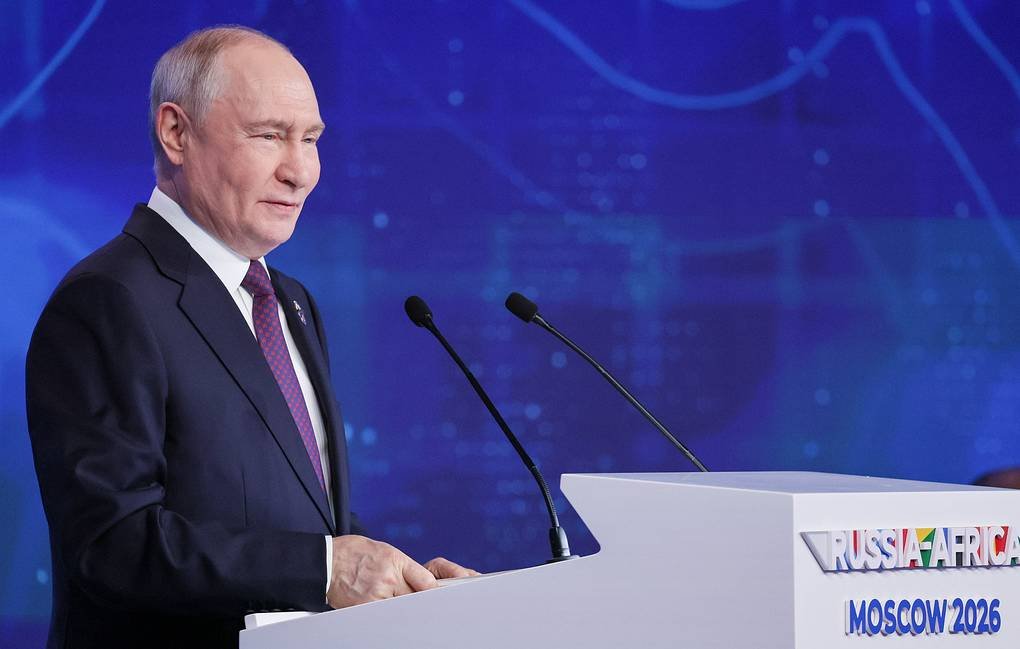
Russian President Vladimir Putin has promised African countries a partnership built around local mineral processing and job creation, seeking to position Moscow as an alternative to foreign powers competing for the continent’s strategic resources.
Speaking at the Russia–Africa Economic and Humanitarian Forum in Moscow on October 28, Putin accused Western countries of perpetuating exploitative economic relationships, while presenting Russian businesses as partners in Africa’s industrial development.
“Our business does not engage in the predatory, neo-colonial exploitation of natural and human resources, but rather expands the processing of raw materials locally, thereby creating new jobs and generating tax revenue,” Putin said.
His remarks come as competition intensifies among Russia, China, the United States and European countries for access to African minerals needed for electric vehicle batteries, renewable energy technologies, electronics and defence industries.
Putin’s address framed Africa’s growing global influence as part of the emergence of a multipolar world in which developing countries should have greater control over their economic futures.
He argued that colonial-era infrastructure had been designed to move raw materials out of Africa rather than support industrial development within the continent.
He also accused Western countries of using debt and economic pressure to constrain African development, invoking former Burkina Faso president Thomas Sankara’s criticism of debt as a mechanism of neo-colonial control.
“There are clear signs of active attempts by Western countries to drive Africans back into debt bondage, to impose much-needed financial resources on them under predatory terms, which subsequently force them to overpay many times over in order to service and settle their debts, to the detriment of long-term development plans,” he said.
The Russian leader said Moscow was supporting African countries through economic cooperation, debt-related programmes and efforts to strengthen Africa’s representation in international financial institutions.
Russia has expanded its presence in parts of Africa through mining, energy and security cooperation. Its growing role in countries such as the Central African Republic and Mali has also attracted scrutiny over the relationship between security partnerships, political influence and access to natural resources.
Western governments have accused Russian-linked security actors of exploiting resource-rich countries to advance Moscow’s interests. Russia rejects such characterisations.
CHINA’S ESTABLISHED POSITION
China occupies a central position in the competition because its companies have invested in African mining operations, while Chinese industries dominate the processing of several critical minerals.
The Democratic Republic of Congo, which produces more than 70 per cent of the world’s cobalt, illustrates the imbalance between mineral extraction and value addition. Cobalt is essential to many rechargeable batteries, but much of the processing and downstream manufacturing takes place outside Africa.
Chinese companies have significant interests in copper, cobalt and lithium projects across the continent, including in the DRC, Zambia and Zimbabwe.
An Organisation for Economic Co-operation and Development assessment of Africa’s critical minerals sector finds that foreign investment remains heavily concentrated in extraction, while most African mineral exports leave the continent in raw or semi-processed form.
The report estimates that Africa accounts for 10.6 per cent of global critical mineral exports. Across the continent, 24 per cent of these exports are raw and 72 per cent are semi-processed, limiting the economic value captured locally.
China’s position has attracted scrutiny over environmental standards, labour conditions, contract transparency and the distribution of mining revenues.
However, Chinese investment has also financed mining operations and related infrastructure, illustrating why African governments face a complex choice between attracting capital and ensuring stronger domestic economic benefits.
WASHINGTON AND EUROPE SEEK ALTERNATIVES
The United States has intensified efforts to secure alternative mineral supply chains and reduce dependence on China.
One prominent initiative is the Lobito Corridor, designed to improve transport connections from mineral-producing regions of the DRC and Zambia through Angola to the Atlantic coast. The corridor could reduce logistical barriers for mineral exports and support wider regional trade, although its developmental impact will depend on how much investment reaches local industries.
The European Union has pursued mineral partnerships with countries including Namibia, the DRC, Zambia and Rwanda. Through its Critical Raw Materials Act and Global Gateway initiative, the bloc seeks to diversify supplies while supporting investment, infrastructure and more sustainable sourcing.
However, European ambitions to secure critical minerals have not yet translated into investment on a scale sufficient to transform Africa’s position in global processing and manufacturing.
The competition creates opportunities for African governments to negotiate better terms, but it also carries the risk that foreign partners will prioritise reliable access to supplies over the development of African industries.