
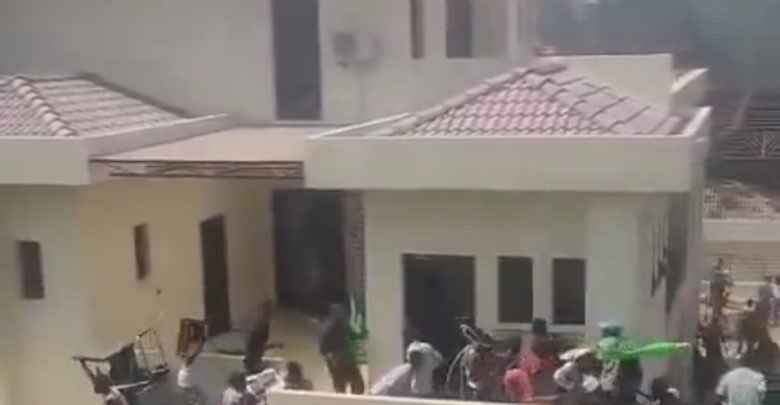
The Kenyan embassy in Kinshasa was on Tuesday attacked and vandalized by demonstrators protesting against the takeover of Goma by M23 and allied forces on Monday.
The protesters also attacked the embassies of France, Uganda, Rwanda, South Africa, France, Belgium, as well as the headquarters of the UN peacekeeping mission.


Foreign Minister Musalia Mudavadi in a protest statement condemned the attack on Kenya Embassy and personnel in Kinshasa and termed it a grave violation of international law.
The Vienna Convention on Diplomatic Relations, in particular, Article 22 (2) and Article 29 provides that the premisses of a diplomatic mission and diplomatic agents are inviolable.
“This unfortunate attacks happened in the full glare of DRC security officers who took no action to mitigate the situation,” Mudavadi said.
He announced that he had reached out to DRC Foreign Minister Thérèse Kayikwamba Wagner, who confirmed the incident and assured measures were being taken to address the situation, including compensation for damages to the embassy.
In an earlier statement on X Foreign Affairs Principal Secretary Korir Sing’Oei expressed “deep concern” over the siege and attacks on the embassy.
“This development is a serious breach of international law and we condemn it in the strongest terms possible. We call on authorities in DRC to take appropriate action,” Sing’Oei said.
Other than the attack on the embassy, the ambassador’s vehicle was stolen and another car burned.
HOSTING M23 IN NAIROBI
While former President Uhuru Kenyatta, the facilitator of the peace talks in eastern DR Congo, has been on the forefront is seeking solutions to the conflict through the Nairobi process, Kenya and DRC have not had close ties in the recent past.
In December 2023, just before the presidential elections, DRC recalled its envoys from Kenya and Tanzania (accredited to EAC) for consultations after a new Congolese political-military alliance was launched in Nairobi.
Congolese politicians and rebel groups, including the M23 rebels, who were causing trouble in eastern DRC and former Congo election commission chief Corneille Nangaa launched the Congo River Alliance in Nairobi.
Nangaa said at least nine armed groups had joined him in his “Congo River Alliance” project for “national unity and stability”, even as he called for “the union of all political, social and military forces” to “rebuild the state” and “restore peace” in the DRC.
He had been sanctioned by the US over graft and for obstructing the 2018 election.

DRC Foreign Ministry summoned the Kenya ambassador at the time to explain how the rebels were allowed to announce the alliance in the country.
“John Nyakeru was summoned to “provide explanations to the Deputy Prime Minister Peter Kazadi on the launch in Nairobi of a political-military coalition,” DRC Foreign Ministry spokesperson Alain Tshibanda wrote on X.
The announced alliance was seen as an additional concern in the eastern DRC, further complicating the three-decade conflict fuelled by ethnicity, minerals and other natural resources as well as political power.
For instance, head of the United Nations Peacekeeping Mission in Congo Bintou Keita said she was “extremely concerned by the creation of a new political-military platform”, while Uhuru said he watched with shock and dismay the launch of yet another political and military alliance to challenge the legitimate political status quo in the DRC.
Uhuru rejected the developments, “in particular their military character, and the accompanying politically charged and provocative rhetoric”.
However, President William Ruto downplayed the incident, saying he had rejected a request by Kinshasa to arrest the opposition and rebel leaders, who addressed the press at a hotel in Nairobi.
“DRC wanted to know if we could arrest the people who released the statement, but we said we cannot. We only arrest criminals not people issuing statements. We are a democracy and Nairobi is a media hub with many bureaus from CNN, BBC…,” the President said in a joint media interview soon after.
“Statements are issued almost every day against me but I never arrested anyone. That is undemocratic…that is not how Kenya is…we are different,” he added.
Asked if there was a diplomatic row, Ruto said as far as he is concerned, there was none, and it is withing Kinshasa’s right to recall its Ambassador in Nairobi. Ruto’s envoy to Kinshasa Shem Amadi is yet to present his letter of credence more than a year since his appointment and posting.
Justina Wamae, a former deputy president candidate, opined that the Kenyan embassy was attacked due to “meddling with DRC affairs”.
Chris Sambu, a journalist covering military and security affairs, noted that even in worse scenarios, the Kenyan Embassy in DRC has never faced an attack on accusations of being complicit in the ongoing war.
“We condemn the attack on Kenya, However; Is there something about the current regime that Congolese knows?” he posed.
Ruto might have added fuel to the fire on Monday when he announced that he had spoken to France President Emmanuel Macron on the situation in the eastern DRC.
Following that call, Ruto said Macron had expressed support for the regional efforts to deal with the crisis
“President Macron also committed his country’s support for the interventions being carried out, and for Kenya’s participation in other peace initiatives in Somalia, Sudan and South Sudan,” Ruto said.
PREVIOUS DIPLOMATIC SPATS
In April last year, Kenya Airways suspended flights to DRC “due to the continued detention of KQ employees by the Military Intelligence Unit in Kinshasa”.
Following diplomatic interventions, the staffers, including the KQ Manager in DRC, were released.
Earlier, President Felix Tshisekedi had expressed dissatisfaction with the Kenya-led East African Community Regional Force (EACRF) approach in dealing with M23.
This led to the Force Commander, Maj. Gen. Jeff Nyagah, who faced criticism for his leadership, and finally the pulling out of the EACRF troops in December 2023.
In May 2024, President Ruto dispatched his Foreign Minister, PCS Musalia Mudavadi, as his special envoy to President Tshisekedi in an attempt to thaw diplomatic ties.
The meeting paved the way for the resumption of the DRC envoy following his recall in December.
INTERNATIONAL CONDEMNATION
The international community continued to condemn the M23 and allied forces take over of Goma, calling for cessation of hostilities.
The International Contact Group for the Great Lakes, with representatives from Denmark, Belgium, the EU, France, Germany, the Netherlands, Sweden, Switzerland, the UK, and the US, “strongly condemned M23 and Rwandan Defense Forces’ (RDF) capture of the town of Sake on 23 January and the current push to capture the city of Goma on 27 January”.
“We call for urgent de-escalation, respect for the cease-fire, and operationalization of the verification mission. The sovereignty and territorial integrity of the Democratic Republic of the Congo must be respected,” they said in a joint statement.
They called on M23 and RDF to cease their offensive in all directions, allow humanitarian access to the city of Goma and withdraw.
“The M23 capture of Goma will have grave humanitarian and security consequences on the ground. Hundreds of thousands of people are currently fleeing their homes, adding to the millions already internally displaced in eastern DRC due to conflict,” they said.
They further warned that renewed offensive undermines efforts to reach a peaceful resolution to the conflict, in particular the Luanda Peace Process led by Angolan President João Lourenço.
“We call on all regional leaders to push for a renewed diplomatic effort at this critical time. We urge the leaders of the DRC and Rwanda to return to the negotiating table, respect the August ceasefire and implement their commitments under the Luanda Process”.