

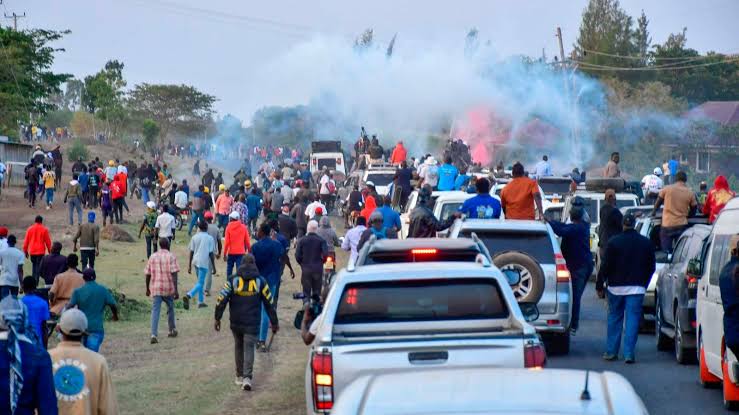
The August 10, 2027 election could unleash a new form of political violence in which gangs, counter-mobs and ordinary citizens become increasingly difficult to control.
According to the Armed Conflict Location and Event Data Project (ACLED), political violence is evolving beyond the traditional use of organised gangs to intimidate opponents.


It says retaliatory mobs are fighting back against political gangs, with the cycle contributing to rising cases of lynching and other forms of collective violence.
This was evident during the August 15 skirmishes in Homa Bay, whereby armed youths attacked a Linda Mwananchi entourage, leaving at least two people dead and several injured.
According to ACLED analysis, the incident points to a new and complicated pattern where political rivalry among different camps creates the conditions for violence that subsequently spreads beyond the control of the politicians who helped mobilise it..
Beyond organised goons disrupting rallies, politicians are increasingly also organising their own “protection”.
During the Homa Bay incident, Embakasi East MP Babu Owino rallied youths who accompanied their entourage to push past the blockades and “handle the opposing goons”.
“Vijana, deal na hao ni wachache sana!” (Youth, deal with them, they are very few!)”
In July, DCP leader Rigathi Gachagua declared he will mobilize local youth to protect communities, properties, and political gatherings if the police fail to provide adequate security for his meetings.
“We are going to mobilise our young people to protect the community from goons and police… to protect our churches, our leaders, our businesses, and our meetings. Goonism will not be allowed again in the mountain,” he said.
ACLED says lynchings reached record levels in 2025 and remained high in 2026, making Kenya the most severe country in Africa for this form of violence.
That trend gives the 2027 election a potentially dangerous dimension, as emerging political alliances could also determine how violence will span out.
A fragmented opposition, the study says, could produce numerous local contests in which rival factions fight for control of constituencies and political bases.
A consolidated opposition, on the other hand, could create a much more direct confrontation between the government and a coordinated opposition, with larger rallies and more organised mobilisation.
ACLED identifies both possibilities. In a fragmented opposition scenario, violence could become more localised, with rival opposition factions competing against one another and incumbent politicians facing increasingly aggressive challengers.
In a consolidated opposition scenario, political groups could become more coordinated, increasing the possibility of larger confrontations involving protesters, police, political gangs and retaliatory mobs.
Constituencies where rival factions are battling for control, areas undergoing political succession and places where competing parties refuse to yield ground could become vulnerable.
A Code for Africa investigation found that local conflicts and political disputes are increasingly being transformed on Facebook, TikTok and X into ethnic and exclusionary narratives.
The report, Weaponised Identity and Digital Polarisation in Kenya, examined online conversations between December 2025 and May 2026 and found that Facebook, TikTok and X were increasingly being used to amplify narratives portraying particular communities as outsiders, threats or undeserving of political power.
The online environment can amplify the physical confrontation, where a local dispute can acquire an ethnic or political interpretation, reach millions of people and generate further mobilisation far beyond the original location.
The Kofi Annan Foundation’s 2026–2027 Electoral Vulnerability Index places Kenya’s risk score at 45.4 and identifies the country among elections requiring attention for potential violence. The Foundation stresses that the index is an early-warning tool, not a prediction that violence will occur.
According to the Index, among the key drivers of possible violence is ethnic and local patronage competition.
“Presidential alliances continue to draw on regional and ethnic blocs, while the succession of established opposition networks may reshape bargaining in key regions. County races may trigger localized clashes where control of devolved resources is at stake,” the foundation said.
It added that security planning should take account of both traditional hotspots and new forms of mobilization.
“Urban protests, youth activism and digital campaigns may reshape risk geography. Election-related violence may occur not only in historically sensitive counties but also in urban centers where cost-of-living grievances and police-community tensions are high,” it added.