

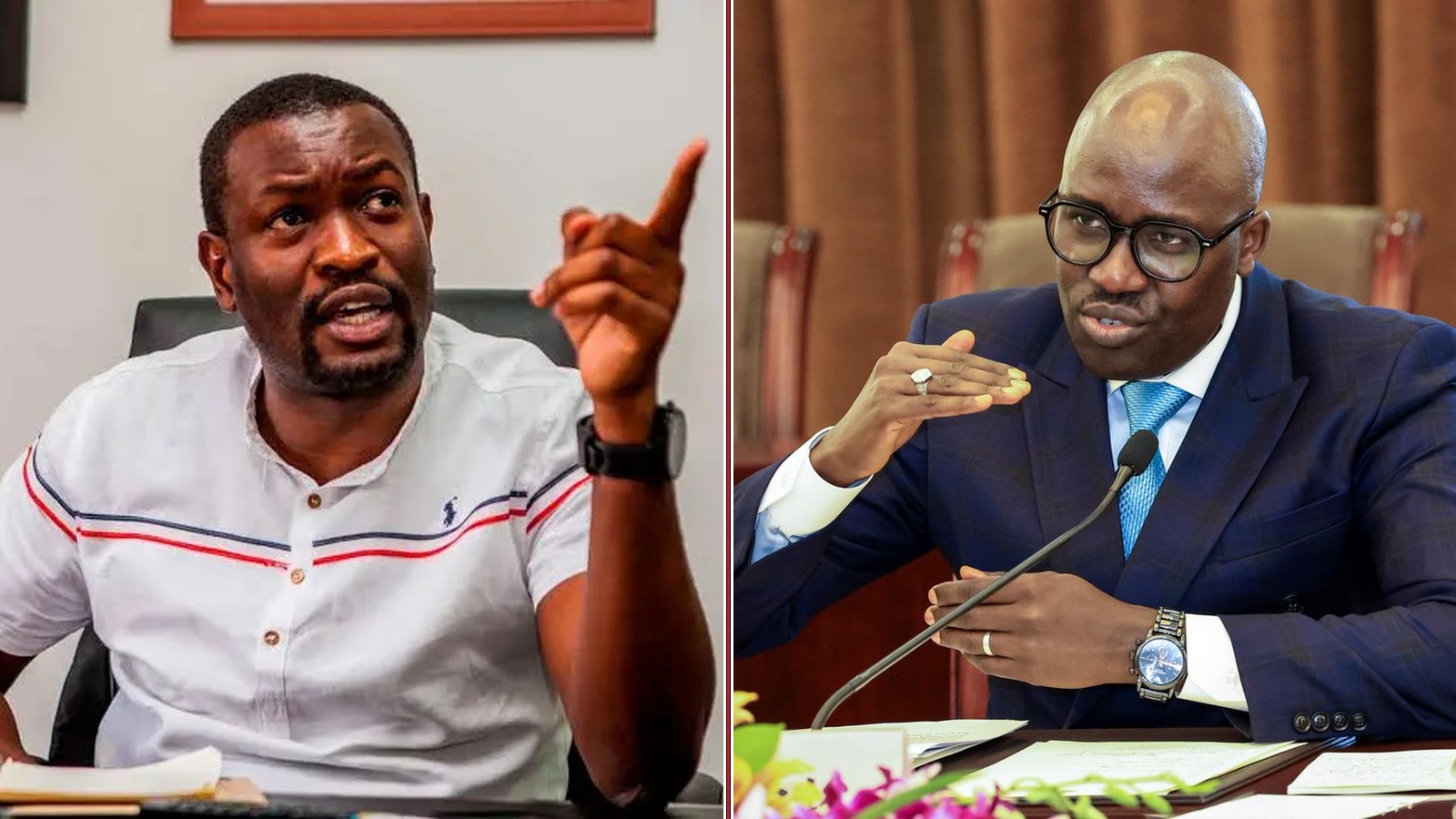
Foreign Affairs Principal Secretary Korir Sing’oei has cautioned Nairobi Senator Edwin Sifuna against drawing inspiration from electoral upsets in Serbia and Brazil.
In rebuttal on the X platform to Sifuna’s optimism about the possibility of an opposition victory in 2027, Sing’oei warned that Kenya’s political dynamics were too complex for outcomes elsewhere to be treated as a blueprint for change.

“Kenya is a unique and complex democracy. Those who looked to Bangladesh in 2024 for inspiration and are now holding up Serbia as exemplar, will suffer deep disappointment,” Sing’oei wrote on X on Monday.
His remarks followed a post by Sifuna, who cited recent electoral wins in Serbia and Brazil as evidence that seemingly difficult political contests could produce unexpected results.
“I don’t know if those who are categorical that there can be no miracles in elections are following the happenings in Serbia and Brazil. I’m super encouraged for 2027 because we in Kenya pray to the same God. Inshallah we get ours too,” Sifuna said.
The exchange comes as opposition leaders explore ways to consolidate their support against President William Ruto ahead of the August 2027 election, in which Ruto is seeking a second term.
The two electoral wins appeared to offer encouragement to Sifuna that a determined political challenge can overcome an established political establishment.
Sing’oei, however, cautioned against assuming that similar outcomes will follow in Kenya.
This set off a political debate over President Ruto’s prospects in the 2027 general election.
SERBIA OFFERS OPPOSITION A FRESH EXAMPLE
Sifuna’s comments came after a student-backed movement in Serbia secured a decisive victory in Sunday’s snap parliamentary elections, defeating the political alliance led by President Aleksandar Vučić.
Preliminary results released by Serbia’s electoral commission on Monday showed the Student List winning 52.65 per cent of the vote, against 39.22 per cent for the Vučić-led United Serbia alliance.
Vučić conceded defeat after more than a decade of dominance by his political camp, marking a significant setback for the ruling establishment.
The victory followed nearly two years of student-led protests that began after 16 people died in the collapse of a railway station canopy in Novi Sad in November 2024.
Demonstrations initially demanding accountability over the disaster evolved into a broader movement against alleged corruption and the concentration of political power.
The student-backed candidates subsequently mobilised support across the country, turning street protests into an electoral campaign that challenged an established political machine.
The result has renewed debate about whether sustained public mobilisation can be converted into electoral success, particularly in countries where opposition forces face an entrenched governing establishment.
BRAZIL ADDS TO SIFUNA’S OPTIMISM
Sifuna also pointed to Brazil, where President Luiz Inácio Lula da Silva secured re-election after defeating right-wing challenger Flávio Bolsonaro.
Lula won approximately 51.8 per cent of the vote against Bolsonaro’s 48.2 per cent in the presidential runoff, overcoming an earlier electoral disadvantage.
Unlike Serbia, where the student-backed movement defeated the governing alliance in parliamentary elections, Brazil’s result involved an incumbent winning another term.
However, according to Sifuna, both scenarios reinforce the argument that electoral outcomes should not be treated as predetermined long before voters cast their ballots.
Sing’oei’s reference to Bangladesh is particularly significant.
In August 2024, student-led protests forced then Prime Minister Sheikh Hasina from power following weeks of demonstrations that escalated into a nationwide political crisis.
The uprising inspired discussions in Kenya after the June 2024 anti-Finance Bill protests, which brought thousands of young people into the streets and triggered wider demands for accountability.
However, Bangladesh’s government fell following a mass uprising rather than an electoral defeat, making the circumstances different from those in Serbia and Brazil.