
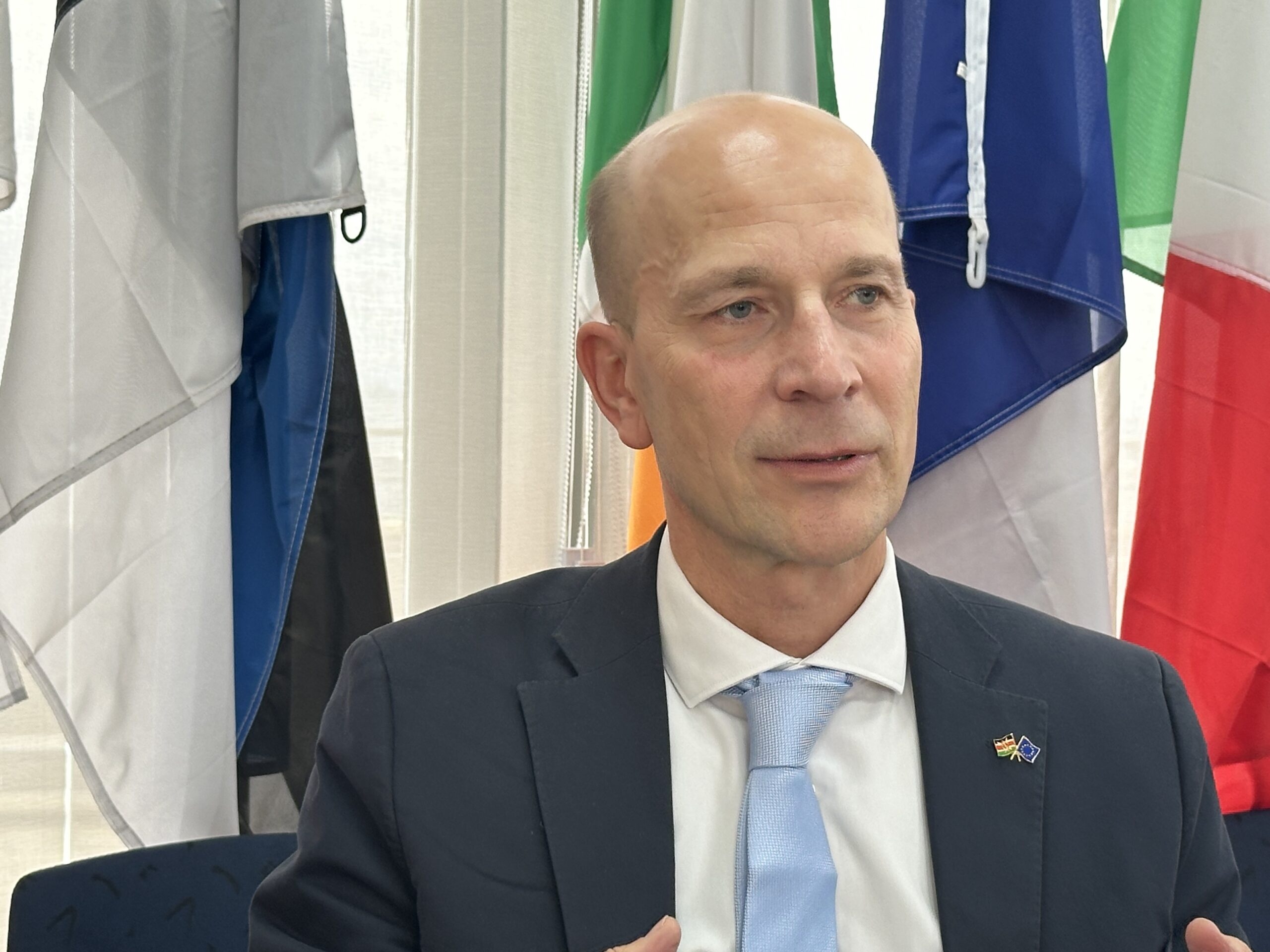
The European Union is expanding its diplomatic presence in Kenya with at least 20 new officials being deployed to Nairobi to drive investment and deepen economic ties.
EU Ambassador to Kenya Andreas Peschke has said the additional staff would form part of a new investment hub within the EU delegation, reflecting Brussels’ growing focus on mobilising European capital for projects in Kenya.
“It’s not only me who’s new. I think I have, apart from the usual changes, we are bringing in at least 20 new colleagues here to the delegation in Nairobi, to create an investment hub, to facilitate our work to boost investment here using the delegation as a hub as well,” Peschke said.
The envoy described investment as one of the EU’s main priorities in its relationship with Kenya, with renewable energy, digital infrastructure and connectivity among areas where Brussels sees significant opportunities.
The move comes as Kenya seeks to attract more foreign capital to finance infrastructure and development at a time of tight public finances and growing pressure to find alternative sources of investment.
Peschke said the EU wanted to work with the Kenyan government and private sector to identify projects where European investment could have a greater impact.
“We also want to boost, whether European and Western, particular area of renewable energies, in the area of connectivity, in the area of digital infrastructure, where actually Europe can bring something useful to the table as well,” he said.
The Ambassador said the investment push would also involve high-level engagement between the European Commission and Kenya.
He said a senior European Commission official responsible for international partnerships was expected in Kenya soon to meet government officials, private-sector representatives and other counterparts.
The official, Peschke said, would be responsible for the EU’s public investment programme and would engage Kenyan authorities on ways of expanding cooperation.
The investment drive will largely be channelled through the EU’s Global Gateway initiative, which Peschke described as the bloc’s public investment programme.
He said the EU was seeking to move away from a traditional model centred on public financing towards one in which public money is used to attract significantly larger private investments.
“We need to use our public money as a lever, really to liberate a much bigger amount of private investment. And that’s what we are trying to do with Global Gateway,” Peschke said.
He said the approach was necessary because public resources alone would not be sufficient to meet the investment needs of Kenya, Africa or Europe.
“If we just use our public money, we will fall short of our mutual investment needs, both here in Africa and Kenya, but also in Europe,” he said.
Renewable energy is expected to be a major beneficiary of the initiative, with Peschke describing Kenya as a leader in the sector because of its natural resources, particularly geothermal energy.
He contrasted Kenya’s position with South Africa, where he previously served and where electricity generation has historically been heavily dependent on coal.
“Kenya is really a transitter,” Peschke said, referring to the country’s potential in renewable energy.
He said digital infrastructure was another area with significant investment potential, pointing to Kenya’s reputation as a pioneer in digital finance following the development of M-Pesa.
Connectivity, particularly in underserved rural areas, is also expected to feature prominently.
Peschke cited the EU-Kenya Last Mile programme, which seeks to extend connectivity beyond areas that already have reliable digital infrastructure.
“If you go to the rural communities, it is a different story,” he said, adding that last-mile connectivity could help rural communities participate more fully in economic and value-creation activities.
The investment push will also build on the EU-Kenya Economic Partnership Agreement signed in 2024, which Peschke said could help expand two-way trade and facilitate access to each other’s markets.
He said the agreement had created opportunities for Kenyan exporters and European investors, but stressed that its implementation needed to be strengthened.
The EU has also established a European Chamber of Commerce in Kenya to provide a platform for European companies operating in the country and strengthen their engagement with the Kenyan government and potential local partners.
Peschke said hundreds of European companies were already operating in Kenya, although he could not provide an exact figure.
The Ambassador said the EU wanted its next business summit with Kenya to become a stronger marketplace where companies from both sides could identify and advance joint projects.
The investment expansion also signals a broader shift in the EU’s relationship with Kenya, with Brussels seeking to combine trade, investment and infrastructure cooperation with its wider strategic partnership.
Asked whether Global Gateway was intended to compete with China’s Belt and Road Initiative, Peschke said the EU’s approach should instead be seen as a refocusing of its efforts around investment.
“I think it’s probably just a refocusing of our efforts and creating a little bit of a new paradigm to really streamline our efforts in the joint interest,” he said.
With the deployment of additional staff and planned high-level engagement, the EU is positioning its Nairobi delegation as a hub for turning its investment ambitions into concrete projects in Kenya.