
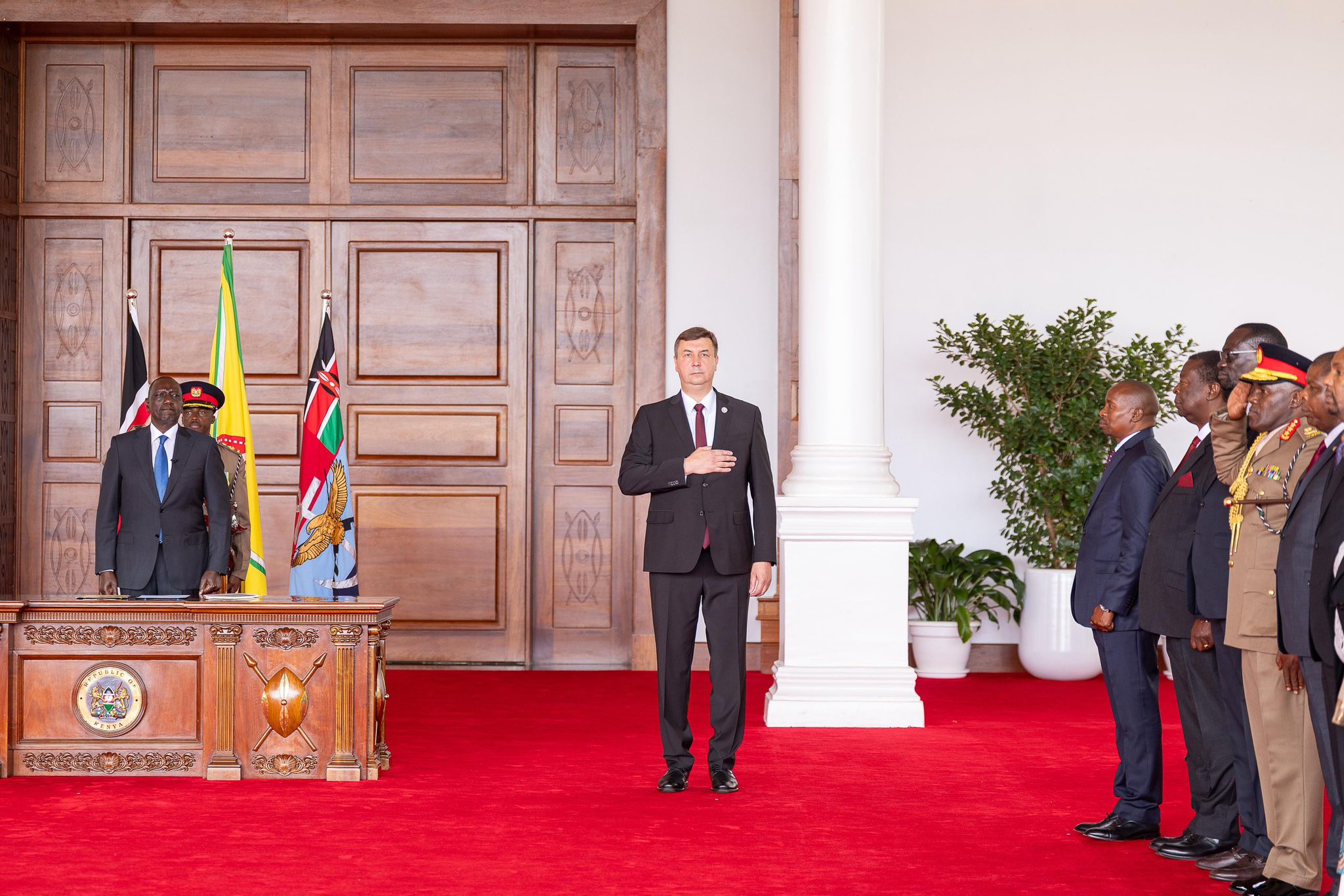
Ukraine’s Ambassador to Kenya Yurii Tokar has welcomed President William Ruto’s reaffirmation of territorial integrity and sovereign equality at the Russia-Africa Summit in Moscow.
Reacting to Kenya’s statement at the Third Russia-Africa Economic and Humanitarian Forum at the Kremlin in Moscow, Ambassador Tokar said President Ruto’s description of the principles of sovereignty were significant given the setting in which they were expressed.
Tokar thanked Ruto for insisting that international relations should be guided by sovereign equality rather than the power of nations or competing spheres of influence, in remarks delivered during a summit hosted by Russian President Vladimir Putin.
“Thank you President @WilliamsRuto for reaffirming that territorial integrity applies to EVERY nation and that international relations must be guided by sovereign equality not power or spheres of influence”.
“Some principles carry particular weight depending on where they are spoken,” Tokar said in a post on X, referring to Ruto’s address.
The Ukrainian envoy’s reaction came after Ruto told the summit that the principles of sovereign equality, territorial integrity and peaceful settlement of disputes must apply consistently to every nation.
The President also called for international relations to be guided by mutual respect rather than competing spheres of influence, in remarks that touched on the geopolitical tensions surrounding Russia’s war against Ukraine.
Principal Secretary for Foreign Affairs Korir Sing’Oei subsequently thanked Tokar for his response, saying the summit had provided an important opportunity to reaffirm fundamental principles of the United Nations Charter.
“The Summit was an important opportunity to reaffirm fundamental principles of the UN Charter,” Sing’Oei wrote on X.
The exchange is significant given Kenya’s previous diplomatic position on Russia’s invasion of Ukraine, which began in February 2022.
In a widely cited address to the United Nations Security Council that month, Kenya’s then Permanent Representative Martin Kimani condemned Russia’s recognition of the separatist regions of Donetsk and Luhansk, warning against attempts to redraw internationally recognised borders through force.
Kimani argued that Africa’s experience with colonialism had taught newly independent states the importance of respecting inherited boundaries rather than pursuing territorial expansion.
Kenya subsequently maintained its support for Ukraine’s territorial integrity and called for a peaceful resolution of the conflict.
While Ruto’s did not directly accuse Russia of violating Ukraine’s sovereignty or explicitly mention the invasion, he invoked universal principles of international relations and welcomed developments towards resolving the conflict.
He also linked prospects for peace to economic opportunities, particularly improved logistics and access to Russian commodities by countries in Africa.
Kenya is seeking to deepen commercial relations with Moscow, including trade in wheat, fertilisers and other commodities, while encouraging Russian investment in manufacturing, energy and infrastructure.
Tokar’s response highlights the importance Kyiv attaches to international reaffirmations of territorial integrity, particularly when they come from leaders engaging directly with Moscow.
The United Nations Charter enshrines the sovereign equality of states and prohibits the threat or use of force against the territorial integrity or political independence of any state, principles that have remained central to international debate over the Ukraine conflict.