
Kenya has urged Germany to accelerate the implementation of a Sh7.8 billion development cooperation package agreed earlier this year, as Nairobi seeks to translate its longstanding partnership with Berlin into tangible economic benefits.
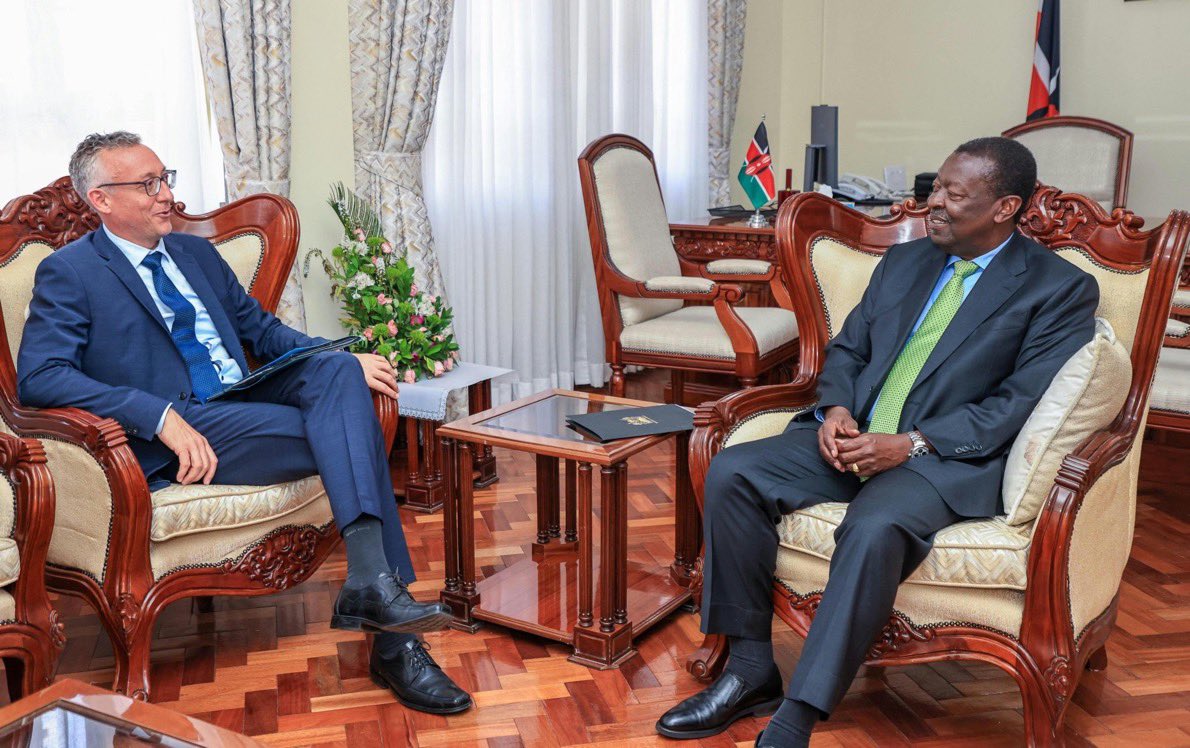
Prime Cabinet Secretary and Foreign Affairs CS Musalia Mudavadi raised the issue during a meeting with German Ambassador to Kenya Sebastian Groth on October 23.


Mudavadi called for the timely implementation of programmes agreed during bilateral government-to-government negotiations in Berlin in June 2026.
The discussions focused on trade and investment, development cooperation, skills mobility, climate action, clean energy, peace and security, with Kenya emphasising the need to move from diplomatic commitments to practical delivery.
The development cooperation package, covering the 2026–28 period, is expected to support priority areas of Kenya’s development agenda, including renewable energy, climate action, sustainable agriculture, vocational training and digital transformation.
Mudavadi welcomed the outcomes of the June negotiations but stressed the importance of ensuring that the agreed programmes are implemented within the proposed timelines.
His appeal comes as Kenya seeks to deepen economic cooperation with Germany, one of its longstanding development partners and an important source of investment, technology and technical expertise.
The two countries have maintained a development cooperation relationship spanning several decades, with Germany supporting programmes in energy, governance, agriculture, water management, education and vocational training.
However, Nairobi is increasingly seeking partnerships that deliver measurable economic outcomes, particularly investments that strengthen local industries, create employment and improve the country’s productive capacity.
Mudavadi encouraged German companies to expand their investments in manufacturing, renewable energy, agro-processing and infrastructure.
He noted that bilateral trade grew by 23 per cent in 2025 to approximately €590 million, arguing that the two countries could build on the growth by increasing exports, promoting local value addition and expanding commercial partnerships.
Germany is among Kenya’s important European trading partners, with opportunities for Kenyan exports including tea, coffee, horticultural products and manufactured goods.
The discussions also highlighted skills mobility as an emerging pillar of bilateral relations.
Mudavadi welcomed an MoU signed on September 15, 2026, between the State Department for Diaspora Affairs and German institutions, aimed at expanding opportunities for skills development and safe, regular employment for qualified Kenyans.
The arrangement builds on the Kenya-Germany Comprehensive Migration and Mobility Partnership Agreement signed in September 2024.
The two countries are seeking to establish pathways through which Kenyan professionals can access employment opportunities in Germany while ensuring that recruitment processes comply with labour standards and protect workers’ rights.
The partnership is particularly relevant as Germany faces shortages of skilled workers in several sectors, while Kenya continues to explore overseas employment opportunities for its growing pool of trained professionals.
On security, Mudavadi called for continued German support for peace initiatives in Africa and cooperation in counter-terrorism, maritime security and military training.
The two officials also discussed progress towards concluding a Defence Cooperation Agreement, which would provide a framework for expanding security collaboration.
Germany has previously supported Kenya’s peace and security efforts, including through training and capacity-building initiatives, as Nairobi seeks to strengthen its role in regional stability.
The meeting further explored possible German support for the government’s Shirika Plan, which seeks to transform refugee camps into integrated settlements by promoting economic inclusion and improving access to services for refugees and host communities.
Climate-smart agriculture and digital innovation were also identified as areas offering opportunities for further cooperation.
Ambassador Groth reaffirmed Germany’s commitment to strengthening the bilateral partnership, citing cooperation in climate action, clean energy, economic and social development, education and vocational training.