

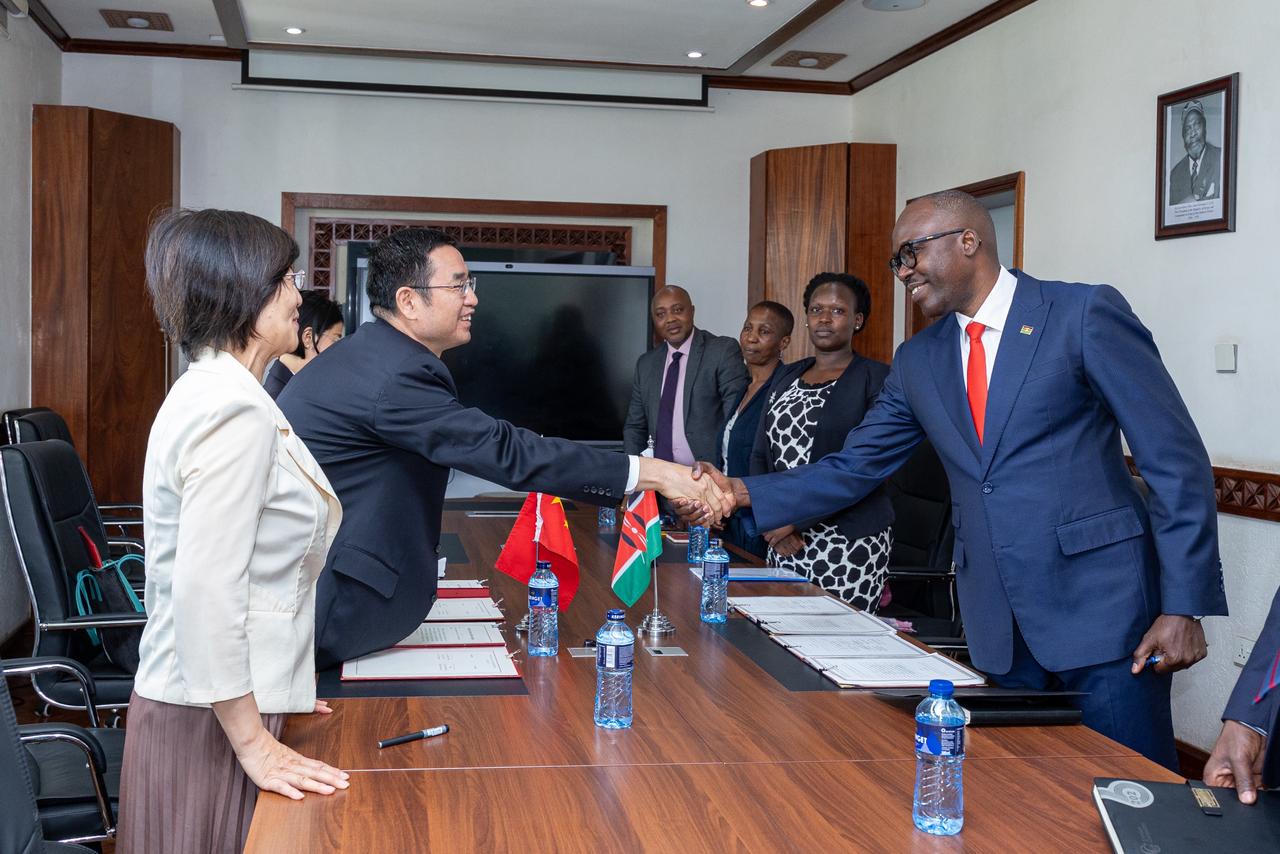
Kenya has signed a key implementation agreement with China International Development Cooperation Agency paving the way for Beijing to construct a new headquarters for the Ministry of Foreign and Diaspora Affairs.
The agreement, concluded on Thursday, was witnessed by Foreign Affairs Principal Secretary Korir Sing’oei and Chinese Embassy Minister Counsellor Zhou Zhencheng, formally launching what officials describe as both a strategic and symbolic project.


Backed under China’s aid framework, the project aims to address longstanding structural challenges within Kenya’s foreign ministry, whose operations are currently fragmented across multiple locations in Nairobi—including Railways, the Old Treasury Building, and Upper Hill.
The Foreign offices says this fragmentation has slowed decision-making, weakened coordination, and strained service delivery in an era where diplomacy is increasingly fast-paced and complex.
“The project is both functional and symbolic,” the State Department said, noting that it reflects growing Kenya–China cooperation anchored in shared development priorities and long-term partnership.
However, while the project underscores deepening bilateral ties while raising fresh sovereignty concerns.
Once complete, the new headquarters is expected to centralise operations, streamline diplomatic coordination, and strengthen consular and diaspora services—an area gaining prominence as the number of Kenyans living abroad continues to rise.
The move also aligns with findings in the Sessional Paper on Foreign Policy 2025, which flagged critical capacity gaps within the ministry, including inadequate office space, staffing constraints, and outdated systems that hinder effective management of Kenya’s expanding foreign service.
Beyond its immediate administrative benefits, the project signals a broader shift in the nature of Kenya–China engagement.
China financing in Kenya has been concentrated in large-scale infrastructure such as roads, railways, and ports. The decision to fund the headquarters of a core government ministry points to an evolving relationship that is increasingly focused on institutional capacity, governance, and state functionality.
Across Africa, Beijing has pursued similar projects, funding and constructing high-profile government buildings as part of its diplomatic outreach.
These include Rwanda Foreign Affairs ministry, African Union headquarters in Ethiopia, ECOWAS headquarters in Nigeria and various parliament buildings, often constructed as gifts to strengthen ties
However, the Kenyan project has sparked debate among policy analysts and foreign affairs experts, particularly given the sensitive nature of the ministry involved.
Critics warn that allowing a foreign power to finance and construct the headquarters of a ministry responsible for diplomacy and the handling of classified communications could pose security and sovereignty risks.
They argue that facilities housing sensitive diplomatic operations—including confidential cables and intelligence-linked communications—require the highest levels of national control and insulation from external influence.
“There are legitimate concerns about operational security and independence,” one foreign policy analyst noted, adding that reliance on external funding for such a critical institution could undermine perceptions of Kenya’s strategic autonomy.
Others point to the broader optics.
While the project is officially framed as a grant under China’s development cooperation, critics say it highlights the constraints facing Kenya’s public finances and raises questions about whether the country should rely on foreign partners for core sovereign infrastructure.
“Kenya should prioritise funding its own critical institutions, especially those tied to national security and foreign policy,” an analyst argued.