

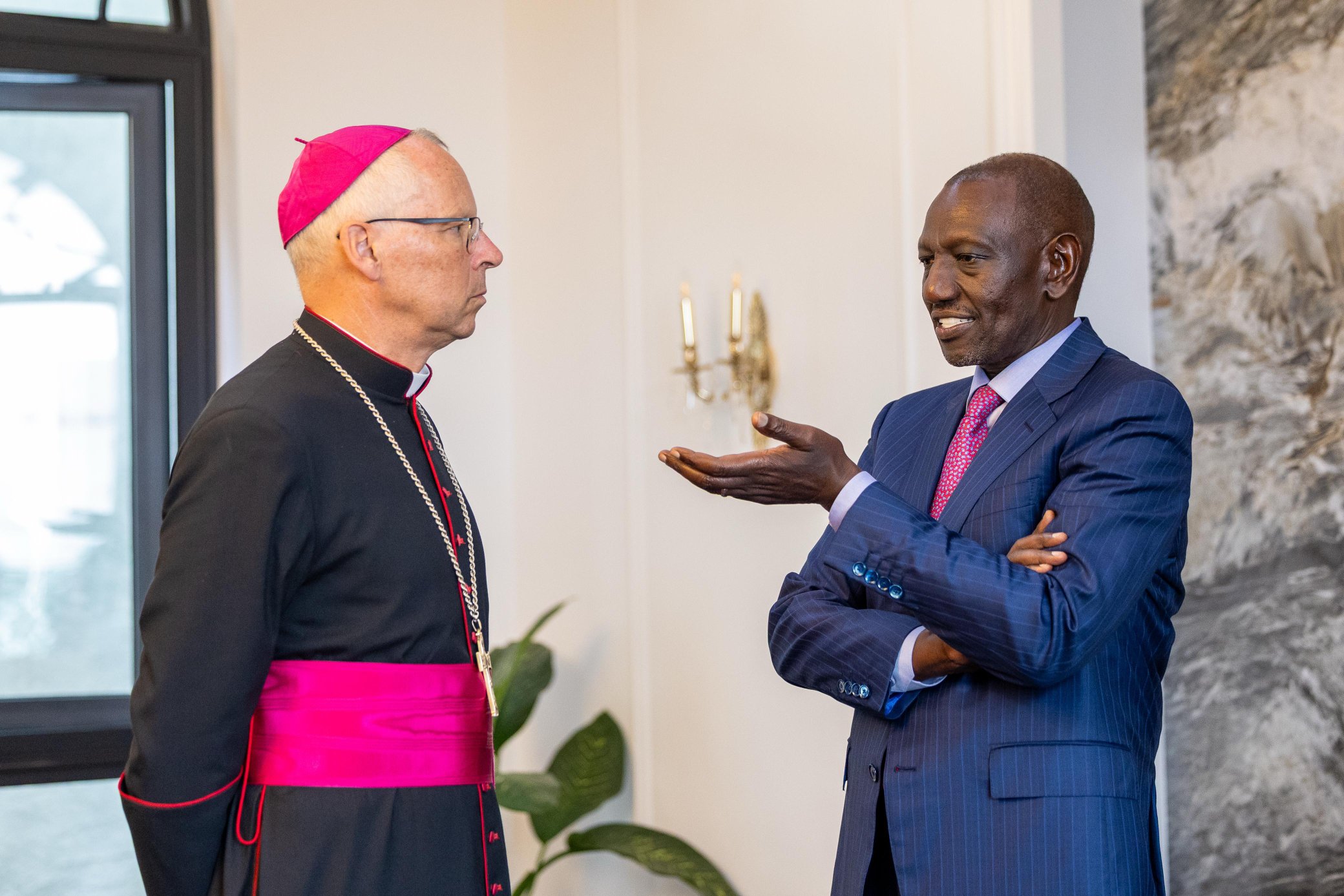
Catholic Apostolic Nuncio Archbishop Hubertus Matheus Maria van Megen is departing Kenya after completing his tour of duty.
Archbishop van Megen is leaving after seven years, which were marked by quiet but steady diplomatic and pastoral engagement that helped deepen ties between Nairobi and the Holy See.


During his tenure, he served as the Vatican’s representative in Kenya, a role that placed him at the intersection of diplomacy and the Catholic Church’s mission in the country. Beyond formal state relations, he acted as a key link between the Vatican and local bishops, clergy and faithful, while also engaging government and civil society on social and moral issues.
His time in Kenya coincided with a period of growing collaboration between the two states, culminating in Kenya’s decision to establish a resident mission to the Holy See for the first time.
The move signalled a shift towards more structured and sustained engagement, even as the country now deploys Julius Murori Mbijiwe as Kenya’s representative to the Vatican.
While biding him goodbye on March 13, President William Ruto said Archbishop van Megen played a significant role in strengthening the ties and cooperation between Kenya and the Holy See for the last seven years.
“During his tenure, Kenya took the historic step of appointing, for the first time, a resident ambassador to the Vatican, further elevating the cordial relations between our two states.
“Conveyed best wishes to the Apostolic Nuncio as he embarks on his next assignment, and expressed appreciation for his dedicated service and contribution to the enduring partnership between Kenya and the Holy See,” Ruto said on X.
Following the announcement by Pope Leo XIV on April 9, Archbishop van Megen moves to Berlin as the new Apostolic Nuncio to Germany. There, he will succeed Archbishop Nikola Eterović.
Archbishop van Megen was a familiar figure at national events and church functions, often representing the Holy See at key state ceremonies and religious gatherings. He also played a visible role in interfaith dialogue and peace-building efforts, particularly during periods of political tension, where the Church has traditionally positioned itself as a mediator and moral voice.
For instance, Archbishop van Megen urged the government to engage in dialogue with the nation’s youth during political unrest and protests in 2025.
Within the Catholic Church, his tenure was marked by close collaboration with the Kenya Conference of Catholic Bishops, supporting initiatives in education, healthcare, and humanitarian outreach—areas where the Church remains one of the largest non-state providers in the country.
Diplomatically, his mission reflected the Holy See’s broader approach of “soft power” engagement, focusing on values such as social justice, human dignity, and community cohesion.
He was also not new to the Horn of Africa region. Prior to his Kenyan posting, he served in Sudan and Eritrea, where the Catholic Church is a minority.
In Africa, he also served as Chargé d’ Affaires in Malawi between 2010-2014, where he was instrumental during the preparation of the Association of Member Episcopal Conferences in Eastern Africa 18th Plenary Assembly.
His departure comes at a moment when Kenya-Vatican relations appear to be entering a new phase. The establishment of a resident Kenyan ambassador to the Holy See is expected to complement the work traditionally handled through the Nunciature, potentially expanding cooperation in areas such as education partnerships, humanitarian work, and cultural exchange.
While President William Ruto formally bid him farewell, the legacy of Archbishop van Megen’s tenure is likely to be measured less in high-profile announcements and more in the steady strengthening of institutional and spiritual ties between Kenya and the Vatican.
Kenya and the Holy See have maintained diplomatic relations since the years following independence, with the Catholic Church continuing to play a central role in social services and advocacy across the country.
As Archbishop van Megen moves to his next posting, he leaves behind a relationship that is not only intact but evolving—anchored in decades of cooperation, and now entering a more structured diplomatic era