
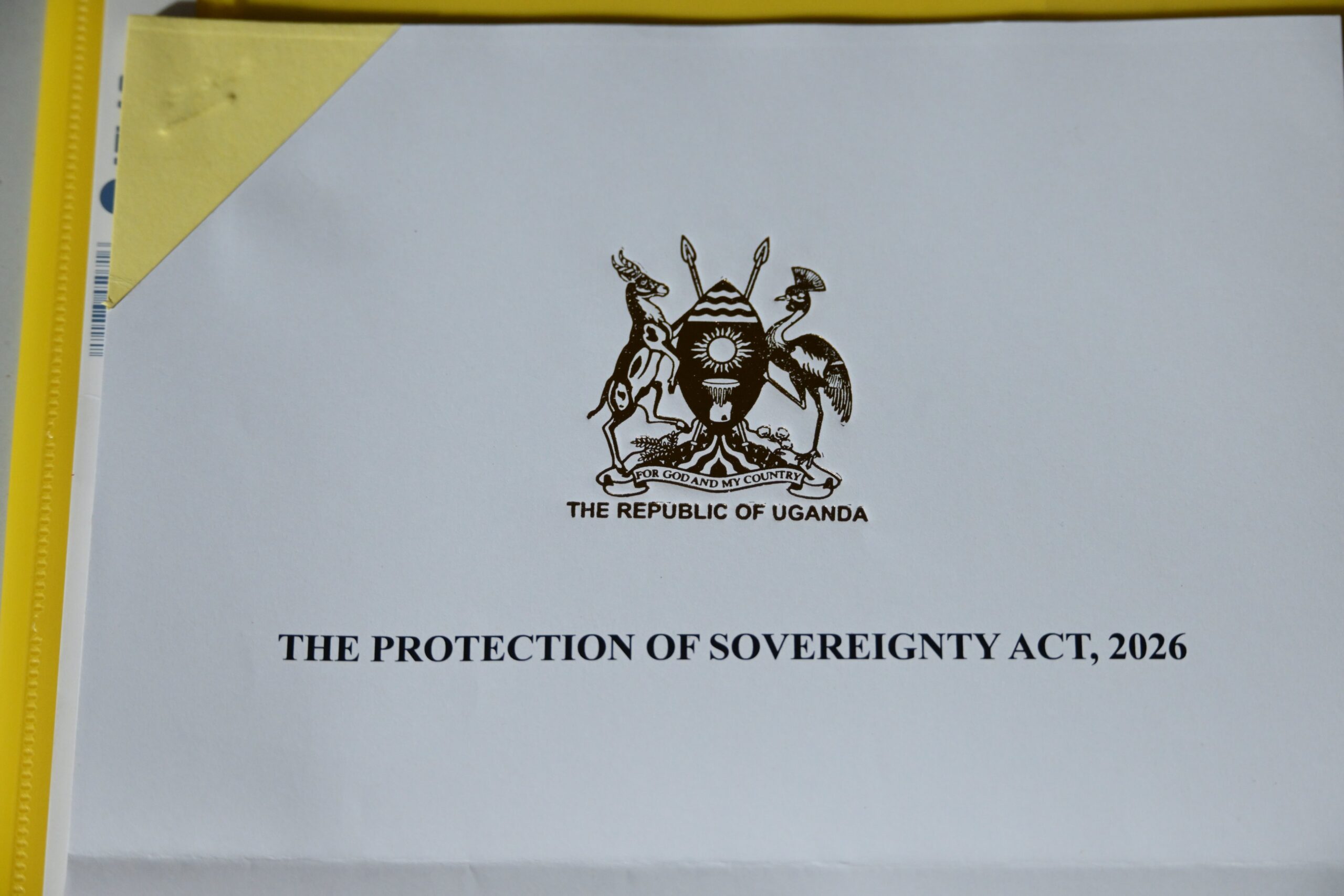
Uganda President Yoweri Museveni on Sunday, May 17, signed into law the controversial Protection of Sovereignty Bill, 2026.
The bill, now an Act of Parliament, has been interpreted as a domestic measure to regulate foreign influence in Uganda. However, what is not coming out directly is that its implications may be felt across the borders.


The Act, which heavily touches on foreign policy and funding of organisations and media, should also be better understood as a development that is likely to affect how journalism is funded, practised and regulated across the region.
The major concern among media practitioners and activists across East Africa is the Act’s broad definition of who qualifies as an “agent of a foreigner.”
Any individual or organisation receiving direct or indirect foreign support — from donors, international NGOs or multilateral institutions — could fall under this category. In Uganda, this will bring journalists, freelance reporters and media development organisations under a security-linked regulatory framework.
While this is a domestic legal provision, its implications extend into a regional reality because much of East Africa’s independent media ecosystem is sustained through cross-border funding, training and collaboration.
Investigative journalism projects, election coverage initiatives and journalist safety programmes frequently operate through regional networks supported by international partners. If one country significantly restricts this model, the effects are unlikely to remain contained.
For instance, media organisations such as the Nation Media Group operating in multiple East African countries will be forced to redesign programmes to comply with Uganda’s requirements, or in some cases scale back operations altogether.
Donors, wary of legal exposure or reputational risk, could become more cautious about funding initiatives that involve Uganda, even when those initiatives are regional in scope. Over time, this will weaken collaborative reporting efforts that rely on shared resources and coordinated investigations across borders.
The funding restrictions reinforce this risk. Foreign funding above a set threshold will now require ministerial approval, with strict disclosure requirements and heavy penalties for non-compliance.
Organisations accustomed to flexible, rapid-response funding, especially during elections or crises, are also likely to face slowed down or even halted critical interventions. If similar regulatory approaches were adopted elsewhere in the region, the cumulative effect could significantly constrain the financial architecture that underpins independent journalism.
Beyond funding, the law provisions intersect directly with core journalistic functions. Restrictions on influencing public opinion or government policy, as well as broad limitations around electoral engagement, raise questions about how standard reporting practices are to be interpreted under the law. Economic reporting is also implicated, with provisions that criminalise the publication of information deemed harmful to the economic system — a category that could, in practice, include reporting on corruption or mismanagement.
These are not uniquely Ugandan dilemmas. Across East Africa, governments continue to grapple with balancing national sovereignty, security concerns and constitutional freedoms. What makes Uganda’s Sovereignty Act notable is the way it brings these tensions into a single, expansive legal framework that explicitly links foreign funding to questions of national control and security.
That framing is significant because it has the potential to have regional implications. Policymakers in neighbouring countries such as Kenya often monitor legislative developments within the region, particularly on issues of governance and regulation.
A law that positions foreign-supported journalism as a matter of state security could influence how similar debates unfold elsewhere, even if not replicated in identical form.
In Kenya, for example, public discourse has periodically returned to the role of foreign funding in civil society and media. While no direct equivalent to the Act, the underlying questions it raises — about influence, accountability and national interest — are familiar. The signining into law of the Bill adds weight to arguments for tighter oversight, or at the very least shift the terms of debate.
Still, it would be premature to suggest a uniform regional trend. Legal systems, political contexts and media landscapes differ across countries, and policy transfer is rarely straightforward. The more immediate impact, however, is likely to be indirect through, for instance, recalibration of how regional media actors operate in response to a more restrictive environment in one key market.
Increased regulatory scrutiny in one country can create other fur-reaching effects that extend beyond Uganda, particularly for reporters involved in cross-border investigations or collaborative projects. Uncertainty about legal exposure may lead to more cautious editorial decisions, even in jurisdictions where such restrictions do not formally apply.
Ultimately, Uganda’s Protection of Sovereignty Act 2026 is not just a test of domestic policy. It is also a moment that highlights the fragility and interconnectedness of media ecosystems in East Africa.