
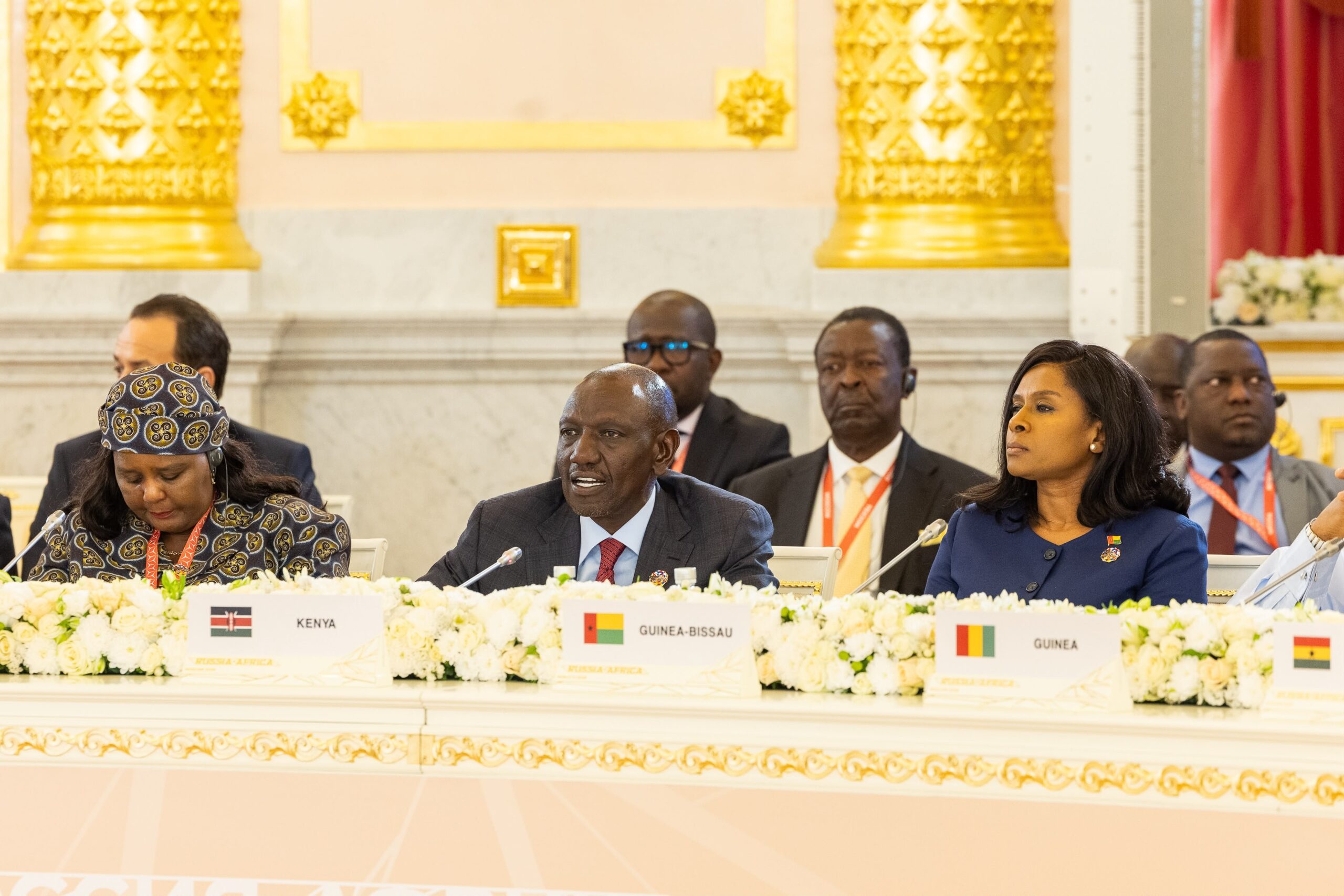
President William Ruto has invoked sovereignty, territorial integrity and peaceful settlement of disputes in Moscow, as Kenya seeks to deepen economic ties with Russia amid the ongoing war in Ukraine.
Addressing the Russia-Africa Summit, Ruto insisted that international relations must be guided by sovereign equality and mutual respect rather than military and economic power, in remarks delivered against the backdrop of Russia’s ongoing war with Ukraine.

“The principles of sovereign equality, territorial integrity and peaceful settlement of disputes must apply consistently to every nation,” Ruto said, signaling Nairobi’s delicate diplomatic balancing act between defending international law and pursuing trade, investment and access to Russian commodities without abandoning its longstanding position on the war in Ukraine.
Although he did not directly accuse Russia of violating Ukraine’s territorial integrity, the emphasis on respect for national borders and peaceful resolution of disputes placed Kenya’s established foreign policy principles at the centre of its engagement with Moscow.
Welcoming Ruto’s remarks, Ukraine’s Ambassador to Kenya, Yurii Tokar, said the President’s reaffirmation of territorial integrity and sovereign equality carried particular significance given that the statement was made in Moscow.
“Thank you President @WilliamsRuto for reaffirming that territorial integrity applies to EVERY nation and that international relations must be guided by sovereign equality not power or spheres of influence,” Amb Tokar said in a post on X.
“Some principles carry particular weight depending on where they are spoken,” Tokar added.
The choice of language is significant given Kenya’s earlier diplomatic response to the conflict, which began with Russia’s full-scale invasion of Ukraine in February 2022.
In a widely cited address to the United Nations Security Council in February that year, Kenya’s then Permanent Representative Martin Kimani condemned Russia’s recognition of the separatist regions of Donetsk and Luhansk, describing the move as a breach of Ukraine’s territorial integrity.
Kimani warned against attempts to redraw internationally recognised borders through force, drawing parallels with Africa’s colonial experience and the decision by newly independent states to preserve inherited boundaries rather than pursue territorial expansion.
Kenya subsequently maintained its opposition to Russia’s invasion. In February 2024, its representative at the UN General Assembly again condemned the invasion and rejected Russia’s attempted annexation of Ukrainian territories.
The latest remarks by Ruto do not explicitly depart from that position. Instead, they reflect a diplomatic approach that places greater emphasis on universal principles and the need for negotiations, while avoiding direct confrontation with Moscow.
The President welcomed developments towards resolving the Russia-Ukraine conflict, arguing that an end to hostilities could unlock significant economic opportunities, particularly in logistics and access to Russian commodities.
“An opportunity presents itself to unlock significant potential for logistics, especially access of commodities from Russia to this part of the world,” he said.
The economic considerations are important to Nairobi as it seeks to expand trade with Russia, particularly in wheat, fertilisers, iron and steel products, while exploring opportunities for Kenyan agricultural exports.
Ruto’s engagement with Russian investors and his bilateral discussions with President Vladimir Putin during the Moscow summit form part of a broader effort to strengthen commercial relations.
At a business roundtable, the President encouraged Russian companies to invest in Kenya’s manufacturing, energy, mining, infrastructure and agricultural processing sectors, presenting the country as a gateway to the wider African market.
But his speech also carried a broader message about Africa’s position in global geopolitics.
Ruto cautioned against international relations being shaped by competing spheres of influence, arguing that countries should engage each other on the basis of mutual respect rather than the pursuit of narrow national advantage.
He added that Kenya wants an Africa that is not simply represented in international institutions but participates in shaping their decisions, and one that moves beyond supplying raw materials to becoming competitive in global production.
Ruto said the Russia-Africa Action Plan 2027-2029 should translate diplomatic commitments into investments, industries, research partnerships and technological cooperation.
His emphasis on factories, laboratories and research institutions suggests that Nairobi views economic sovereignty as an important extension of political independence.