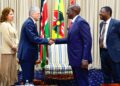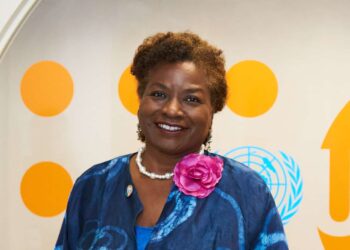

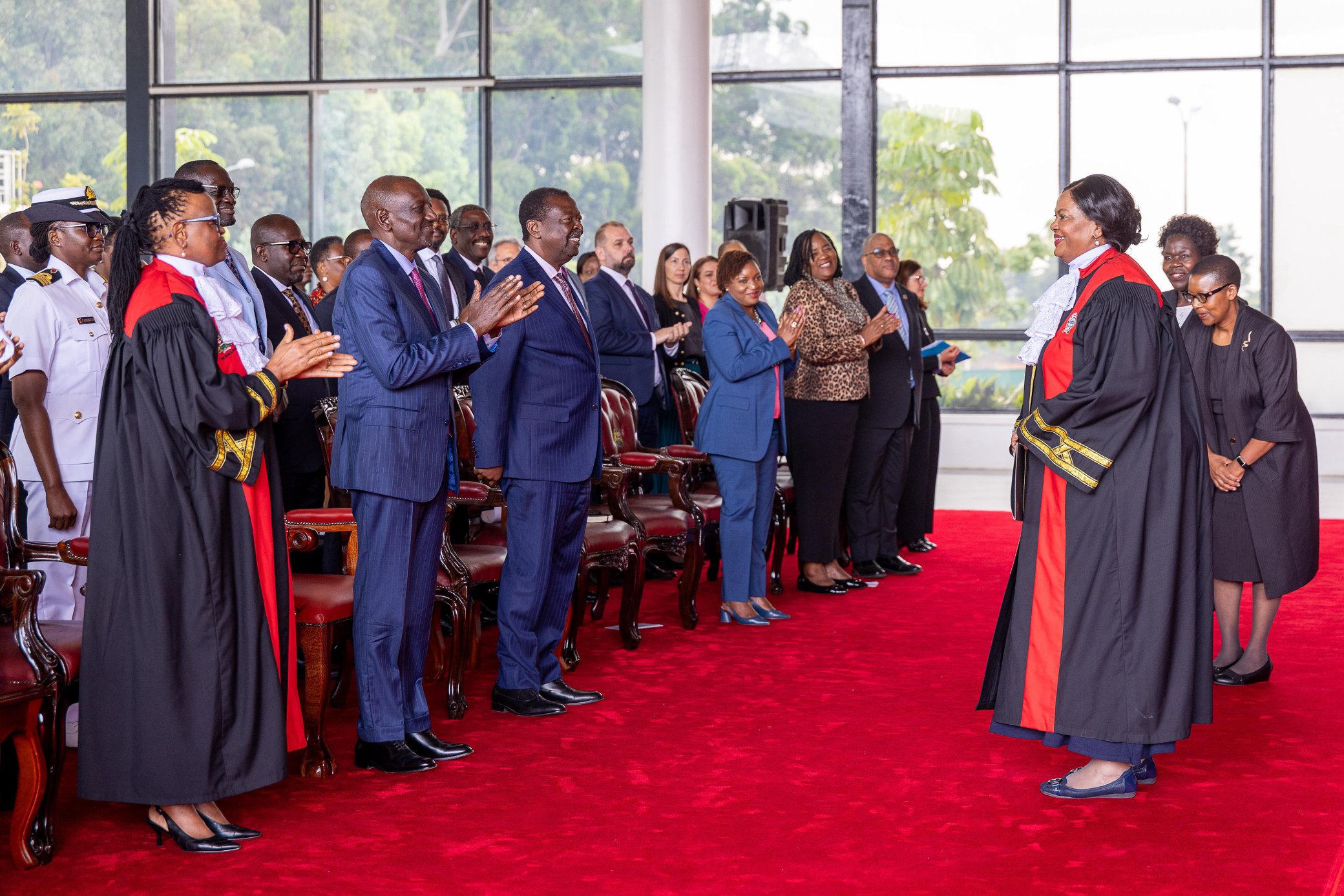
President William Ruto has officially unveiled Supreme Court Judge Njoki Ndung’u as Kenya’s candidate for election to the International Criminal Court (ICC), as Nairobi simultaneously pushes a second bid for a seat at the International Court of Justice (ICJ).
The launch signals what officials describe as a coordinated “double bet” by Kenya to expand its footprint in global judicial institutions, with the government also backing Justice Phoebe Okowa for a full term at the ICJ.


Speaking during the unveiling, President Ruto said the decision to front Justice Ndung’u followed a competitive national process and careful consideration of her record in public service.
“Kenya reviewed her record, reflected on her many years of distinguished service… and considered her lifelong contribution to constitutionalism, gender justice, the protection of the vulnerable,” he said.
“Without hesitation, I concluded that she is exceptionally well suited for this important international responsibility.”
Ruto framed the ICC bid as a national project rather than an individual pursuit, calling for unity across political and institutional lines as Kenya prepares to lobby for votes internationally.
“There are moments when we stand together as a nation, irrespective of all other considerations. This is one such moment,” he said.
He added that Kenya has a responsibility to contribute to global justice systems, noting that the country has increasingly taken on a more visible role in international diplomacy.
The dual candidature — ICC and ICJ — underscores a broader strategy by Nairobi to position itself as a key player in multilateral governance, particularly in legal and judicial spaces.
Foreign Affairs Cabinet Secretary Musalia Mudavadi said the government has already activated diplomatic channels to support both campaigns, with President Ruto personally engaging other countries.
“He has already pitched and canvassed with quite a number of nations already. So he’s not waiting. He’s moving,” Mudavadi said.
He said the Cabinet had formally endorsed the ICC bid, signalling full state backing.
“We have all signed the cabinet memo… the government is fully aligned,” he said.
Mudavadi described the campaigns as part of a structured effort to place qualified Kenyans in international positions, noting that the Foreign Affairs ministry has a dedicated unit to support such bids.
However, he cautioned against domestic political contestation around the nominations, saying it could weaken Kenya’s chances abroad.
“When a president endorses a candidate… that is now a Kenyan candidate. We must divorce that from any local partisan issues,” he said.
“We cannot go there saying it is a different ball game. We must be united so that we focus on Kenya as a nation.”
Chief Justice Martha Koome also defended the nomination process, saying Justice Ndung’u’s selection followed a transparent and merit-based procedure anchored in international legal frameworks.
She said the judiciary invited applications from judges of superior courts, subjected them to evaluation by the Judicial Service Commission, and forwarded qualified candidates for presidential consideration.
“It is upon the conclusion of this transparent and competitive process that the President nominated Justice Njoki Ndung’u as Kenya’s candidate,” Koome said.
Koome added that Kenya’s judiciary has increasingly become a strategic national asset, contributing to the country’s international profile through its jurisprudence and institutional credibility.
The twin bids come as six judicial positions are set to open at the ICC in the upcoming election cycle, with at least two slots reserved for African candidates — presenting a key opportunity for Kenya.
At the same time, Justice Phoebe Okowa is seeking a full term at the ICJ after previously securing a shorter stint, placing Kenya in a rare position of contesting seats in two of the world’s top courts simultaneously.
However, the strategy has not been without controversy.
The Law Society of Kenya has raised concerns about the potential overlap, warning that multiple bids could complicate Kenya’s diplomatic calculations or undermine support for individual candidates.
In a February 25 letter to Attorney General Dorcas Oduor, then LSK president Faith Odhiambo warned that sponsoring multiple candidates for international judicial positions within the same election cycle could undermine Kenya’s broader diplomatic strategy.
LSK said Kenya’s campaign to secure the re-election of Prof Okowa to the International Court of Justice, where she is serving following her election in 2025, risks being compromised by an additional ICC bid.
The ICJ elections are scheduled for November, just weeks before the ICC vote.
“It would be imprudent for Kenya to nominate candidates for elections to two international courts in the same year,” Odhiambo cautioned.
The LSK further noted that Kenya had already made concessions and secured commitments from other states during the campaign that saw Okowa elected in the first place, agreements that could now be strained if Nairobi shifts focus or appears to double its ambitions.
At the same time, Kenya will also trigger competition withing the East African region, which will deny any candidate a bloc support.
Rival candidates from Kenya, Uganda and Tanzania will split the EAC
vote, which risks weakening chances for Justice Ndung’u.
The candidates are Rosette Muzigo-Morrison (Uganda), who worked at the office of the Prosecutor at the ICC in The Hague and court of Appeal Judge Deo John Nangela (Tanzania).
Other candidates are Evelyn Ankumah (Ghana), GuénaëlMettraux (Switzerland), Diana Bacares (Colombia) and Yoshimitsu Yamauchi (Japan).
In multilateral elections, regional blocs, such as the African Group and EAC, often play a decisive role.
A divided East African vote could thus hand an advantage to candidates from other regions or better-coordinated African campaigns.
There have also been claims in political circles suggesting the ICC nomination could have implications for succession dynamics within the Supreme Court, a suggestion government officials have dismissed.
However, the Ruto administration is projecting confidence, presenting the dual campaigns as complementary rather than competing efforts.
Officials argue that success in either or both races would elevate Kenya’s standing in global governance and reinforce its reputation as a hub for legal expertise in the region.